
When Banks Reject Powers of Attorney: Your Legal Guide
Discover why banks can legally refuse a power of attorney, your rights as an agent, and strategies to ensure smooth financial management for loved ones.
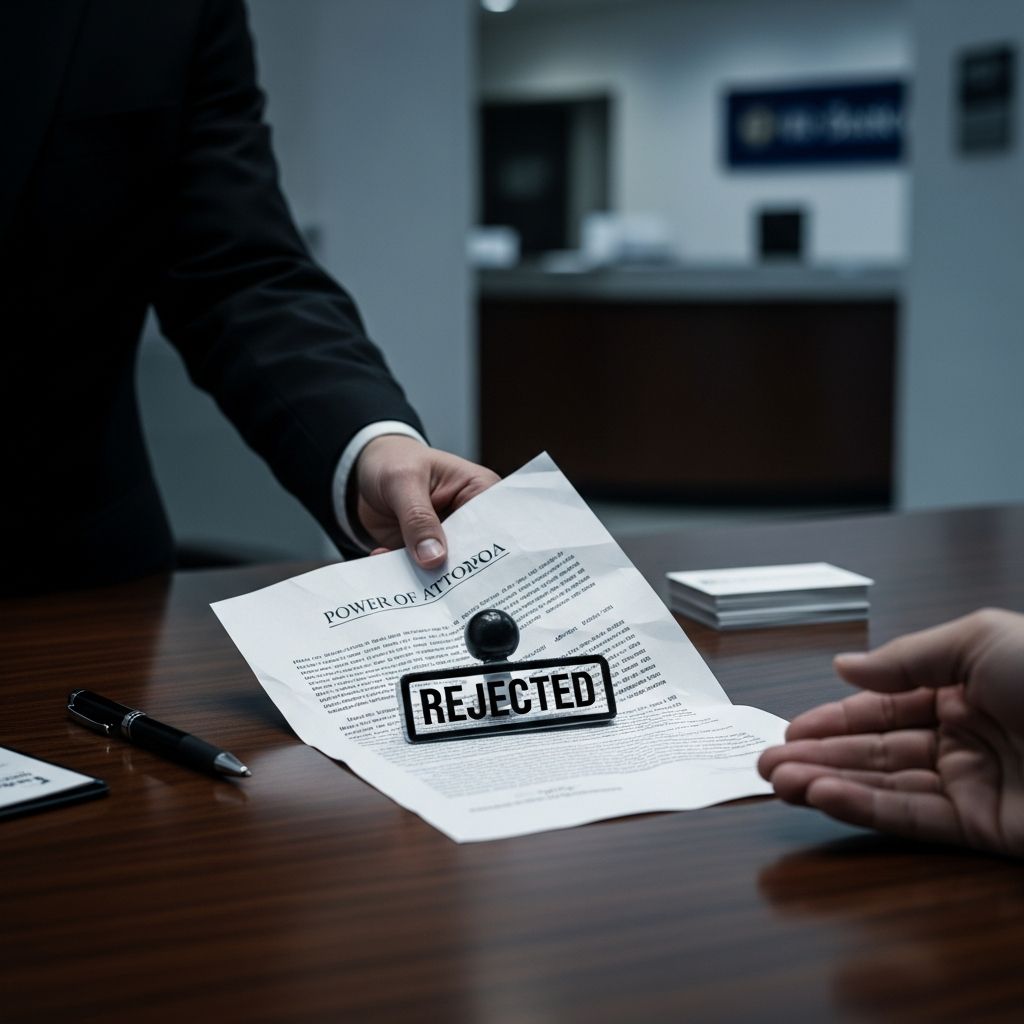
Powers of attorney (POAs) empower trusted individuals to manage finances when the principal cannot, but banks sometimes refuse them despite validity. This guide examines reasons for refusals, legal obligations, remedies, and prevention strategies, drawing from state laws and federal guidelines to equip you with actionable knowledge.
Understanding Powers of Attorney and Their Role in Finance
A
power of attorney
is a legal instrument where a principal grants an agent authority over financial matters, such as banking transactions, investments, or bill payments.Durable POAs
remain effective even if the principal becomes incapacitated, making them vital for aging populations or those facing health challenges.Financial institutions handle vast sums daily, heightening their caution against fraud. While POAs streamline care, banks balance acceptance with risk management. Federal agencies like the Consumer Financial Protection Bureau (CFPB) emphasize POA validity under state law, yet refusals occur due to internal policies or suspicions.
Common Triggers for Bank Refusals of POAs
Banks do not reject POAs arbitrarily; specific concerns prompt scrutiny. Here’s a breakdown:
- Non-Notarized Documents: Many states require notarization for presumptive validity. Unacknowledged POAs invite refusal.
- Outdated or Non-Durable Forms: If incapacity has occurred without a durable clause, banks halt acceptance to prevent abuse.
- Institutional Forms Mismatch: Some prefer proprietary templates for clarity on actions like beneficiary changes or margin trading.
- Suspicion of Fraud or Expiry: Knowledge of revocation, invalidity, or agent overreach triggers rejection.
- Internal Compliance Reviews: Legal departments may delay or deny based on risk protocols.
These issues arise frequently in elder care scenarios, where time-sensitive needs like medical payments clash with bank procedures.
State Variations in POA Acceptance Rules
Laws differ by jurisdiction, imposing duties on banks while allowing refusals. Key examples illustrate:
| State | Key Statute | Acceptance Timeline | Refusal Grounds | Penalties for Wrongful Refusal |
|---|---|---|---|---|
| North Carolina | N.C.G.S. § 32C-1-119/120 | 5 business days after certification | 9 specific reasons, e.g., non-notarized, fraud suspicion | Court orders, attorney fees |
| Connecticut | Conn. Gen. Stat. § 1-350s | 5-7 business days | Must accept acknowledged POA unless proven invalid | Lawsuits for fees/costs |
| General U.S. | Uniform Power of Attorney Act (adopted variably) | Reasonable time | Good faith doubts on validity/authenticity | Potential liability |
Most states adopt elements of the Uniform Power of Attorney Act, mandating good-faith acceptance of notarized, apparently valid POAs. Banks gain liability shields for reliance, encouraging acceptance unless red flags appear.
Your Rights When a Bank Challenges a POA
If refused, agents hold strong recourse. Start by requesting written reasons—banks must often comply under state law. Next:
- Provide Agent Certification: Submit an affidavit affirming the POA’s validity, no revocation knowledge, and authority scope.
- Offer Translation or Counsel Opinion: For non-English or complex documents, supply these within deadlines.
- Escalate Internally: Engage branch managers or legal teams, referencing specific statutes.
- Seek Judicial Intervention: Courts can mandate acceptance, awarding fees against non-compliant banks.
Pro tip: Pre-submit POAs when principals are capable, familiarizing banks ahead of crises.
Proactive Measures to Strengthen POA Enforceability
Forewarned is forearmed. Craft POAs with these elements:
- Durability Clause: Explicitly state it survives incapacity.
- Specific Powers: Detail banking, investments, real estate to avoid ambiguity.
- Bank-Friendly Language: Include indemnification for the institution and successor agent provisions.
- Multiple Execution: Notarize and witness per state rules; record if real property involved.
- Annual Reviews: Update every 3-5 years to signal currency.
Consult estate attorneys for state-compliant drafts. Some banks accept “springing” POAs (activating on incapacity), but durables are safer universally.
Real-World Scenarios and Lessons Learned
Consider a caregiver whose parent needs funds for nursing care. The bank rejects an older POA lacking modern clauses. Resolution: Certification and statute citation force acceptance within days.
In another case, fraud suspicions from irregular transactions lead to refusal. Investigation reveals legitimate needs, but delays cost fees—highlighting communication’s role.
Statistics underscore urgency: AARP notes millions manage elder finances yearly, with POA disputes common in 20-30% of cases per industry reports.
Navigating Federal Oversight and Consumer Protections
The
CFPB
advises that state-compliant POAs bind institutions. Resistance persisting? File complaints via CFPB portals, prompting investigations. Federal banking regs reinforce anti-fraud but prioritize valid document honor.Frequently Asked Questions About Bank POA Refusals
Can a bank demand its own POA form?
No, if yours is state-valid and authorizes the transaction, they cannot mandate alternatives unless specified in law.
What if the principal is incapacitated?
Durable POAs apply; non-durables do not, justifying refusal.
How long can a bank take to decide?
Typically 5-7 business days post-certification; unreasonable delays invite challenge.
Are there costs to enforce a POA?
Potentially, but wrongful refusals often shift fees to the bank.
Should I notify banks in advance?
Yes—pre-registration smooths future use.
Expert Tips from Estate Planners
Professionals recommend hybrid approaches: Statutory forms plus custom riders for banks. Digital POAs emerge, but verify acceptance. Always pair with trusts for comprehensive planning.
In summary, while banks safeguard against abuse, legal frameworks protect POA users. Knowledge empowers swift resolutions, ensuring seamless support for those who need it most.
References
- Can a Bank Refuse to Accept a Power of Attorney? — Law Firm Carolinas. 2023-05-15. https://blog.lawfirmcarolinas.com/can-a-bank-refuse-to-accept-a-power-of-attorney/
- Can Banks Refuse a Power of Attorney? — Nolo. 2024-02-10. https://www.nolo.com/legal-encyclopedia/can-banks-refuse-a-power-of-attorney.html
- My family member signed a power of attorney (POA) but when I took it to the bank/credit union, I was told the POA has to be on the bank/credit union’s form. What can I do? — Consumer Financial Protection Bureau. 2025-01-20. https://www.consumerfinance.gov/ask-cfpb/my-family-member-signed-a-power-of-attorney-poa-but-when-i-took-it-to-the-bankcredit-union-i-was-told-the-poa-has-to-be-on-the-bankcredit-unions-form-what-can-i-do-en-1151/
- What Caregivers Can Do When Banks Reject a Power of Attorney — AARP. 2024-08-05. https://www.aarp.org/caregiving/financial-legal/power-of-attorney-bank-approval/
- What Can I Do If A Bank Won’t Accept My Power Of Attorney? — Disability Planning Partners. 2023-11-12. https://www.disabilityplanningpartners.com/news/what-can-i-do-if-a-bank-wont-accept-a-power-of-attorney
Similar Articles








Read full bio of medha deb




