
Autopilot DUIs and Self‑Driving Car Liability
How drunk driving laws, automation features, and evolving liability rules collide in the age of self‑driving and autopilot vehicles.
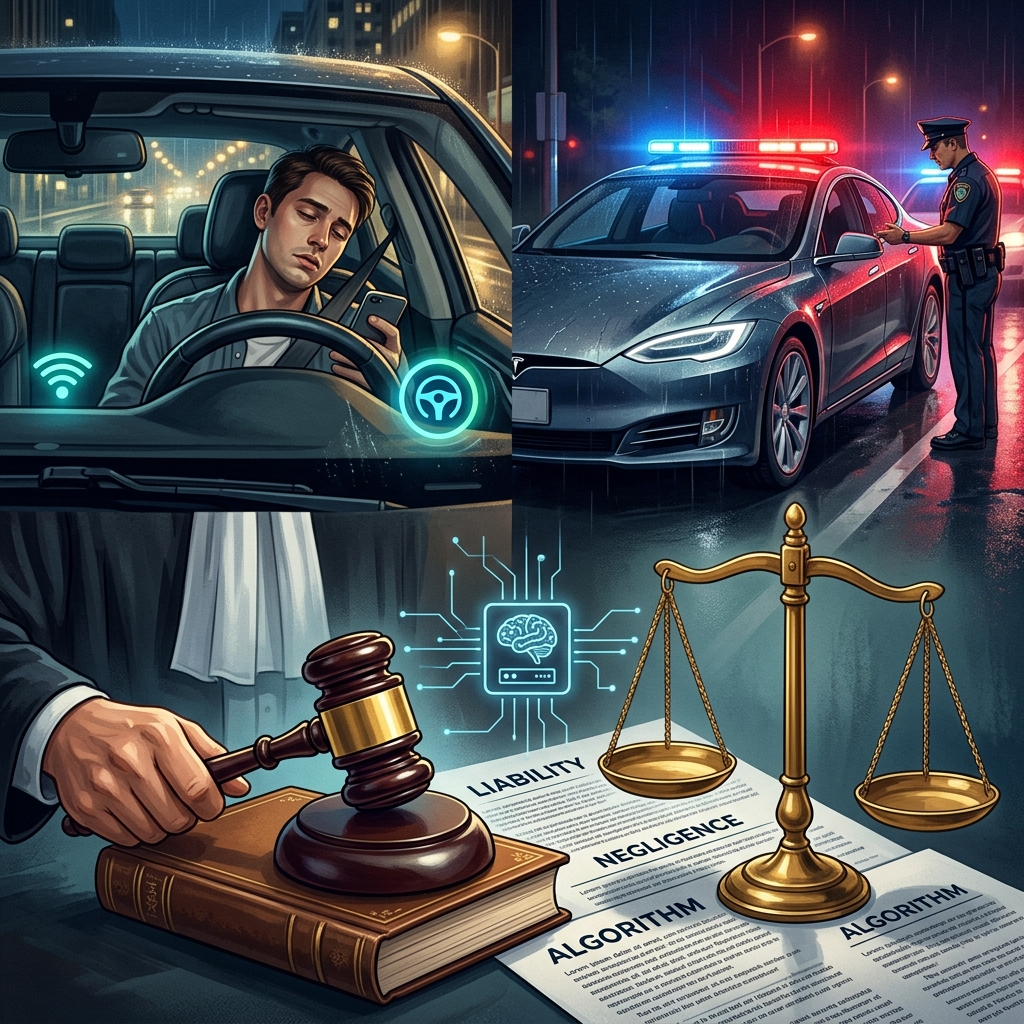
Vehicle automation has moved from science fiction to everyday reality, but criminal and civil liability rules were built for a world in which a human driver is always in charge. As automakers roll out advanced driver assistance systems (ADAS) and autopilot‑style features, courts and lawmakers are wrestling with a new question: who is legally responsible when a car can steer, brake, and accelerate on its own?
One of the most striking pressure points is the rise of “autopilot DUIs” — drunk driving charges against people who rely on automated systems instead of driving themselves. These cases highlight the gap between what technology can do and what the law still expects from anyone behind the wheel.
From Cruise Control to Autopilot: How Automation Changes the Driver’s Role
Understanding autopilot DUIs begins with recognizing that not all automated systems are the same. Engineers and regulators describe vehicle automation in levels, but criminal law usually sees only one category: “driver.”
- Basic assistance: tools like cruise control, lane departure warnings, and automatic emergency braking support a human driver but do not replace them.
- Partial automation: systems that can steer, accelerate, and brake under limited conditions, often labeled as “autopilot” or “hands‑free,” still require human supervision.
- High automation: vehicles that can operate without human input in defined areas and conditions, sometimes marketed as self‑driving or driverless.
Many legal disputes arise because drivers treat partial automation as if it were full autonomy. Marketing language, user experience design, and public perception can all tempt people to “let the car drive itself,” even though manufacturers typically warn that the driver must stay attentive and ready to intervene.
Why Autopilot DUI Cases Are Emerging
Drunk driving laws were drafted on the assumption that a human controls the vehicle’s path. A driver who is impaired is considered dangerous because they make poor decisions about speed, lane position, and reactions to hazards. Autopilot systems disrupt this logic by offloading some decision‑making to software.
Several factors explain why autopilot DUIs are appearing in court dockets:
- Continued legal focus on “control”: Most jurisdictions treat the person in the driver’s seat as “operating” or “in actual physical control” of the vehicle, even if automation is engaged.
- Safety concerns: Lawmakers and judges remain skeptical that consumer‑grade autopilot is sufficiently reliable to counteract the risks of impairment.
- Ambiguous expectations: Some drivers believe the car can handle emergencies or actively advertise that they “let the car drive,” while legal standards still expect active supervision.
In practice, this means many courts still impose DUI liability whenever the driver is present and the vehicle is moving, regardless of which systems are controlling steering or braking at a given moment.
Criminal Liability: Is the Human Always the Driver?
At the criminal level, three themes dominate the emerging treatment of autopilot DUIs.
1. Actual Physical Control
In drunk driving law, the concept of “actual physical control” often extends beyond hands on the wheel. A person can be deemed in control if they are in the driver’s seat with the ability to start or move the vehicle, even while parked or stopped.
- Engaging autopilot does not usually remove that control; the driver can deactivate the system, change speed, or take the wheel at any moment.
- Courts therefore tend to view automation as a tool, not a replacement for the legally accountable operator.
2. Public Policy and Deterrence
Drunk driving statutes also serve a deterrent function. If people could avoid DUI rules by turning on autopilot, lawmakers worry it would invite risky behavior.
- Deterrence logic encourages courts to interpret “operation” broadly, preserving DUI charges even where software manages most driving tasks.
- This approach prioritizes safety: the presence of an impaired person in the driver’s position is seen as inherently dangerous.
3. Technology Reliability and Edge Cases
Current autopilot systems have well‑documented limitations. They can misinterpret lane markings, struggle in bad weather, or fail to recognize unusual obstacles.
- If an impaired driver cannot respond when the system encounters a situation it cannot handle, the risk of a serious crash increases.
- Consequently, criminal law still expects a sober, attentive human overseer, even when automation performs most routine tasks.
Civil Liability: Who Pays When Autopilot Fails?
Autopilot DUIs are only one side of the legal story. When an automated system contributes to a crash, civil courts must decide who compensates injured parties. Unlike criminal law, civil liability is more fluid and may allocate responsibility among several players.
| Potential Defendant | Role in Autopilot Crash | Typical Legal Theory |
|---|---|---|
| Human driver | Misuse of autopilot, failure to intervene | Negligence, statutory violations (e.g., DUI) |
| Vehicle manufacturer | Defective design, misleading warnings, unsafe automation | Product liability, failure to warn, design defect |
| Software developer | Algorithm errors, outdated software, poor updates | Product liability, negligence in software maintenance |
| Fleet or employer | Use of automated vehicles for work, policy failures | Vicarious liability, negligent supervision |
| Government entity | Poor infrastructure, signage, or road design | Public entity liability, design or maintenance negligence |
Product Liability and the “Computer Driver” Concept
Scholars have suggested treating the automated driving system as a “computer driver”, evaluated under similar standards as a human driver. Under this approach:
- The manufacturer is responsible whenever the computer driver fails to perform as safely as a reasonable, unimpaired human driver would have in the same situation.
- Claims are assessed under negligence or strict product liability, focusing on whether the system’s design, training data, or safety testing met reasonable expectations.
This idea helps courts avoid reinventing legal doctrine for each new technology. Judges and juries already understand how to assess human driving negligence; they can apply similar reasoning to software behavior.
Negligence: When Human Drivers Misuse Automation
Many civil cases will still focus on human negligence. Examples include:
- Activating autopilot in conditions where the system is not recommended, such as heavy snow or complex urban environments.
- Ignoring prompts to keep hands on the wheel or maintain attention.
- Using autopilot while impaired, distracted, or fatigued.
Courts often ask whether a reasonable, attentive driver would have used the system in the same way or would have intervened before the crash. If not, the driver may bear a share of responsibility even when automation played a role.
Levels of Autonomy and Shifting Responsibility
The degree of automation matters. Higher levels of autonomy (vehicles that can drive without human oversight in certain scenarios) raise different liability questions than systems that simply assist the driver.
- Lower levels (0–2): the human driver is clearly responsible; systems are tools.
- Intermediate levels (3): the vehicle may handle most driving but expects the human to take over upon request, creating blurred lines.
- High autonomy (4–5): the vehicle may operate with no human driver present; responsibility may shift more heavily toward manufacturers and system operators.
Even at the highest levels, owners may still be liable for poor maintenance or ignoring safety recalls, while operators or fleet managers may be responsible for using vehicles in inappropriate environments.
State Laws and the Definition of “Operator”
Liability rules for autonomous vehicles vary by jurisdiction, and several states have adopted statutes defining who counts as an “operator” when automation is engaged.
- Some laws specify that the person who activates the automated driving system is treated as the operator for regulatory purposes.
- Others focus on the entity that designs or deploys the system, especially for commercial fleets.
- Insurance requirements and duties to remain at the scene of a crash are often tailored to automated operations.
At the federal level, regulators have issued voluntary safety guidelines and performance expectations for automated vehicles, while leaving most liability and insurance questions to the states.
Key Challenges in Regulating Autopilot and Self‑Driving Systems
Autopilot DUIs sit at the intersection of several broader regulatory challenges.
- Data and event recording: Regulators increasingly push for robust data logs (like aviation “black boxes”) to reconstruct what automation and humans did before a crash.
- Cybersecurity: Vulnerabilities in software or connectivity can generate liability if hacks or malfunctions cause accidents.
- Ethical choices by algorithms: How automated systems prioritize different risks may raise negligence questions if design decisions systematically endanger certain road users.
- Insurance models: Traditional policies centered on drivers must adapt to cover software failures, manufacturer responsibilities, and fleet operations.
Practical Guidance for Drivers Using Autopilot Features
For individual drivers, the legal landscape remains clear on one core point: automation does not excuse unsafe or illegal behavior. Until laws explicitly change, people using autopilot systems should assume they are still responsible for how the vehicle is used.
- Stay sober: Engaging autopilot while impaired can still lead to DUI charges if you are considered in control of the vehicle.
- Remain attentive: Courts and regulators expect drivers to supervise automated systems and intervene when necessary.
- Follow manufacturer guidance: Use automation only in recommended conditions and comply with prompts to hold the wheel or focus on the road.
- Keep software and hardware updated: Failing to install safety updates or address recalls can expose owners to liability.
Frequently Asked Questions About Autopilot DUIs and Liability
Can I avoid a DUI if my car is driving itself?
In most jurisdictions, no. If you are in the driver’s seat and the vehicle is moving, you are likely considered to be operating or in control of the vehicle, even when autopilot is engaged. Drunk driving laws generally do not provide exceptions for consumer‑grade automation.
Who is liable if autopilot causes an accident?
Liability can be shared. The human driver may be responsible for misuse or failure to intervene, while manufacturers or software developers may be liable if a design defect, software error, or inadequate warning contributed to the crash. Courts examine the specific facts and the role each party played.
Does full self‑driving change who is considered the “operator”?
Some state laws define the person or entity that activates the automated driving system as the operator, even if the system controls all driving tasks. However, criminal liability rules and definitions may still treat a human occupant as operating the vehicle, particularly in DUI contexts.
Could a manufacturer be criminally liable for autopilot DUIs?
Criminal liability for manufacturers is rare and would typically require proof of willful misconduct or gross negligence, such as knowingly releasing dangerously defective systems. Most disputes over autopilot failures are handled through civil product liability suits rather than criminal charges.
How should I use autopilot safely from a legal perspective?
Use automation as a driver assistance tool, not a replacement for driving. Stay sober, attentive, and ready to take over at any moment. Follow all traffic laws and manufacturer instructions, and remember that current legal standards still treat you as responsible for the vehicle’s operation.
References
- Setting the standard of liability for self-driving cars — Brookings Institution. 2022-02-01. https://www.brookings.edu/articles/setting-the-standard-of-liability-for-self-driving-cars/
- Navigating Liability in the Age of Autonomous Vehicles — Wood, Smith, Henning & Berman LLP. 2023-04-05. https://www.wshblaw.com/publication-navigating-liability-in-the-age-of-autonomous-vehicles
- Navigating Liability in the Era of Driverless Vehicles — HeplerBroom. 2023-09-18. https://heplerbroom.com/blog/when-no-one-has-to-drive-navigating-liability-in-the-era-of-driverless-vehicles/
- Autonomous Car Crashes & Liability Laws by State — NST Law. 2023-11-07. https://www.nstlaw.com/faqs/autonomous-car-accidents-liability-laws-by-state/
- Understanding Self-Driving Car Liability — AIRROC Update. 2022-06-30. https://www.airrocupdate.org/understanding-self-driving-car-liability
- Safety and Liability: Key Challenges in Regulating Self-Driving Cars — UrbanSDK. 2023-05-10. https://www.urbansdk.com/resources/safety-and-liability-key-challenges-in-regulating-self-driving-cars
- Autonomous Vehicles and Liability Law — American Journal of Comparative Law (Oxford Academic). 2022-09-01. https://academic.oup.com/ajcl/article/70/Supplement_1/i39/6655619
Similar Articles








Read full bio of Sneha Tete




