
Auto Loan Payment Strategy: Principal vs Interest
Master your auto loan payoff strategy by understanding how payments are split between principal and interest.
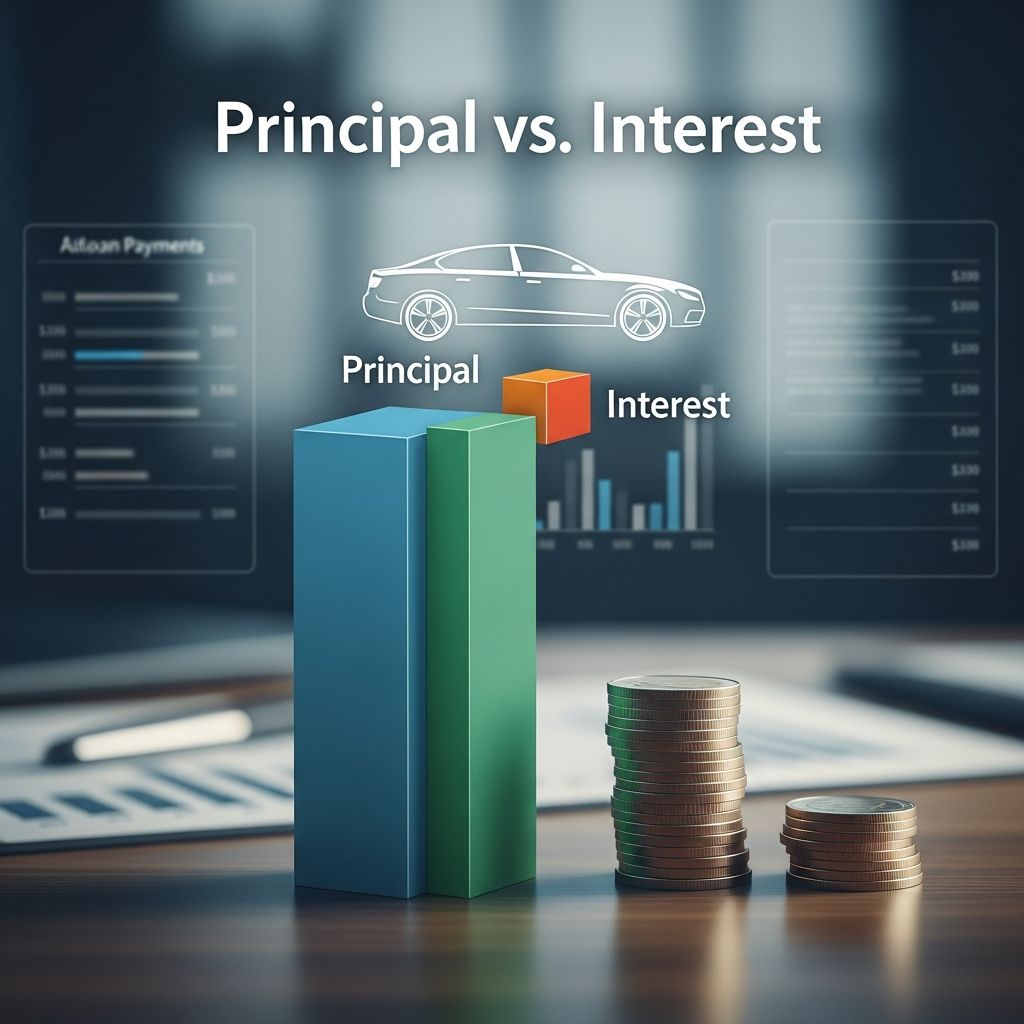
Decoding Your Auto Loan Payment Structure
When you finance a vehicle, your monthly payment represents more than a simple fixed amount sent to your lender. Each installment is strategically allocated between two distinct components: the principal balance and the accumulated interest. Understanding this division is crucial for making informed decisions about how to manage your auto loan efficiently.
The principal is the original amount of money you borrowed to purchase your vehicle. This is the core debt you must repay. Interest, conversely, represents the cost charged by the lender for providing you with the loan. It’s calculated as a percentage of the outstanding principal balance and added to your monthly payment obligation. When you make your monthly car payment, a portion goes toward reducing the principal, while another portion covers the interest accrued since your previous payment.
How Your Monthly Payment Gets Divided
The allocation of your monthly payment between principal and interest follows a predictable pattern over the life of your loan. When you first take out a simple interest auto loan, more of your payment is applied toward interest than toward the principal. This front-loaded interest structure is intentional and reflects how lenders calculate and manage their risk.
Consider a concrete example: if you secure a $36,000 auto loan with a 6 percent interest rate and a four-year term, your monthly payment would be approximately $845, with total interest costs reaching about $4,582 over the life of the loan. In the first month, your payment breaks down with roughly $180 going toward interest and $665 toward principal. However, as you progress through your loan term, this dynamic shifts significantly.
By month 12, only $139 of your $845 payment covers interest, while $707 reduces your principal balance. This progression continues until the final month, when your entire payment goes toward principal since the balance has been substantially reduced. This amortization pattern means that early payments have a larger interest component, making the later portions of your loan term more efficient for building equity in your vehicle.
The Impact of Your Interest Rate
Your interest rate dramatically influences both your monthly payment amount and the total interest you’ll pay over the loan’s duration. Interest rates vary based on several factors, including your credit score, the loan term length, and current market conditions. Even seemingly small differences in interest rates create substantial financial consequences over time.
For illustration, consider two $40,000 loan scenarios: one at a 6.49% APR and another at 10.89% APR, both for 72 months. The lower rate generates a monthly payment of $672.21, while the higher rate requires $759.11 monthly—nearly $100 more each month. Over the entire loan term, this $100 monthly difference translates to $6,257 in additional interest charges for the higher rate. This dramatic difference underscores why securing the best possible interest rate should be a priority during the loan application process.
Understanding Principal Reduction Strategies
While your standard monthly payment automatically reduces the principal, several strategies can accelerate this process and generate significant savings. The most straightforward approach involves making extra payments directly toward the principal balance. When you pay additional amounts beyond your required monthly payment, these extra funds bypass the interest calculation and go directly to reducing what you owe.
Practical example: If your regular payment on a $30,000 auto loan with 7.49% APR over 60 months is approximately $601, adding just $100 monthly to reach $701 accomplishes two important objectives. First, it reduces the total payoff time by nine months. Second, it substantially decreases the total interest paid over the loan’s remaining duration. This accelerated payoff strategy compounds its benefits as lower principal balances generate lower interest charges in subsequent months.
A larger down payment represents another effective principal reduction tactic. When you put down a substantial amount upfront, you reduce the loan amount from the beginning. This lower starting principal generates lower interest calculations throughout the entire loan term. For instance, increasing your down payment from $4,000 (10%) to $8,000 (20%) on a $40,000 new car with a 60-month loan at 7% APR reduces total interest paid from $6,771 to $6,018—a savings of $753 without any changes to your monthly payment amount.
Loan Term Length and Total Interest Costs
The length of your loan term creates a critical trade-off between monthly affordability and total interest expense. A longer-term loan reduces your monthly payment but substantially increases the total interest you’ll pay. This counterintuitive relationship surprises many borrowers who focus exclusively on keeping their monthly payment manageable.
Consider this comparison: a $25,000 loan at 5% interest costs approximately $1,800 in interest over a 60-month term, but the same loan over an 84-month term increases that interest cost to approximately $2,800. While the monthly payment might seem more manageable with the longer term, you’re ultimately paying $1,000 more in total interest. Similarly, a $25,000 loan at 9% interest costs $4,862 over 48 months but $7,446 over 72 months—a difference of $2,584 for the same borrowed amount.
This dynamic reveals an important principle: shortening your loan term whenever possible directly benefits your financial position by reducing total interest obligations. Even a 12-month reduction in loan term can generate substantial savings without dramatically increasing your monthly payment burden.
Simple Interest vs. Compound Interest Calculations
Understanding whether your auto loan uses simple or compound interest is essential for accurate financial planning. Most auto loans utilize simple interest, meaning the interest rate applies only to the remaining principal balance rather than to both principal and accumulated interest. This distinction matters significantly for your total interest calculations.
With simple interest auto loans, the amount you’re charged in interest decreases as your outstanding loan balance shrinks. This structure rewards early principal payments and incentivizes payoff acceleration. Some lenders, however, use precomputed interest, where they calculate your total interest upfront, add it to the principal, and divide the sum evenly across all monthly payments. With precomputed interest, making extra payments or paying off your loan early provides minimal savings since the interest has already been determined and incorporated into your payment schedule.
Before accepting any auto loan, clarify which interest calculation method your lender employs. If possible, seek simple interest loans that reward you for accelerating your payoff timeline and making extra payments.
The Critical Difference: APR vs. Interest Rate
Many borrowers conflate interest rate with APR (Annual Percentage Rate), but these represent distinctly different concepts with meaningful financial implications. Your interest rate is simply the cost of borrowing money, calculated as a percentage of your principal loan amount. APR encompasses this interest rate plus additional fees and charges associated with financing, such as origination fees, documentation costs, and other lender charges.
When comparing auto loan offers, always evaluate the APR rather than just the interest rate. The APR provides a comprehensive picture of your true borrowing cost. Two lenders might offer the same interest rate, but their APRs could differ substantially based on the fees they charge. By focusing on APR when evaluating loan options, you make more accurate comparisons and avoid hidden costs that inflate your total borrowing expense.
Optimizing Your Payment Strategy
Developing an effective auto loan payment strategy requires balancing several competing priorities. Your immediate goal should be securing the lowest possible interest rate by maintaining strong credit and comparing multiple lender offers. Even small interest rate reductions generate substantial long-term savings given the amount you’re borrowing.
Next, consider your down payment amount carefully. While larger down payments require more upfront capital, they reduce your loan amount and generate interest savings throughout the loan term. If you have adequate savings, a larger down payment typically outperforms other financial uses of that capital.
Finally, evaluate your loan term strategically. Choose the shortest term you can comfortably afford monthly, recognizing that extending your term for payment relief costs significantly in total interest. If your budget tightens in the future, you can always maintain extra payments to accelerate principal reduction without committing to a longer-term loan structure.
Making Extra Principal Payments Effectively
If your financial situation improves after taking out your auto loan—through a salary increase, bonus, or inheritance—directing these additional funds toward your auto loan principal accelerates your payoff and generates ongoing interest savings. When making extra payments, verify with your lender that these additional funds are applied directly to principal rather than held as credit toward future payments.
The cumulative effect of regular extra payments compounds powerfully. Even adding $50 or $100 monthly to your payment accelerates your payoff date and reduces total interest. For borrowers with simple interest loans, these extra payments are particularly valuable since they immediately reduce the principal balance on which future interest calculations are based.
Frequently Asked Questions About Auto Loan Payments
Should I prioritize paying off interest or principal?
You cannot choose between paying interest or principal—your monthly payment automatically covers both based on your loan’s amortization schedule. However, you can accelerate principal reduction by making extra payments, which directly decrease the amount owed and reduce future interest charges. Extra payments always benefit simple interest loans by reducing the principal balance immediately.
How much of my payment goes toward principal vs. interest each month?
The proportion changes monthly as your outstanding balance decreases. Early payments have larger interest components, while later payments increasingly go toward principal. You can request an amortization schedule from your lender or use online calculators to see the exact breakdown for each payment throughout your loan term.
Can I pay off my auto loan early without penalties?
This depends on your specific loan agreement. Most simple interest auto loans allow early payoff without penalties, rewarding you with substantial interest savings. However, some precomputed interest loans impose prepayment penalties. Review your loan documents carefully or contact your lender to understand any restrictions on early payoff.
Does a larger down payment really save money in the long run?
Yes, significantly. A larger down payment reduces your initial loan amount, which lowers the principal on which interest is calculated throughout the loan term. The interest savings compound over your entire repayment period, making a larger initial investment worthwhile if you have the available funds.
What interest rate should I target for an auto loan?
Your achievable interest rate depends on your credit score, the vehicle type, and current market conditions. Borrowers with excellent credit scores (781-850) average around 4.88% for new cars, while those with nonprime credit (601-660) face rates near 9.77% for new vehicles. Shop multiple lenders to find competitive offers and improve your rate through credit-building efforts before applying.
Is a longer loan term ever advisable?
While longer terms reduce monthly payments, they substantially increase total interest paid. Consider a longer term only if your budget truly cannot accommodate a shorter timeline, and then prioritize making extra principal payments whenever possible to counteract the higher interest costs.
References
- Understanding Car Payments — Pacific Service Credit Union. Accessed 2025-12-07. https://www.pacificservice.org/learn/money-matters/understanding-car-payments
- Understanding Auto Loan Terms — UK Federal Credit Union. Accessed 2025-12-07. https://www.ukfcu.org/blog/understanding-auto-loan-terms
- Anatomy of a Car Payment — Achieve Financial Credit Union. Accessed 2025-12-07. https://www.achievefinancialcu.com/Services/Financial-Education-Center/Financial-Articles/Anatomy-of-a-Car-Payment
- What Is A Simple Interest Auto Loan & How Does It Work? — Bankrate. Accessed 2025-12-07. https://www.bankrate.com/loans/auto-loans/simple-interest-auto-loans/
- Principal vs. Interest: Key Differences — Capital One. Accessed 2025-12-07. https://www.capitalone.com/learn-grow/money-management/principal-vs-interest/
- Auto Loan Calculator: Estimate Your Car Payment — NerdWallet. Accessed 2025-12-07. https://www.nerdwallet.com/auto-loans/calculators/auto-loan-calculator
- Understanding APR vs. Interest Rate for Auto Loans — Santander Consumer USA. Accessed 2025-12-07. https://santanderconsumerusa.com/blog/apr-vs-interest-rate-auto-loan
Similar Articles








Read full bio of medha deb




