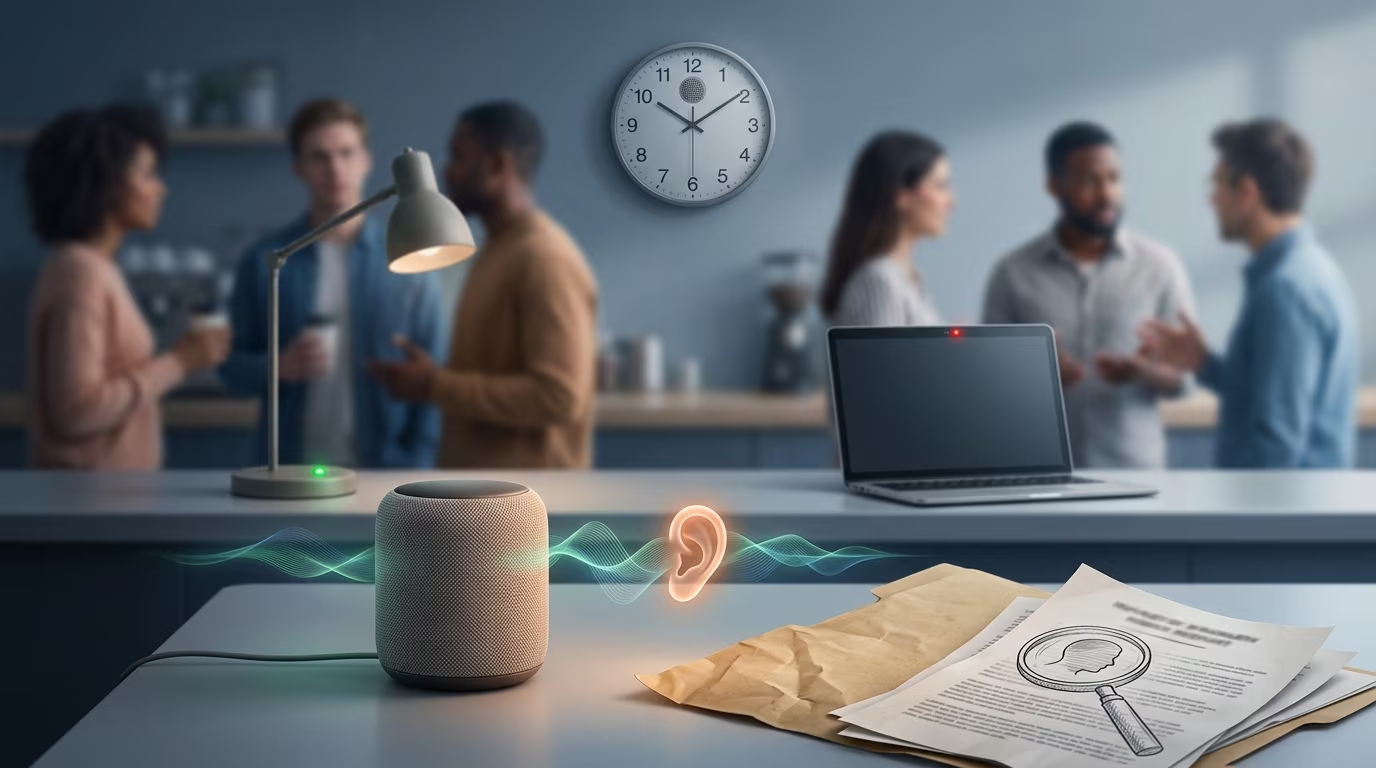
The Silent Threat: How Audio Surveillance in Civic Spaces Undermines Democratic Freedoms
For decades, the physical presence of security cameras in public spaces has been a normalized, albeit begrudgingly accepted, aspect of modern life. From the moment citizens step onto a public sidewalk to the time they enter a local government building to pay a parking ticket, apply for a building permit, or dispute a municipal tax assessment, they are thoroughly accustomed to the silent, sweeping gaze of Closed-Circuit Television (CCTV) cameras. However, a profound and controversial technological shift is quietly occurring within the administrative halls of local governments and civic institutions: the deployment of hidden audio surveillance. When a municipality consciously installs active microphones in public hallways, waiting rooms, or lobbies, it actively crosses a dangerous boundary between passive visual security and aggressive auditory intrusion. This quiet transition—from simply monitoring physical movement to secretly capturing the exact spoken words of citizens—poses significant, tangible threats to democratic participation, fundamental civil liberties, and the essential trust between a representative government and its people. This comprehensive article explores the deep implications of ambient audio monitoring, the stringent legal frameworks governing secret recordings, and the critical policy boundaries necessary to protect free civic expression.
The Evolution of Public Monitoring: From Visual to Auditory
The history of public surveillance in democratic nations is largely a visual one. The widespread adoption of CCTV systems in the late twentieth century was pitched to the public as a necessary, balanced compromise for physical security. Citizens generally accepted the premise that their physical movements would be meticulously documented to deter crime and identify physical threats. Video monitoring, in its traditional and silent form, captures human behavior but fundamentally leaves the internal intricacies of human interaction intact. Two citizens could stand in a city hall lobby and engage in a highly sensitive, heated debate about a local zoning ordinance or a burgeoning political scandal, secure in the absolute knowledge that while their physical gestures were visible to security personnel, their words were carried only as far as the natural acoustics of the room allowed.
Today, rapid advances in digital surveillance technology have drastically lowered the financial cost and exponentially increased the capabilities of acoustic monitoring devices. High-definition microphones can now be embedded invisibly within standard security camera domes, smoke detectors, or integrated seamlessly into existing municipal networks. This represents a massive paradigm shift in public administration. Audio surveillance does not merely capture what a person is doing; it captures exactly what they are thinking, planning, and expressing to others in real time. In the past, capturing high-quality audio required a targeted, deliberate act, like obtaining a judicial warrant for a wiretap on a specific criminal suspect. Now, it is positioned as an ambient, always-on feature of the standard environment. This technological leap transforms the civic environment into a digital panopticon of persistent auditory tracking, where the state becomes an omnipresent, uninvited listener to the daily lives of its constituents.
The Intimacy of Voice: Why Audio Monitoring is Uniquely Invasive
To fully understand why audio surveillance alarms privacy scholars and civil liberties advocates far more than its visual counterpart, one must clearly recognize the unique, profound intimacy of the human voice. A video feed might simply show two people standing close together in a municipal hallway, but an active audio feed reveals the entire substance and context of that proximity. It captures the frantic, hushed whispers of a municipal whistleblower discussing bureaucratic corruption with a trusted colleague. It meticulously records the desperate, embarrassed tone of a local resident pleading with a housing advocate for leniency on a utility bill, or the quiet legal strategizing of a concerned constituent and their attorney outside a closed-door zoning board meeting.
Human voice data is deeply and inherently revealing. It betrays emotion, regional origins, psychological distress, and the intricate webs of personal and professional relationships. When citizens realize their government is passively capturing and permanently storing their spoken words in ostensibly public but fundamentally civic spaces, a documented psychological phenomenon known as the “chilling effect” immediately takes hold. Individuals self-censor their speech, radically alter their behavior, or entirely withdraw from public participation out of a distinct fear of state monitoring and potential reprisal. If a citizen cannot converse freely in the corridor of their own city hall without the latent fear of the administration digitally cataloging their private complaints, the building ceases to be a true house of democratic representation. Instead, it devolves into a space of subtle intimidation, disproportionately silencing marginalized groups who already face steep systemic barriers when navigating government bureaucracy.
Navigating the Legal Landscape of Secret Recordings
The legal framework comprehensively surrounding audio surveillance is far more complex, restrictive, and perilous than the laws governing photography or video recording in public spaces. At the absolute heart of American privacy jurisprudence is the Fourth Amendment, which fiercely protects citizens from unreasonable searches and seizures by the state. The modern interpretation of this constitutional protection heavily relies on the landmark 1967 Supreme Court case, Katz v. United States. In Katz, the Supreme Court famously ruled that the Fourth Amendment “protects people, not places,” thereby establishing the vital “reasonable expectation of privacy” test. If an individual has a subjective expectation of privacy that society is prepared to recognize as objectively reasonable, the government simply cannot electronically intercept their private conversations without a specialized warrant.
When municipalities unilaterally install continuous ambient audio monitoring in their hallways, they frequently exploit a perceived legal grey area, arguing that citizens have no reasonable expectation of privacy in a publicly accessible government building. However, privacy in public spaces is not a simple binary construct. Two people whispering in a secluded corner of a busy administrative lobby, deliberately lowering their voices to prevent others from eavesdropping, reasonably expect that their conversation remains strictly private from a distant security desk—even if they acknowledge they are standing in a public building.
Furthermore, strict federal and state statutes strictly govern the interception of oral communications. The Federal Wiretap Act generally prohibits the intentional interception of any wire, oral, or electronic communications. While the Act crucially includes a consent exception—meaning monitoring is legal if at least one party to the conversation explicitly consents—this exception rarely justifies ambient, dragnet recording in civic hallways. In a scenario where a hidden microphone captures two private citizens talking exclusively to each other, neither party has consented to the government’s auditory interception. State laws heavily complicate this operational reality even further; several states are strictly “two-party consent” or “all-party consent” jurisdictions, requiring the explicit permission of everyone involved before a conversation can be lawfully recorded. By simply activating ambient microphones under the vague guise of “building security,” local governments willfully open themselves to severe civil rights litigation and deeply violate the foundational trust of their electorate.
Civic Spaces as Sanctuaries for Free Expression
The architecture, daily function, and underlying philosophy of local government buildings are uniquely and inextricably tied to the concept of the democratic public square. A city hall is not merely an administrative office where paper permits are processed; it is an active, vital forum for civic life. It is the exact location where citizens bravely petition their elected leaders, where local journalists aggressively conduct impromptu interviews with council members, and where the community naturally gathers to organize ahead of contentious public hearings. Because of this intrinsic, irreplaceable democratic function, civic spaces must be fiercely protected as safe sanctuaries for free expression.
When local governments publicly argue that constant audio surveillance is strictly necessary to protect municipal staff from aggressive or unruly visitors, they inadvertently frame the general public as a constant, inherent threat rather than the ultimate sovereign authority to which the government answers. While physical security and the safety of public servants are undeniably vital administrative priorities, achieving that safety through invisible, dragnet audio surveillance represents a grossly disproportionate and constitutionally destructive response. It inappropriately shifts the entire burden of physical security directly onto the free speech rights of the populace. A healthy democratic society must structurally accept a certain degree of friction and robust, even heated, public debate. Attempting to artificially sanitize and digitally control the civic environment through constant government listening utterly destroys the spontaneity, privacy, and candor strictly required for authentic democratic engagement.
The Risks of Unchecked Surveillance Creep
One of the most insidious and well-documented aspects of implementing hidden recording systems is the phenomenon known as “mission creep” or “function creep.” A surveillance system initially authorized by a city council under the strict, narrow justification of emergency physical security—perhaps specifically to listen for the sounds of glass breaking or physical altercations—rarely remains confined to that singular, publicly approved purpose. Once the hardware infrastructure is fully in place and the audio data is steadily flowing into municipal servers, the administrative temptation to utilize that granular data for other, unauthorized purposes becomes overwhelming.
Municipal managers might quietly begin using the audio feeds to aggressively monitor employee productivity, secretly listen in on casual staff complaints, or illegally eavesdrop on union organizing efforts. Unscrupulous political leaders might access the digital archives to track the lobbying strategies of their political opponents or intercept the plans of community activists who frequently visit the building to lobby for change. Furthermore, as audio surveillance seamlessly interfaces with modern Artificial Intelligence (AI), the systemic threat multiplies exponentially. Ambient microphones can easily be coupled with voice biometric software to instantly identify and log specific individuals as they walk through a building. The recorded audio can be paired with sentiment analysis algorithms to actively categorize the mood, frustration levels, and compliance of the local populace. What begins simply as a benign microphone embedded in a ceiling tile can rapidly and quietly evolve into an automated, AI-driven surveillance state at the local municipal level, operating entirely without judicial oversight, operational transparency, or public consent.
Building Better Boundaries: Policy Recommendations
To successfully preserve the absolute integrity of civic spaces while maintaining a reasonably secure environment for public employees, local governments must proactively establish strict, transparent, and legally binding boundaries regarding the deployment of surveillance technology. The default administrative position of any democratic institution should be an absolute prohibition on continuous, ambient audio recording in any areas where citizens publicly gather, wait, or converse.
When security upgrades are deemed absolutely necessary, municipalities should adhere strictly to the following comprehensive framework:
- Conduct Privacy Impact Assessments (PIAs):strong> Before procuring or installing any new surveillance technology, city councils must mandate independent, public assessments to thoroughly evaluate the potential chilling effects on free speech, civil rights, and civic participation.
- Implement Strict Visual-Only Policies: Security cameras installed in public hallways and administrative lobbies should have their audio-recording capabilities physically disabled or permanently disconnected by the manufacturer to prevent accidental or clandestine activation.
- Enhance Human-Centric Security: Instead of relying entirely on invasive, passive surveillance technology, municipalities should heavily invest in trained de-escalation personnel, improved environmental lighting, and better architectural design to ensure building safety without violating constitutional rights.
- Mandate Public Transparency: If a municipality fundamentally insists on utilizing any form of advanced electronic monitoring, it must undergo robust public hearings, require explicit legislative authorization through a public vote, and post clear, unmistakable signage at all entrances informing the public of the exact nature and scope of the surveillance.
Security Measures vs. Privacy Impacts
| Security Measure | Primary Purpose | Privacy Impact | Democratic Appropriateness |
|---|---|---|---|
| Visual CCTV (No Audio) | Deters theft, visually documents physical incidents | Moderate (captures physical presence and movement) | Generally Accepted (Standard security baseline) |
| Emergency Panic Buttons | Instantly alerts authorities during active, immediate crises | Low (Only activated deliberately during emergencies) | Highly Appropriate (Targeted, consent-driven response) |
| Ambient Audio Recording | Continuous environmental monitoring of all sound | Severe (Intercepts and archives private conversations) | Highly Inappropriate (Causes severe chilling effect) |
| Voice Biometric Tracking | Identifies specific individuals via unique speech patterns | Extreme (Automated profiling and persistent tracking) | Unacceptable in Civic Spaces |
Frequently Asked Questions (FAQs)
Do citizens have a reasonable expectation of privacy in a public government building?
Yes, depending entirely on the specific context of the situation. While citizens acknowledge they are standing in a public administrative building, the law frequently recognizes that two individuals conversing quietly in a secluded area or an empty municipal hallway have a highly reasonable expectation that their exact words are not being secretly intercepted, recorded, and archived by the government.
Is it legal for a city to record audio without explicit consent?
In many jurisdictions, it is highly legally contentious and frequently outright illegal. The Federal Wiretap Act and various state-level electronic surveillance laws fundamentally require either one-party or all-party consent to record a conversation lawfully. If an ambient microphone captures a private discussion between two visitors in a lobby, neither party has consented to the recording, potentially violating these strict statutes.
Why is audio surveillance considered far worse than standard video surveillance?
Video capturing technology isolates physical actions, gestures, and presence, which are inherently exposed to the public eye. Audio, however, captures the intimate, intellectual content of private thoughts, legal strategies, political organizing, and deep emotional distress. This active interception causes a severe, well-documented chilling effect on free speech, deterring citizens from engaging in open civic participation.
How can I find out if my local government is secretly recording audio?
Citizens should carefully look for posted surveillance signage, which is sometimes legally required depending on the state’s specific recording laws. Additionally, local residents, journalists, and advocacy groups can file formal public records requests (such as FOIA requests) regarding the procurement contracts and technical specifications of their municipal security systems to definitively determine if the hardware includes active microphones.
References
- Katz and the Adoption of the Reasonable Expectation of Privacy Test — Legal Information Institute, Cornell Law School. 2023-01-01. https://www.law.cornell.edu/constitution-conan/amendment-4/katz-and-the-adoption-of-the-reasonable-expectation-of-privacy-test
- Ethical Considerations in the Conduct of Electronic Surveillance Research — Carnegie Mellon University. 2004-12-01. https://www.cs.cmu.edu/~caremedia/publications/Ethical-Considerations-in-the-Conduct-of-Electronic-Surveillance.pdf (Justification: This foundational academic paper provides essential technical definitions for distinguishing the distinct ethical impacts of visual versus auditory electronic surveillance.)
- The Fourth Amendment Future of Public Surveillance: Remote Recording and Other Searches in Public Space — American University Law Review. 2013-11-02. https://digitalcommons.wcl.american.edu/aulr/vol63/iss1/2/ (Justification: This peer-reviewed legal analysis remains a primary, authoritative framework for understanding the constitutional bounds of public surveillance and expected privacy.)
- Wiretapping Laws and Audio Surveillance — Wisconsin Association of School Boards. 2019-10-01. https://wasb.org/wp-content/uploads/2017/03/Legal_Comment_Oct_2016.pdf (Justification: This legal policy document offers crucial analysis of state-level electronic surveillance control laws directly relevant to civic and public institutions.)