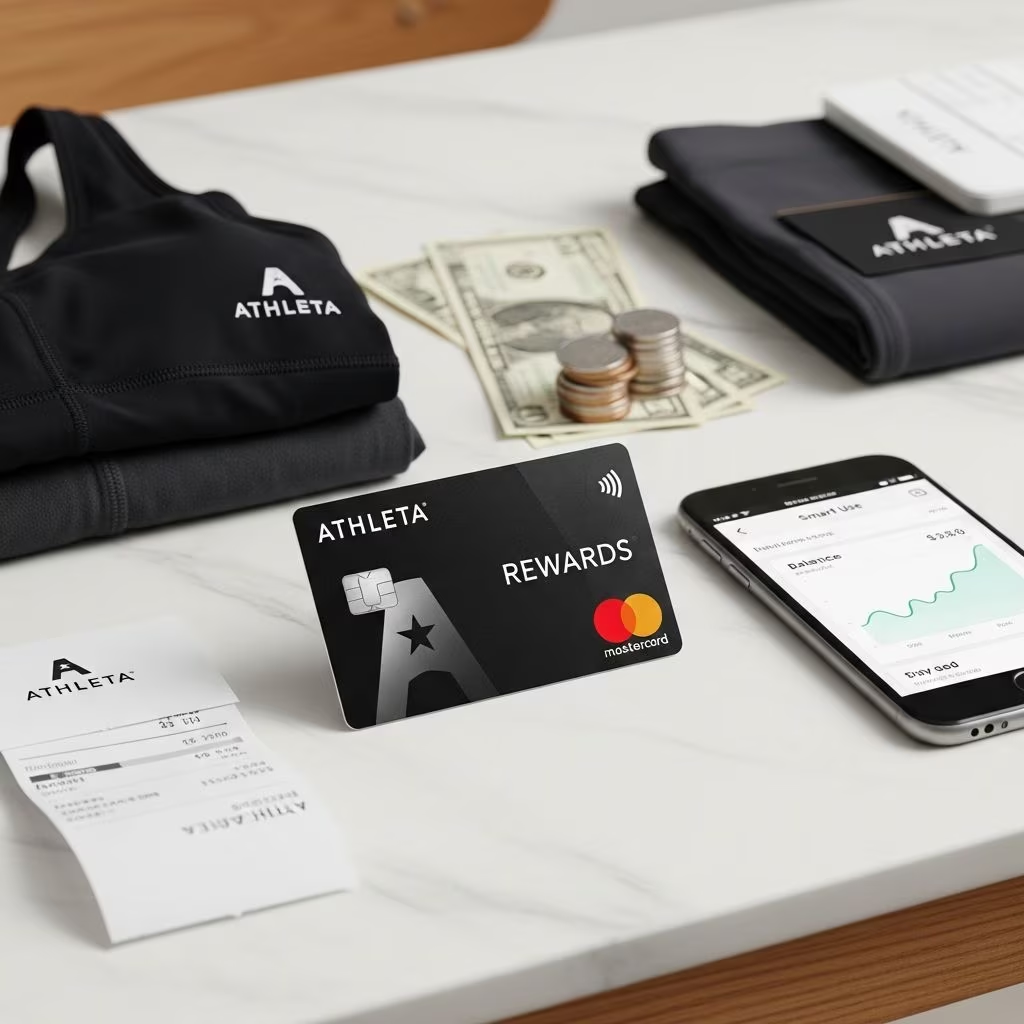
The Athleta Rewards Mastercard is a store-branded credit card that combines everyday payment features with loyalty rewards for Athleta and related brands. Used thoughtfully, it can help frequent shoppers earn discounts and perks; used carelessly, it can become an expensive way to borrow.
This guide explains how this type of card works, breaks down key terms you are likely to see in the official credit card agreement, and offers tips to decide whether the Athleta Rewards Mastercard fits your financial plans.
What Type of Credit Card Is the Athleta Rewards Mastercard?
The Athleta Rewards Mastercard is generally considered a co-branded retail credit card. That means:
- Issued by a bank (not Athleta itself) under the Mastercard network.
- Linked to a specific retail program that awards points or rewards on brand purchases.
- Usable beyond the store wherever Mastercard is accepted, unlike some “closed-loop” store cards that work only at the retailer.
Although details like interest rates, credit limits, and promotional offers are specific to this product, its legal structure and disclosures must follow the federal Truth in Lending Act and Regulation Z, which govern credit card agreements and how terms are presented to consumers.
Core Features You Can Expect
While exact terms come from the official cardholder agreement and pricing disclosure, co-branded cards like the Athleta Rewards Mastercard commonly include several shared features:
- Rewards on eligible purchases at Athleta and related brands (such as points or certificates).
- Standard variable APR on purchases and possibly on balance transfers and cash advances.
- Late payment and returned payment fees when you miss a due date or a payment does not clear.
- Minimum payment requirement each month to keep your account in good standing.
- Cardholder agreement posted and updated online as required by Regulation Z.
The value of the card depends on your spending habits, whether you carry a balance, and how consistently you pay on time.
Interest Rates and How They Affect You
Interest is often the largest cost of using a retail rewards card. Most card agreements specify several different annual percentage rates (APRs):
- Purchase APR – applies when you do not pay your full balance by the due date.
- Balance transfer APR – charged on balances you move from other cards, if that feature is available.
- Cash advance APR – generally higher, applied when you use the card to access cash.
- Penalty APR – may apply if you pay very late or break other terms of the agreement.
APRs on store-branded credit cards are typically higher than those on low-interest or credit union cards, which can make carrying a balance especially costly. To estimate the impact of interest, look at your typical monthly card balance and apply the purchase APR, then compare that cost to the value of the rewards you earn.
Grace Period and When Interest Starts
Most consumer credit cards provide a grace period, meaning no interest on new purchases if you:
- Start the billing cycle with a zero balance or have paid your previous statement in full, and
- Pay the full statement balance by the due date every month.
If you revolve a balance, you generally lose the grace period on new purchases, so interest starts accruing from the date of the transaction.
Fees to Watch Before You Apply
Card issuers must disclose key fees in a standardized table (often called the “Schumer box”) so you can compare offers. Common fees you may encounter on the Athleta Rewards Mastercard include:
- Late payment fee – charged if your payment arrives after the due date.
- Returned payment fee – charged if your bank rejects a payment.
- Cash advance fee – applied when you take cash from an ATM or over the counter.
- Foreign transaction fee – a percentage added when you make transactions in another currency, if applicable.
Under U.S. law, there are caps on certain penalty fees, and issuers must explain clearly when and how these charges apply. Reviewing this section before applying helps you avoid surprises.
How the Rewards Program Typically Works
The main attraction of a co-branded card is its rewards structure. While specific earn rates and redemption rules come from the official program terms, most store cards operate in similar ways:
- You earn points or rewards for eligible purchases at Athleta and partner brands.
- You may earn lower rewards or none at all on non-partner purchases.
- Rewards can usually be redeemed as certificates or statement credits toward future purchases.
- Rewards may expire if unused for a certain period or if your account closes.
To judge whether the card is worthwhile, compare:
- The extra value of rewards you earn at Athleta and partner brands versus a general cash-back card.
- The potential interest and fees you might pay if you cannot always pay your balance in full.
Rewards vs. Costs: Quick Comparison
| Factor | Potential Benefit | Potential Drawback |
|---|---|---|
| Rewards on Athleta purchases | Higher earn rate than general cards, leading to more store discounts | Rewards tied to a specific brand; limited flexibility |
| Use anywhere Mastercard is accepted | Convenient single card for many purchases | Spending beyond the store can encourage higher balances |
| Promotional offers | Introductory discounts or special financing may save money | Deferred interest offers can be costly if not fully repaid by the end date |
| Annual fee | No annual fee on many retail cards | If present, fee reduces the net value of rewards |
Eligibility, Credit Check, and Account Management
Applying for the Athleta Rewards Mastercard usually involves a credit check, where the issuer reviews your credit history, income, and existing obligations. This process helps the bank decide whether to approve your application and what credit limit to grant.
Once opened, the account will appear on your credit reports with major U.S. credit bureaus. How you manage it can affect your credit profile:
- On-time payments help build a positive history.
- High utilization (balances close to your limit) can hurt your credit scores.
- Missed payments can trigger penalty fees and may be reported as delinquencies.
Editorial standards at major credit information sites stress the importance of understanding these effects before applying, since every new account and hard inquiry can influence your overall credit standing.
Security, Fraud Protection, and Your Responsibilities
As a Mastercard product, the Athleta Rewards card generally includes standard fraud protection features, but cardholders also have legal protections when unauthorized transactions occur. Under federal law, consumer liability for unauthorized credit card charges is limited, and card networks typically provide zero-liability policies when you report fraud promptly.
Still, you are responsible for taking reasonable steps to protect your account:
- Keep your card and account number private.
- Avoid writing card numbers in easily accessible places or on paper that others might see, which exposes you to theft and may violate data security standards.[10]
- Monitor statements and online activity monthly.
- Report lost cards or suspicious charges to the issuer immediately.
Comparing the Athleta Card to Other Options
Before you commit to a store-branded card, compare it with a few alternatives:
- General cash-back cards – may offer flat or category-based rewards usable anywhere, often in the form of statement credits or deposits.
- Low-interest or credit union cards – can have significantly lower APRs, which may be better if you carry a balance.
- Secured cards – for building credit if you are new to credit or rebuilding, though they may not offer brand-specific rewards.
Weigh the Athleta card’s higher in-store rewards against the flexibility and potentially lower borrowing costs of more general products.
When This Card May Be a Good Fit
- You shop at Athleta and related brands regularly.
- You can reliably pay your statement balance in full each month.
- You value store-specific perks and are comfortable managing another credit line.
When You Might Want to Skip It
- You often carry balances on your credit cards.
- Your budget is tight and late fees would be hard to cover.
- Your Athleta spending is infrequent, so rewards would accumulate slowly.
How to Use the Athleta Rewards Mastercard Wisely
If you decide the card fits your needs, use these strategies to reduce risk and maximize value:
- Set a personal spending cap lower than your credit limit to avoid overextending yourself.
- Automate payments for at least the statement balance or a fixed amount above the minimum.
- Track rewards so you know when they post and when they expire.
- Avoid cash advances, as they usually start accruing interest immediately and carry extra fees.
- Review statements monthly for errors or unfamiliar charges, and report problems quickly.
Key Terms Commonly Found in the Card Agreement
Official card agreements can be technical, but a few key concepts appear in nearly every document:
- APR (Annual Percentage Rate) – the yearly cost of borrowing on the card, expressed as a percentage.
- Variable rate – an APR that can change with an index such as the prime rate; issuers must explain how and when it can adjust.
- Billing cycle – the period between statements, usually around a month.
- Minimum payment – the smallest amount you must pay by the due date to keep the account in good standing, usually a percentage of the balance plus any fees.
- Default or penalty terms – describe what happens if you fail to meet your obligations, such as late fees or a penalty APR.
Regulation Z requires that card agreements and periodic statements clearly disclose these features so consumers can compare products and understand their obligations.
Frequently Asked Questions (FAQs)
Q: Is the Athleta Rewards Mastercard the same as an in-store Athleta card?
A: Many retailers offer both a network-branded card (like a Mastercard) and a store-only card. The network version can typically be used anywhere the network is accepted, while the store card only works with that retail group. Check the application page and agreement to confirm which version you are considering.
Q: Will applying for this card hurt my credit?
A: The issuer usually performs a hard credit inquiry when you apply, which may cause a small, temporary dip in your credit scores. Over time, responsible use—on-time payments and moderate balances—can help your credit history, while late payments or high utilization can harm it.
Q: What happens if I pay late?
A: If your payment does not arrive by the due date, the issuer may charge a late fee, and interest will continue to accrue on your unpaid balance. Repeated or severely late payments can also lead to a penalty APR and may be reported to credit bureaus.
Q: Do my rewards expire?
A: Many retail rewards programs set expiration dates on points or certificates, especially if you do not earn or redeem for a certain period. Review the specific rewards terms to see when rewards expire and what conditions apply.
Q: Can I use the Athleta Rewards Mastercard for cash advances?
A: If the account allows cash advances, they typically carry a higher APR and separate fees, and interest often starts immediately without a grace period. Because of the high cost, it is usually best to avoid using any credit card for cash advances unless absolutely necessary.
References
- 1026.58 Internet posting of credit card agreements — Consumer Financial Protection Bureau. 2011-03-15. https://www.consumerfinance.gov/rules-policy/regulations/1026/58
- Editorial Guidelines — CreditCards.com. 2023-08-10. https://www.creditcards.com/editorial-guidelines/
- Editorial Guidelines — CardRates.com. 2023-09-01. https://www.cardrates.com/editorial-guidelines/
- Why You Should Never Write Down Credit Card Information — IntelliPay. 2022-06-01. https://intellipay.com/why-you-should-never-write-down-credit-card-information/