
When Assault and Racial Slurs Become Hate Crimes
Exploring when offensive language and physical attacks cross the legal line into hate crime territory under modern laws.
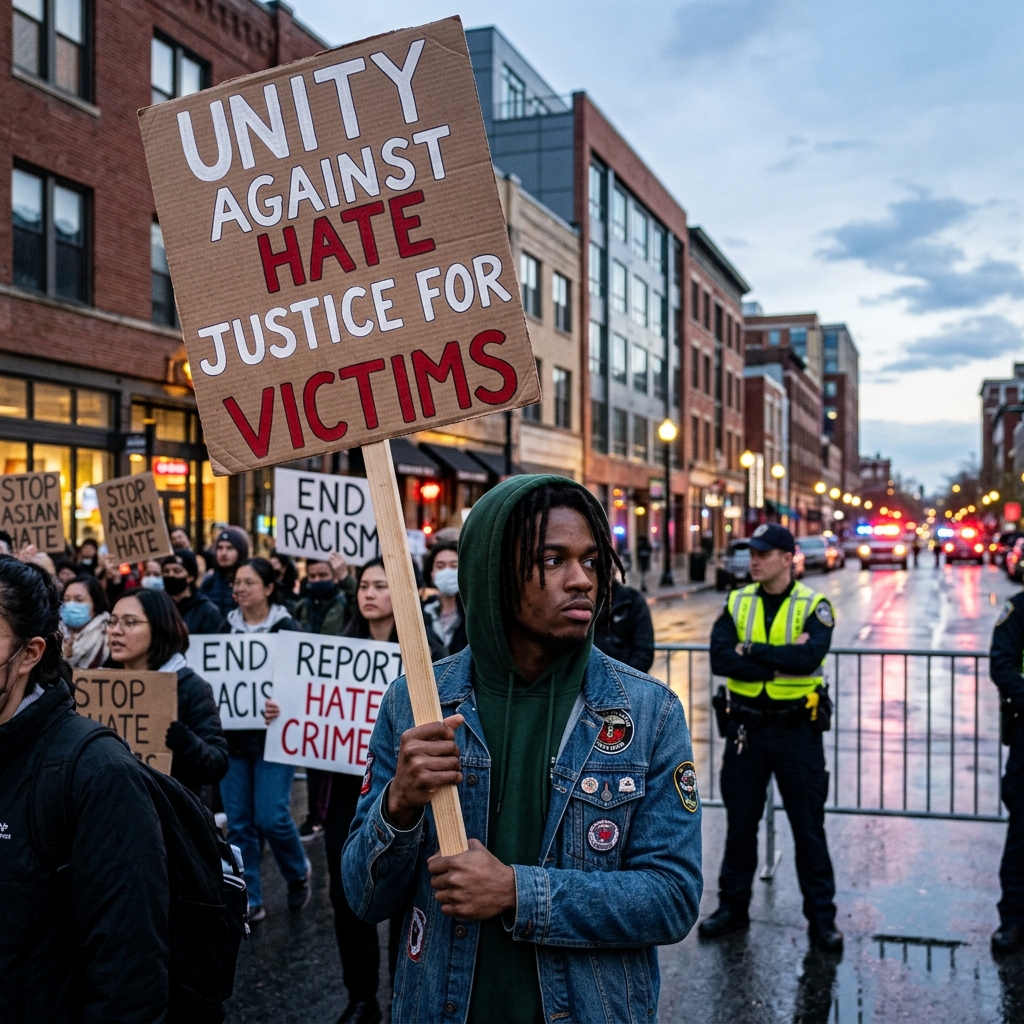
Hateful words and violent acts often happen together, leaving victims and bystanders wondering whether the incident is more than “just” an assault or “only” offensive speech. The answer matters, because labeling an offense as a hate crime can dramatically change how it is investigated, prosecuted, and punished.
This article explains how U.S. law generally treats racial slurs and assault, when they cross the line into a hate crime, and how that differs from non-criminal hate incidents and racial harassment. It is intended for informational and educational purposes and is not legal advice.
Understanding the Core Legal Concepts
What Is a Hate Crime?
Across U.S. law, a hate crime is not a completely separate type of offense; it is usually a traditional crime such as assault, vandalism, or threats, combined with a specific bias motivation. At the federal level, the U.S. Department of Justice defines a hate crime as a criminal act committed because of the victim’s actual or perceived race, color, religion, national origin, sexual orientation, gender, gender identity, or disability.
A widely used formulation is:
- A crime (for example, assault, threats, property damage), plus
- A motive based on bias against a legally protected characteristic,
which together make a hate crime.
What Is Hate Speech?
In the United States, there is no single legal definition of “hate speech” and much of what people call hate speech is protected by the First Amendment. The American Library Association describes hate speech as expression that vilifies, humiliates, or incites hatred against a group based on characteristics such as race, religion, or sexual identity.
In practice, this means that:
- Deeply offensive slurs can still be protected speech if they do not directly involve threats or criminal acts.
- Governments generally do not criminalize hate speech by itself, but may enhance penalties when crimes are committed with a hateful motive.
Hate Crime vs. Hate Incident
Law enforcement agencies increasingly distinguish between hate crimes and bias or hate incidents. The U.S. Department of Justice defines a bias or hate incident as an act of prejudice that does not involve violence, threats, or property damage and therefore does not meet the legal definition of a crime.
As one prosecutorial office explains, if someone uses a racial slur without committing another offense, the event is typically treated as a “hate incident” rather than a hate crime. The distinction affects whether criminal charges are available, and what kind of support or reporting mechanisms may be used.
Protected Characteristics and Bias Motivation
Commonly Protected Characteristics
Specific protected categories vary slightly by jurisdiction, but many laws follow a similar pattern. Federal law and numerous state provisions cover bias based on characteristics such as:
- Race or color
- Religion or creed
- National origin or ancestry
- Ethnicity
- Gender and gender identity
- Sexual orientation
- Disability (mental or physical)
Some state statutes, such as those in Washington and California, explicitly list these and other characteristics in their hate crime definitions.
How Bias Motivation Is Proven
A central challenge in hate crime cases is proving that bias based on one of these characteristics was a motivating factor. Prosecutors may use evidence such as:
- Words spoken during or immediately before the crime (for example, racial or religious slurs).
- Symbols or conduct associated with bias (such as burning a cross or displaying extremist insignia).
- Prior statements, social media posts, or patterns of behavior suggesting prejudice.
- The circumstances of the offense (for example, targeting a victim because of their appearance or location such as a house of worship).
Some state laws explicitly allow courts to infer intent from certain actions. For instance, Washington’s hate crime statute permits an inference of bias motivation when a person burns a cross on someone’s property because of the victim’s perceived heritage.
Assault, Racial Slurs, and the Hate Crime Threshold
Is Using a Racial Slur by Itself a Hate Crime?
In most U.S. jurisdictions, words alone, even repugnant racial slurs, do not automatically constitute a hate crime if they are not accompanied by threats, violence, or other criminal conduct.
Key points include:
- Hate speech that does not include a true threat, incitement, or criminal act is generally protected by the First Amendment.
- Many state statutes explicitly state that “words alone” are not enough unless the circumstances make the words a threat.
- Prosecutors and law enforcement often categorize such conduct as a “hate incident” rather than a crime, though it may still violate workplace or school policies.
When Assault and Slurs Together Become a Hate Crime
The legal picture changes significantly when racial slurs accompany a physical attack or credible threats. If a person assaults another while using bias-based language that shows the victim was targeted because of their race or another protected characteristic, the assault may qualify as a hate crime.
For example, under some state laws:
- Assault motivated in whole or in part by the victim’s race or national origin may be charged as a hate crime offense.
- Threatening a specific person or group while expressing racial animus, and placing them in reasonable fear of harm, can meet the definition of a hate crime.
- Property damage (such as vandalizing a home with racist graffiti) can be treated as a hate crime if bias motivation is proven.
In practice, courts look at the totality of circumstances: the language used, the conduct, the setting, and any prior interactions. The presence of slurs during an assault often serves as strong evidence of bias motivation, but prosecutors still need to show that the victim was targeted because of a protected characteristic, not merely cursed in the heat of a dispute.
Comparing Different Legal Outcomes
| Scenario | Likely Classification | Key Legal Consideration |
|---|---|---|
| Person yells a racial slur at a stranger and walks away. | Bias or hate incident (not a crime in many jurisdictions). | No assault, no threat, speech generally protected. |
| Person punches someone while repeatedly using racial slurs. | Assault potentially charged as a hate crime. | Physical attack plus bias motivation indicated by slurs. |
| Person threatens to beat or kill someone because of their race. | Criminal threat; may qualify as a hate crime. | True threat combined with clear bias-based motive. |
| Person vandalizes a home with racist symbols and language. | Property crime potentially treated as a hate crime. | Damage to property plus targeted bias against protected group. |
How Different Jurisdictions Define Hate Crimes
Federal Approach in the United States
At the federal level, hate crime statutes focus on crimes motivated by bias against specific protected characteristics such as race, color, religion, national origin, sexual orientation, gender, gender identity, or disability. The federal government often becomes involved when the crime affects interstate commerce, occurs on federal property, or implicates particular federal laws.
Federal authorities emphasize that “hate” itself is not illegal; only crimes motivated by bias qualify. The underlying offense might be assault, arson, vandalism, or conspiracy to commit such acts.
State-Level Examples
States implement their own hate crime statutes, which generally mirror federal principles but differ in wording and scope. A few illustrative examples include:
- Washington: The state defines a hate crime offense as maliciously and intentionally assaulting, damaging property, or threatening someone in whole or in part because of the victim’s race, color, religion, ancestry, national origin, gender, sexual orientation, gender identity or expression, or disability. Words alone are not a hate crime unless the context makes them a threat.
- California: State law defines a hate crime as a criminal act or attempted criminal act motivated in whole or in part by the victim’s membership in a protected class, including race, religion, national origin, disability, gender, or sexual orientation. Discriminatory or offensive conduct that does not rise to a criminal act is not classified as a hate crime.
- Massachusetts: The state describes a hate crime as a felony or misdemeanor motivated by the perpetrator’s prejudice based on characteristics such as race, color, religion, national origin, sexual orientation, or disability.
While terminology varies, the core idea is consistent: a crime becomes a hate crime when prejudice against a protected characteristic significantly motivates the offense.
Racial Harassment, Civil Rights, and Non-Criminal Remedies
Racial Harassment Under Human Rights Laws
Even when racial slurs and hostile behavior do not meet the threshold of a criminal hate crime, they may still amount to racial harassment under civil rights and human rights statutes. For example, the Ontario Human Rights Commission defines racial harassment as bothering, threatening, or treating someone unfairly because of their race, ancestry, ethnic origin, creed, or citizenship.
Typical contexts include:
- Workplaces, where repeated racial slurs or hostile behavior may violate employment and human rights laws.
- Housing, where tenants may be protected from racially hostile conduct from landlords or other residents.
- Schools or public services, where policies and laws protect against discriminatory harassment.
In these settings, victims may pursue remedies through human rights tribunals, internal complaint procedures, or civil litigation, even if criminal charges are not filed.
Difference Between Criminal and Civil Responses
The distinction between hate crimes and racial harassment can be summarized as follows:
- Criminal response: Focuses on punishment (jail, fines, probation) when a bias-motivated offense such as assault or threats occurs.
- Civil or administrative response: Aims at stopping discriminatory conduct, compensating victims, and changing institutional practices where harassment or hate incidents occur.
Both systems may operate simultaneously. For instance, a racially motivated assault might lead to criminal hate crime charges while also giving rise to a civil lawsuit or employment-related consequences.
Legal Consequences of Hate Crime Classification
Enhanced Penalties
Many jurisdictions treat hate crimes more severely than comparable non-bias offenses. This can mean longer sentences, higher fines, or enhanced charges. For example, some states classify certain hate crimes as felonies and allow longer prison terms when assault or threats are motivated by bias.
Common consequences include:
- Misdemeanor hate crimes: Up to a year in local jail, fines, and probation terms.
- Felony hate crimes: Multi-year prison sentences, especially when the crime involves serious injury, weapons, or repeated conduct.
- Additional sanctions: Restitution to victims, mandatory counseling, or community service requirements.
Civil Liability and Restitution
Victims of hate crimes may have civil legal options beyond the criminal case. They can sometimes sue perpetrators for damages such as emotional distress, pain and suffering, and lost income. Courts also frequently order restitution for property damage or medical expenses as part of criminal sentencing.
From a victim’s perspective, it is important to consult a legal professional or victim advocacy organization to understand both criminal and civil options after an assault accompanied by racial slurs.
Practical Guidance for Victims and Witnesses
Steps to Take After an Incident
If you experience or witness an assault or threat involving racial slurs or other bias indicators, practical steps may include:
- Ensure safety first: Move to a safe location and seek medical assistance if needed.
- Contact law enforcement: Report the incident to the police, especially where violence, credible threats, or property damage occurred.
- Document the event: Record details such as the language used, the location, time, witnesses, and any injuries or damage.
- Notify relevant authorities: In workplaces, schools, or housing, report to managers, human resources, or landlords where appropriate.
- Seek support: Reach out to victim services, community organizations, or legal aid for guidance on next steps.
Why Reporting Matters
Federal, state, and local agencies rely on detailed reporting to understand the scope of hate crimes and bias incidents. The FBI and other bodies collect data to track patterns and inform policy responses. Reporting helps:
- Ensure appropriate charges and protections for victims.
- Identify hotspots where communities may need additional resources or outreach.
- Support broader efforts to combat bias, harassment, and violence.
Frequently Asked Questions
Does shouting a racial slur always make an assault a hate crime?
Not inevitably. Racial slurs during an assault can be powerful evidence of bias, but prosecutors still need to show that the victim was targeted because of their race or another protected characteristic. In some cases, slurs may be viewed as part of a personal dispute rather than the primary motive. Courts consider all surrounding facts before deciding whether to apply hate crime charges.
Can hateful speech be punished even without violence?
Generally, hateful speech alone is protected by the First Amendment unless it qualifies as a true threat, incitement to imminent lawless action, or another recognized exception. However, it may be subject to workplace discipline, school sanctions, or human rights complaints even if it does not lead to criminal charges.
What is the difference between a hate crime and a bias incident?
A hate crime involves a criminal act such as assault, vandalism, or threats, motivated by bias against a protected characteristic. A bias incident involves prejudice or offensive conduct that does not include violence, threats, or property damage and therefore does not meet the legal definition of a crime. Both are serious, but only the former leads to criminal prosecution.
Are laws against hate crimes constitutional?
Courts, including the U.S. Supreme Court and state supreme courts, have repeatedly upheld hate crime statutes as constitutional. These laws punish criminal acts and allow enhanced penalties when offenders are motivated by bias, rather than punishing mere speech or beliefs.
What should I do if racial harassment occurs at work or in housing?
Document the conduct, report it to someone in authority (such as human resources, a manager, or a landlord), and consider contacting a civil rights or human rights body for guidance. Where harassment makes you feel unsafe or leads to violence or threats, contacting law enforcement is appropriate.
References
- Learn About Hate Crimes — U.S. Department of Justice. 2023-05-01. https://www.justice.gov/hatecrimes/learn-about-hate-crimes
- RCW 9A.36.080 Hate crime offense — Washington State Legislature. 2023-07-25. https://apps.leg.wa.gov/rcw/default.aspx?cite=9A.36.080
- Understanding Hate Crimes: Legal Definitions and Consequences — Zachary MccCready Law. 2022-11-10. https://zacharymccreadylaw.com/blog/understanding-hate-crimes-legal-definitions-and-consequences/
- Hate Speech and Hate Crime — American Library Association, Office for Intellectual Freedom. 2021-09-15. https://www.ala.org/advocacy/intfreedom/hate
- Hate Crimes FAQs — San Diego County District Attorney. 2020-06-01. https://www.sdcda.org/helping/hate-crimes-faq.html
- Racial Harassment: Know Your Rights — Ontario Human Rights Commission. 2019-03-01. https://www.ohrc.on.ca/en/racial-harassment-know-your-rights-brochure
- Hate Crime Law in Massachusetts — Commonwealth of Massachusetts. 2018-10-18. https://www.mass.gov/news/hate-crime-law-in-massachusetts
Similar Articles








Read full bio of Sneha Tete




