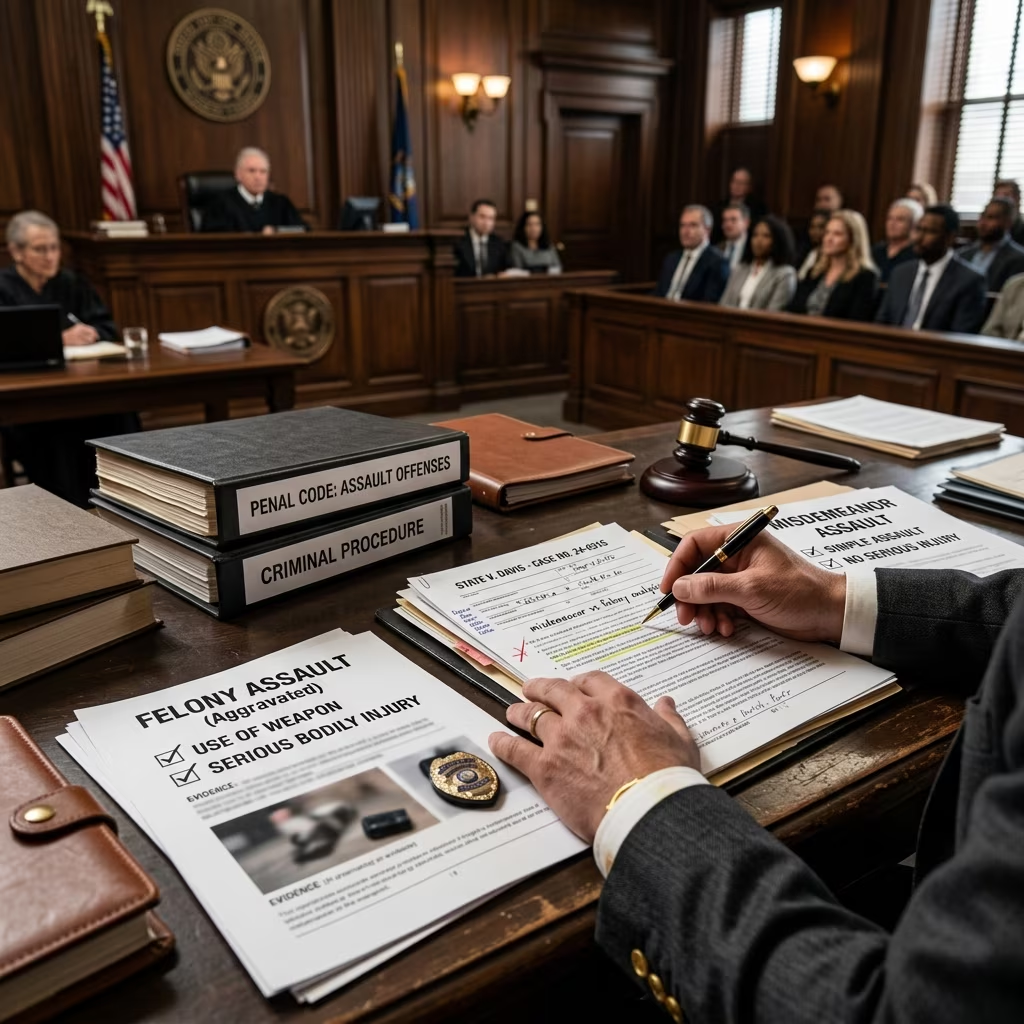
Whether an assault charge is treated as a misdemeanor or a felony depends on state law and the facts alleged by prosecutors. In most systems, the level of the offense turns on the amount of injury, the presence of a weapon, the status of the alleged victim, and whether the accused is said to have acted intentionally, knowingly, recklessly, or in a way that created a serious risk of harm.[10]
That distinction matters because it affects everything from jail exposure and fines to plea negotiations, collateral consequences, and whether the case is handled in lower or higher criminal court. In practical terms, even a charge described as “simple assault” can become much more serious if aggravating factors are present.[10]
How assault is usually classified
Across the United States, criminal offenses are commonly divided into misdemeanors and felonies based on punishment severity. A misdemeanor is generally an offense punishable by one year or less in jail, while a felony is typically punishable by more than one year in prison.[10]
States then layer their own assault statutes on top of that broad framework. Some states use one assault offense with several levels; others separate assault, battery, aggravated assault, and related offenses. The label matters less than the statutory elements, because the prosecutor must prove the facts that move the charge into a higher category.[10]
| Charge level | Typical features | Usual punishment range |
|---|---|---|
| Misdemeanor assault | Minor injury, threatened harm, or limited contact | Up to one year in jail, often with fines or probation |
| Felony assault | Serious injury, weapon use, protected victim, or extreme conduct | More than one year in prison, higher fines, and longer supervision |
What usually keeps assault in misdemeanor territory
Misdemeanor assault often involves conduct that is harmful or threatening but not especially severe. Examples may include a minor injury, an attempted strike that misses, a shove that causes brief pain, or conduct that places another person in immediate fear of being hit.[10]
Some states also treat lower-level assaults as misdemeanors when there is no serious bodily injury and no deadly weapon is involved. In Texas, for example, assault may be a misdemeanor when it involves bodily injury or threatening harm, while more dangerous facts can elevate the case to a felony.
- The injury is minor rather than serious.
- No weapon is alleged.
- The complainant is not in a specially protected category.
- The accused is alleged to have caused fear, not lasting harm.
- The incident lacks facts showing extreme violence or repeated injury.
What can turn assault into a felony
Aggravating facts are what most often push an assault case into felony territory. The most common examples are serious physical injury, use of a deadly or dangerous weapon, attacks on protected individuals, or conduct that shows a substantial disregard for human safety.
Kentucky law illustrates this grading system clearly. Fourth-degree assault is a misdemeanor, while first-, second-, and third-degree assault are felonies based on the seriousness of the injury, the use of a weapon, or the identity of the victim.
- Serious bodily injury or injury with permanent effects.
- Use of a firearm, knife, or other dangerous instrument.
- Assault on police officers, firefighters, teachers, correctional staff, or other protected workers.
- Assault involving family violence or a domestic relationship, where state law increases penalties.
- Conduct tied to another felony, such as robbery or sexual assault.
Why the victim’s status can matter so much
Many states increase assault penalties when the alleged victim is a public servant, peace officer, emergency responder, healthcare worker, child, or other protected person. Ohio and Kentucky both show how a lower-level offense can be elevated when the victim falls into a protected category.
The reason is policy-based: legislatures often decide that attacks on people performing public or vulnerable roles deserve greater punishment. That means a case that might otherwise be charged as a misdemeanor can become a felony even if the injury itself is not extensive.
The role of injury severity
Injury level is one of the most important factors in charging decisions. A scratch, bruise, or temporary soreness may support a misdemeanor charge in many jurisdictions, while broken bones, serious lacerations, loss of function, or injuries creating a risk of death can support felony allegations.[10]
Some statutes do not require permanent harm for a felony. Instead, prosecutors may rely on the risk created by the conduct, the degree of pain, or the use of a weapon. This is why the same physical act can be treated very differently depending on the jurisdiction and the medical evidence.[10]
How prosecutors decide what to file
Charging decisions are usually made after reviewing police reports, witness statements, body-camera footage, medical records, and any available physical evidence. Prosecutors then compare the facts to the state statute and choose the lowest offense that can still be proven, or a higher offense when aggravating facts are strong.[10]
That decision may also depend on local office policy, the defendant’s criminal history, whether the alleged act was spontaneous or planned, and whether there are negotiation opportunities. A case with weak evidence of injury may begin as a felony accusation and later be reduced, but the reverse can also happen when new evidence appears.[10]
Possible penalties and collateral consequences
Penalties vary widely by state, but misdemeanor assault commonly carries up to one year in jail, probation, counseling, community service, and fines. Felony assault can bring multi-year prison terms, larger fines, post-release supervision, and a permanent record that affects employment, licensing, housing, and firearms rights.[10]
The difference is not only about the sentence after conviction. A felony label can affect bail, pretrial release conditions, immigration consequences, and the availability of diversion programs. Even a misdemeanor assault conviction may create significant problems if the charge involves domestic violence or another category with special legal consequences.[10]
Common defenses and charge-reduction strategies
Defenses depend on the evidence, but assault cases often turn on identity, intent, self-defense, accident, or lack of injury. If the accused acted to protect themselves, did not start the confrontation, or reasonably believed force was necessary, the charge may be reduced or dismissed depending on state law.
Other cases may involve mistaken witness accounts, exaggerated injury claims, or insufficient proof that the defendant caused the harm. Defense counsel may also challenge whether the alleged victim qualifies as a protected person, whether the injury meets the statutory threshold, or whether the state can prove the required mental state beyond a reasonable doubt.[10]
- Self-defense or defense of others.
- Accident or lack of intent.
- Insufficient evidence of bodily injury.
- Misidentification or unreliable witness testimony.
- Improper elevation of the charge under state law.
Why state law changes the answer
There is no single national rule for assault classification. One state may treat a basic physical confrontation as a misdemeanor, while another may classify similar conduct differently because of how its statute defines injury, weapon use, or protected victims.
That is why legal advice must be grounded in the specific state statute and the charging document. A person charged with assault in one state may face a very different legal outcome than someone charged with similar facts somewhere else.[10]
Questions people often ask about assault charges
Can a first-time assault charge still be a felony?
Yes. A first arrest does not prevent a felony charge if the facts show serious injury, a weapon, or another aggravating factor. Prior record may matter, but it is not required for a felony filing.[10]
Does minor contact always count as assault?
No. Minor contact may lead to a charge only if the statute covers offensive touching, injury, or the creation of reasonable fear. The legal definition varies by state, so the same conduct may be criminal in one place and noncriminal in another.[10]
Can an assault charge be reduced from felony to misdemeanor?
Yes. Reduction can happen through plea bargaining, new evidence, witness problems, or proof that the facts do not support the higher level of harm. The likelihood depends on the state statute and the strength of the evidence.[10]
Do assault convictions affect more than jail time?
Yes. A conviction can affect employment, licensing, custody disputes, immigration status, firearm possession, and future sentencing. Those collateral effects can be as important as the direct penalty.[10]
What to do after being charged
If you are charged with assault, the most important step is to understand exactly what the complaint alleges. The words used in the charging instrument may determine whether the offense is treated as a misdemeanor or felony, and they may reveal what the prosecutor believes can be proven.[10]
It is also wise to preserve evidence quickly. Text messages, surveillance video, medical records, photographs, and witness contact information can matter greatly in a case where the difference between misdemeanor and felony depends on injury level or intent.[10]
Because assault statutes are highly state-specific, a defense attorney can evaluate whether the charge is overstated, whether a reduction is realistic, and whether early negotiation can limit long-term consequences. In many cases, prompt legal intervention makes a meaningful difference in both the classification and the final result.[10]
FAQs
Is assault always a felony?
No. Many assault cases are misdemeanors, especially when the alleged injury is minor and no weapon or protected victim is involved.[10]
What is the biggest factor in deciding the charge level?
Serious injury, weapon use, and the victim’s status are usually the most important factors, though each state’s statute is different.[10]
Can verbal threats count as assault?
In some states, yes. Some statutes cover conduct that places another person in reasonable fear of harm even if no physical contact occurs.[10]
Does a misdemeanor assault conviction stay on your record?
Usually, yes, unless it is later sealed, expunged, or set aside under state law. Availability of relief varies widely by jurisdiction.[10]
References
- Legal Classification of Criminal Offenses — Justia. 2024-01-01. https://www.justia.com/criminal/classification/
- Misdemeanor vs. Felony Assault in Texas Key Differences — McCarty Larson Law. 2025-01-01. https://www.mccartylarson.com/misdemeanor-vs-felony-assault-in-texas-key-differences/
- Florence Assault Lawyer — Busald Funk Zevely PSC. 2025-01-01. https://bfzlaw.com/florence-criminal/assault-lawyer/
- The Difference Between Felony and Misdemeanor Assault — Drew Cochran Law. 2024-06-03. https://www.drewcochranlaw.com/2024/06/03/the-difference-between-felony-and-misdemeanor-assault/
- Assault and Battery Charges in Ohio: Laws, Penalties, and Defense — Meade Law Group. 2025-01-01. https://themeadelawgroup.com/blog/assault-battery-laws-ohio/
- Misdemeanor vs. Felony Assault in North Carolina — Koontz Law. 2025-01-01. https://www.koontzlawnc.com/the-difference-between-misdemeanor-and-felony-assault-in-north-carolina
- Understanding Misdemeanor Versus Felony Assault — ATL Not Guilty. 2025-04-01. https://atlnotguilty.com/2025/04/understanding-misdemeanor-versus-felony-assault/