
Assault Charges in Texas: Definitions, Penalties, and Practical Guidance
Understand how Texas law defines assault, the range of penalties, and what factors can turn a minor incident into a serious felony.
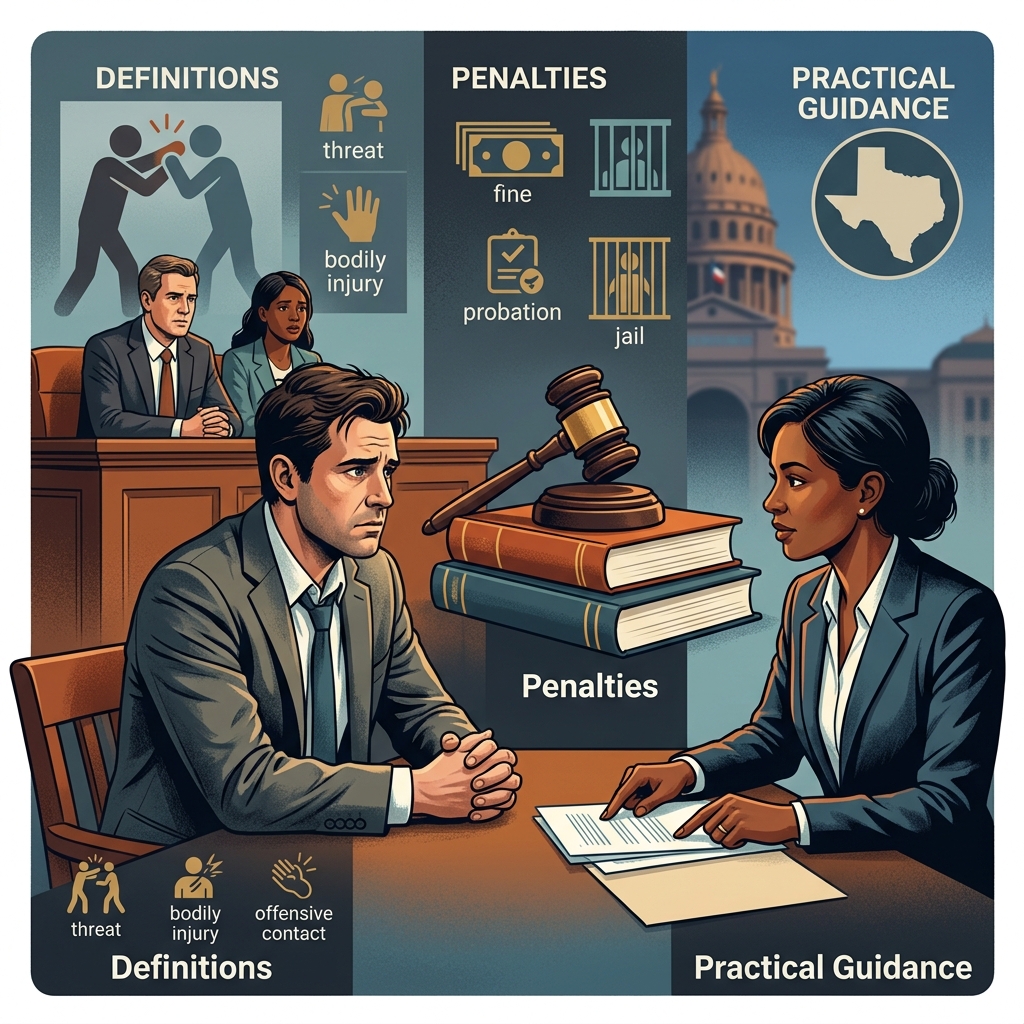
Assault law in Texas reaches far beyond violent attacks that cause serious injury. Under the Texas Penal Code, a person can face an assault charge for causing bodily injury, for making a credible threat of harm, or even for physical contact that another person finds offensive. Because these laws cover conduct ranging from a minor misunderstanding to life-threatening violence, understanding how assault is defined and punished is critical for anyone living or working in Texas.
How Texas Law Defines Assault
The primary statute governing assault in Texas is Texas Penal Code § 22.01. This provision sets out three core ways a person can commit assault:
- Causing bodily injury to another person, including a spouse.
- Threatening another with imminent bodily injury.
- Causing physical contact with another when the actor knows or should reasonably believe the other will regard the contact as offensive or provocative.
Importantly, the law focuses on whether the conduct is intentional, knowing, or reckless, rather than requiring that the actor specifically planned a criminal outcome. This makes seemingly minor and spontaneous conduct potentially criminal if injury or offensive contact occurs.
Understanding Key Legal Terms
Texas assault law relies on several legal concepts that are essential to interpreting the statute:
- Intentionally – Acting with the conscious objective or desire to cause a particular result, such as injury.
- Knowingly – Acting with awareness that conduct is reasonably certain to cause a particular result.
- Recklessly – Consciously disregarding a substantial and unjustifiable risk that bodily injury will occur.
- Bodily injury – Broadly defined under Texas law to include physical pain, illness, or any impairment of physical condition.
Because “bodily injury” is defined broadly, even temporary pain or minor impairment, without visible marks, can be enough for an assault charge.
Three Main Forms of Assault in Texas
Most assault charges in Texas fall into three general categories: assault causing bodily injury, assault by threat, and assault by offensive or provocative contact.
Assault Causing Bodily Injury
Assault causing bodily injury occurs when someone intentionally, knowingly, or recklessly causes bodily injury to another. Common examples include hitting, pushing, or striking another person in a way that causes pain or physical impairment.
In typical cases where the victim is not a protected class and the injury is not severe, this offense is charged as a Class A misdemeanor. Penalties can include:
- Up to 1 year in county jail.
- Up to $4,000 in fines.
- Both jail time and fines, plus potential probation and other court conditions.
Assault by Threat
Assault by threat occurs when a person intentionally or knowingly threatens another with imminent bodily injury, including a spouse. No physical contact or actual injury is required. The key issue is whether the victim could reasonably perceive the threat as imminent and credible.
As a starting point, assault by threat is generally treated as a Class C misdemeanor, carrying:
- Up to $500 in fines.
- No jail time for the base Class C misdemeanor itself.
However, the charge can be enhanced depending on who the alleged victim is and the circumstances surrounding the threat.
Assault by Offensive or Provocative Contact
Assault by offensive contact involves intentionally or knowingly making physical contact with another person when the actor knows or should reasonably believe that the other will regard the contact as offensive or provocative. Importantly, the law focuses on the victim’s perspective and the actor’s awareness of how the contact will be perceived.
This type of assault is commonly charged as a Class C misdemeanor, similar to assault by threat, with fine-only penalties up to $500 for a basic offense.
Simple Assault vs. Aggravated Assault
Texas law distinguishes between simple assault and aggravated assault based on the severity of harm and the presence of weapons or aggravating circumstances.
Simple Assault
“Simple assault” is a broad term covering conduct charged under Penal Code § 22.01 that does not meet the requirements for aggravated assault. It can involve:
- Bodily injury that is not serious or life-threatening.
- Threats of imminent bodily harm.
- Offensive or provocative contact.
Depending on the specifics, simple assault can range from a Class C misdemeanor (offensive contact or certain threats) up to a second-degree felony when enhancements are present.
Aggravated Assault
Aggravated assault is defined under Texas Penal Code § 22.02, which elevates an assault to aggravated status when either of the following is proven:
- The assault causes serious bodily injury to another person, including a spouse.
- The assault involves the use or exhibition of a deadly weapon during the commission of the assault.
Under default rules, aggravated assault is a second-degree felony, but the offense can be enhanced to a first-degree felony when certain protected victims or aggravating circumstances are involved.
Penalties for aggravated assault can include:
- Second-degree felony: 2 to 20 years in prison and up to $10,000 in fines.
- First-degree felony: 5 years to life imprisonment and up to $10,000 in fines.
Aggravated assault charges are frequently filed in cases involving firearms, knives, or other deadly weapons, or when injuries create a substantial risk of death, permanent disfigurement, or long-term loss of function.
Misdemeanor vs. Felony Assault in Texas
Assault charges in Texas span from fine-only misdemeanors to life-imprisonment felonies. The level of the charge depends on the nature of the conduct, the injury, the relationship between the parties, and whether aggravating factors are present.
Overview of Penalty Ranges
| Offense Level | Typical Scenario | Max Fine | Confinement Range |
|---|---|---|---|
| Class C misdemeanor | Threats or offensive contact without injury | Up to $500 | No jail time (for base offense) |
| Class A misdemeanor | Bodily injury without aggravating factors | Up to $4,000 | Up to 1 year in county jail |
| Third-degree felony | Assault involving certain protected victims or enhancements | Up to $10,000 | 2 to 10 years in prison |
| Second-degree felony | Aggravated assault (serious injury or deadly weapon) | Up to $10,000 | 2 to 20 years in prison |
| First-degree felony | Aggravated assault against certain protected individuals | Up to $10,000 | 5 years to life imprisonment |
Factors That Increase Assault Penalties
While basic definitions set the starting point for an assault charge, numerous circumstances can enhance the level of the offense and the potential penalties. These include the victim’s status, the relationship between the parties, and the severity of the harm.
Protected Victims and Enhanced Charges
Texas law provides elevated protections for certain classes of victims, such as:
- Public servants acting in their official capacity.
- Family members, household members, and intimate partners in domestic violence cases.
- Elderly or disabled individuals, who receive enhanced protections and higher penalty ranges.
- Security officers and emergency responders.
When assault is committed against these protected individuals, the offense may be elevated from a misdemeanor to a felony, or from a lower-degree felony to a higher-degree felony, even when the underlying conduct is similar.
Use of Deadly Weapons
Use or exhibition of a deadly weapon dramatically increases the seriousness of an assault. In Texas, a deadly weapon includes not only firearms and knives but also other objects used in a manner capable of causing death or serious bodily injury.
Where a deadly weapon is involved:
- A simple assault can be reclassified as aggravated assault.
- Aggravated assault charges often start at the second-degree felony level and may be enhanced to first-degree felony in specific circumstances.
Serious Bodily Injury
Another key aggravating factor is serious bodily injury. Under Texas law, serious bodily injury refers to injuries that create a substantial risk of death, cause permanent disfigurement, or result in long-term loss or impairment of a bodily organ or function.
When serious bodily injury is present, an otherwise simple assault can be charged as aggravated assault, resulting in substantially higher penalty ranges.
Collateral Consequences of an Assault Conviction
Beyond fines and incarceration, an assault conviction can have long-lasting consequences in many areas of life. These collateral effects often include:
- Criminal record impacting future employment, housing, and professional licensing.
- Immigration consequences for non-citizens, especially in cases involving violence or weapons.
- Loss of firearm rights in certain family-violence and felony convictions.
- Restraining or protective orders affecting where a person can live or work and who they may contact.
Because many assault charges arise from heated moments, the long-term consequences are often not apparent at the time of the incident. This makes early legal guidance particularly important.
Common Questions About Assault in Texas (FAQs)
1. Can I be charged with assault even if no one was physically injured?
Yes. Assault by threat and assault by offensive or provocative contact do not require proof of physical injury. A credible threat of imminent harm or physical contact that is knowingly offensive can be enough for a charge.
2. What is the difference between a Class C and Class A assault charge?
Class C misdemeanor assault typically involves threats or offensive contact and is punishable by a fine up to $500 with no jail time for the base offense. Class A misdemeanor assault involves bodily injury without aggravating factors and can carry up to one year in county jail and a fine up to $4,000.
3. When does an assault become a felony in Texas?
An assault becomes a felony when certain aggravating factors are present, such as assault against a protected victim, involvement of a deadly weapon, or serious bodily injury. Depending on those circumstances, the offense may be charged as a third-degree, second-degree, or first-degree felony.
4. How serious are aggravated assault charges?
Aggravated assault is among the more serious violent offenses under Texas law. Penalties range from 2 to 20 years in prison for a second-degree felony and may extend from 5 years to life for a first-degree felony, plus fines that can reach $10,000.
5. Does an assault conviction always mean jail time?
Not necessarily. While higher-level misdemeanors and felonies carry potential jail or prison time, courts may impose probation, community supervision, or other alternatives in some cases. However, the availability of non-custodial options depends on the seriousness of the offense, prior criminal history, and other case-specific factors.
Practical Tips for Navigating Assault Allegations
Because assault charges can escalate quickly and involve complex factual disputes, individuals who are under investigation or have been arrested should consider the following practical steps:
- Do not discuss the incident with law enforcement beyond identifying information until speaking with counsel; statements can be used as evidence.
- Preserve any evidence that may be relevant, including text messages, videos, photographs, or witness contact information.
- Understand the range of potential charges, from Class C misdemeanors to felonies, so that plea discussions or defense strategies are informed.
- Consider long-term consequences, not just immediate penalties, when evaluating options such as plea agreements.
Texas assault law is intentionally broad to address a wide spectrum of conduct. The same statute can apply to a minor shove or to a violent attack with a weapon. The outcome often depends on factual details and legal nuances, making professional legal guidance essential.
References
- Texas Penal Code § 22.01 – Assault — Texas Legislature. 2023-01-01. https://statutes.capitol.texas.gov/Docs/PE/htm/PE.22.htm
- Texas Penal Code § 22.02 – Aggravated Assault — Texas Legislature. 2023-01-01. https://statutes.capitol.texas.gov/Docs/PE/htm/PE.22.htm#22.02
- Assault: Texas Penal Code §22.01 — Saputo Law Firm. 2024-03-01. https://saputo.law/criminal-law/texas/assault/
- Assault in Texas Explained — Versus Texas (Law Office of Trey Porter). 2023-09-15. https://versustexas.com/assault-in-texas/
- Texas Assault Laws: Guide for Legal Defense in 2025 — Barnett Howard & Williams PLLC. 2025-02-10. https://www.bhwlawfirm.com/tag/assault/
- How Long Do You Go to Jail for Assault in Texas? — Warren & Migliaccio, L.L.P. 2023-06-20. https://www.wm-attorneys.com/how-long-do-you-go-to-jail-for-assault-in-texas/
- How Do the Texas Assault Laws Work? — Thiessen Law Firm. 2024-05-01. https://www.thetexastrialattorney.com/blog/texas-assault-laws/
Similar Articles








Read full bio of Sneha Tete




