
Arizona Traffic Laws Every Driver Should Know
A practical overview of Arizona road rules, common violations, and driver responsibilities.
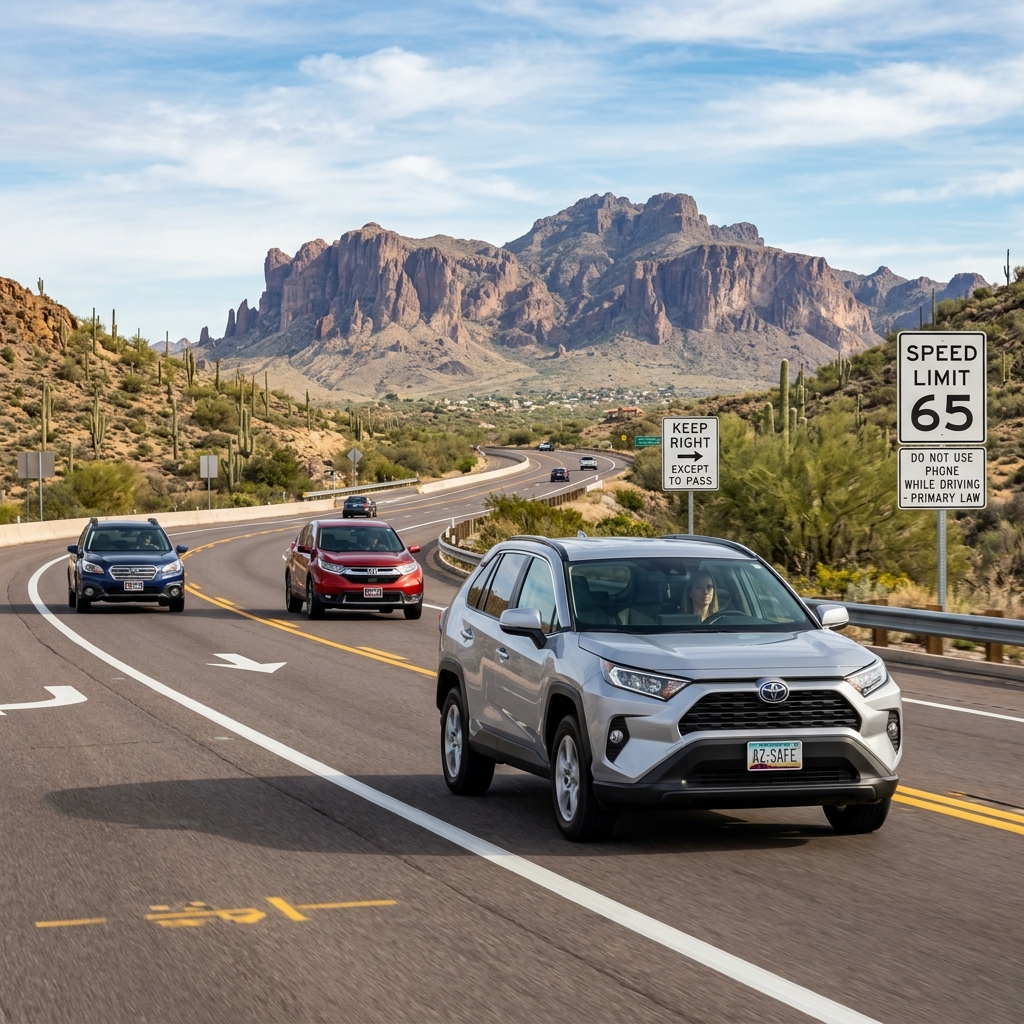
Arizona traffic rules are designed to keep roads predictable, reduce crashes, and protect people in vehicles, on bicycles, and on foot. For drivers, the most important lesson is that traffic laws are not just about avoiding tickets; they shape everyday decisions such as when to yield, where to pass, how fast to travel, and what to do after a collision.
This guide breaks down the major categories of Arizona road rules in plain language. It also highlights a few laws that surprise drivers, especially those who are new to the state or who only drive there occasionally.
How Arizona organizes traffic regulation
Arizona’s traffic code is part of Title 28 of the Arizona Revised Statutes, which covers transportation and vehicle regulation. That body of law includes rules for licensing, vehicle operation, safety duties, and enforcement standards. The state driver manual also explains practical rules that every motorist is expected to follow on public roads.
Most traffic enforcement begins with a simple idea: drivers must operate with reasonable care and must obey posted signs, roadway markings, and signal instructions. In practice, that means road users are expected to react to conditions around them, not just memorize a few isolated speed or lane rules.
Speed limits and basic pacing rules
Speed limits in Arizona vary by road type and by local posting. When no sign is posted, the state driver manual lists default limits such as 15 mph near a school crosswalk, 25 mph in business or residential districts, 55 mph on open highways or city freeways, 65 mph on designated open highways, and 75 mph on rural freeways.
Those numbers are only starting points. Posted signs always control when they differ from the default rule, and conditions such as traffic, weather, visibility, and road design can make a posted limit unsafe even when driving at or below the maximum allowed speed.
Drivers should also remember that speed is not judged only by a number on a sign. Arizona road rules expect motorists to travel at a speed that is reasonable for the conditions, which means a legally posted limit does not excuse unsafe driving in heavy rain, dense traffic, or other hazardous situations.
Lane use, passing, and keeping traffic moving
Arizona drivers are expected to use lanes in a way that supports orderly traffic flow. On multi-lane roads, the left lane is generally treated as a passing lane rather than a place to cruise indefinitely while slower traffic builds behind you. When a driver finishes passing, moving back to the right helps prevent congestion and reduces the risk of aggressive maneuvers by other motorists.
Passing rules are closely connected to safety. A driver who moves left to overtake another vehicle should make sure the maneuver can be completed without cutting off traffic, forcing another driver to brake suddenly, or entering a blind spot too quickly. The central idea is simple: pass decisively, then return to a travel lane when it is safe to do so.
Lane discipline also matters around freeway interchanges, merging zones, and multi-lane highways with heavy commuter traffic. In those settings, lingering in the wrong lane can create unnecessary conflict and make it harder for other vehicles to merge smoothly.
Right-of-way at intersections and crossings
One of the most common causes of traffic disputes is confusion about right-of-way. Arizona’s driver manual explains that drivers must yield at intersections when another vehicle has already entered the intersection, when two vehicles arrive at about the same time, and in other situations where the law assigns priority to one road user over another.
Pedestrians receive special protection. Drivers must yield to pedestrians in marked and unmarked crosswalks, and they must stop for school crossings when the crosswalk is occupied. Even when a traffic light changes to green, a driver still must watch for pedestrians and vehicles already in the intersection.
Those rules matter because intersections are dynamic. A green light does not erase the duty to look carefully, and a crosswalk does not stop being a crosswalk simply because there is no painted stripe on the pavement.
Emergency vehicles and the Move Over rule
Arizona law requires drivers to yield to emergency vehicles using sirens or flashing lights. The driver manual says motorists should move to the right and stop until the emergency vehicle has passed, then proceed only when it is safe.
The state also applies a Move Over rule when drivers approach stopped emergency vehicles or emergency personnel. If a lane change is possible, motorists should move over to create a buffer. If it is not possible to move over safely, they should slow down and continue with caution.
This is one of the most important safety rules on the road because roadside work zones, crash scenes, and emergency stops expose first responders and stranded motorists to serious risk. The purpose is not only to protect the emergency crew; it is also to reduce secondary collisions caused by distracted or impatient driving.
Distracted driving and electronic devices
Arizona has strong restrictions on handheld device use while driving. The state’s hands-free rules prohibit talking, texting, and other use of a standalone electronic device unless the driver is using it in hands-free mode.
In practical terms, drivers should not hold a phone or other device while operating a vehicle, including holding it between the head and shoulder. They should not read, write, send messages, browse the internet, or watch videos on a handheld device while driving.
Hands-free calling and some emergency uses remain allowed, but the basic message is clear: if a task requires sustained attention to a screen, it should not be done from the driver’s seat. Distraction delays reaction time and makes otherwise routine maneuvers, such as merging or stopping, much more dangerous.
DUI and impaired driving
Arizona treats impaired driving as a serious public safety issue. The state considers a motorist to be driving under the influence when the driver has a blood alcohol concentration of 0.08 or higher.
DUI enforcement is not limited to alcohol alone. Arizona’s broader enforcement framework also covers controlled substances and other impairment-related conduct through transportation and motor carrier rules, reflecting the state’s emphasis on keeping impaired operators off the road.
For drivers, the practical standard is straightforward: if alcohol, drugs, or a combination of substances can affect alertness, reaction time, coordination, or judgment, driving becomes dangerous very quickly. Arizona law responds to that danger with criminal penalties, license consequences, and other collateral effects.
Special Arizona rules that catch drivers off guard
Some traffic rules are so specific that new residents often do not learn about them until they are cited or involved in a crash. One well-known example is the “Stupid Motorist Law,” which can make drivers financially responsible for rescue or recovery costs when they knowingly drive around barriers or warnings into flooded areas.
Another example is the state’s broader approach to highway and off-highway vehicle safety. Recent reporting on Arizona’s highway-law changes has highlighted tighter rules for young drivers, helmet use for younger riders, and restrictions on open containers in off-highway vehicles. Those changes reflect the state’s continuing effort to reduce risk in settings where speed, inexperience, and limited protection can make injuries more severe.
Arizona also enforces vehicle-equipment and visibility rules. The state has restrictions related to vehicle lamps and lighting patterns, which are meant to prevent confusing or unsafe displays on highways. In addition, the driver manual and related statutes address equipment that helps a vehicle stay visible and roadworthy under ordinary driving conditions.
What to do after a crash
Traffic law becomes especially important after a collision. The first priorities are safety, emergency response, and documentation. Arizona drivers should stop, check for injuries, and contact law enforcement when required or appropriate. If anyone needs urgent care, medical attention should be sought immediately.
After the scene is secure, drivers should exchange information, take photos if possible, and preserve any official reports. A police report can be valuable later when insurance companies, courts, or repair shops need a factual record of what happened.
It is also wise to avoid making quick assumptions about fault at the scene. Crashes often involve overlapping issues such as speed, following distance, distracted driving, and right-of-way. Careful documentation usually matters more than a hurried explanation.
Common Arizona driving scenarios and the legal issue they raise
| Situation | Likely legal concern | Driver’s safest response |
|---|---|---|
| Approaching a crosswalk | Pedestrian right-of-way | Slow down and yield if anyone is in or entering the crossing |
| Driving in the left lane | Improper lane use | Pass only when needed, then return right when safe |
| Seeing flashing lights ahead | Move Over compliance | Change lanes if possible or reduce speed and pass carefully |
| Using a phone in traffic | Distracted driving | Use hands-free functions or wait until parked |
| Facing a flooded roadway | Flood-barrier compliance and rescue liability | Turn around and never bypass warning signs or barricades |
Why these rules matter beyond tickets
Traffic laws do more than create penalties. They create a shared system of expectations that helps drivers predict one another’s behavior. When people follow speed limits, yield correctly, move over for emergency vehicles, and put away handheld devices, the road becomes more manageable for everyone.
For that reason, even seemingly minor violations can have large consequences. A brief distraction can trigger a rear-end collision. A missed yield can injure a pedestrian. A lane-choice mistake can lead to road rage or a chain reaction crash. The legal rule and the safety lesson usually point in the same direction.
Frequently asked questions
Do I always have to stop for pedestrians in Arizona?
Yes. Drivers must yield to pedestrians in marked and unmarked crosswalks, and they must stop for an occupied school crossing.
Can I use my phone if I am only talking?
Arizona’s rules require hands-free use for electronic devices while driving, so holding a phone or otherwise manually operating it is not allowed in ordinary driving situations.
What is the easiest way to remember the left-lane rule?
Treat the left lane as a passing lane, not a place to remain when you are not overtaking slower traffic.
What should I do if an emergency vehicle approaches from behind?
Move right and stop if necessary so the vehicle can pass safely.
Does Arizona use a standard DUI alcohol limit?
Yes. A blood alcohol concentration of 0.08 or higher is the standard threshold described in Arizona driving-law materials.
Practical habits that keep you compliant
- Check posted signs before assuming a road has the default speed limit.
- Yield early at intersections instead of trying to “beat” another vehicle through.
- Move out of the left lane after passing.
- Keep your phone out of reach unless it is being used hands-free.
- Slow down well before school zones, crosswalks, and crash scenes.
- Never drive through flood barriers or warning signs.
- Pull over promptly when emergency lights or sirens are behind you.
References
- Arizona Driver License Manual — Arizona Department of Transportation, Motor Vehicle Division. 2024-01-01. https://apps.azdot.gov/files/mvd/mvd-forms-lib/99-0117.pdf
- Laws and Rules — Arizona Department of Transportation. 2026-01-01. https://azdot.gov/mvd/services/enforcement/new-entrant-program/laws-and-rules
- Arizona’s 2025 highway laws and key changes for drivers — Ramos Law. 2025-01-01. https://www.ramoslaw.com/arizonas-2025-highway-laws-and-key-changes-for-drivers-2/
- Arizona driving laws you should know — Phoenix Law Team. 2025-01-01. https://www.phoenixlawteam.com/blog/arizona-driving-laws/
- A.R.S. Title 28 – Arizona Revised Statutes — Arizona Legislature. 2026-01-01. https://www.azleg.gov/arsDetail/?title=28
Similar Articles








Read full bio of Sneha Tete


