
Arizona Prenuptial Agreements: Rights, Rules, and Practical Guidance
Understand how Arizona prenuptial agreements work, when they are enforceable, and how to draft a fair, legally sound contract.
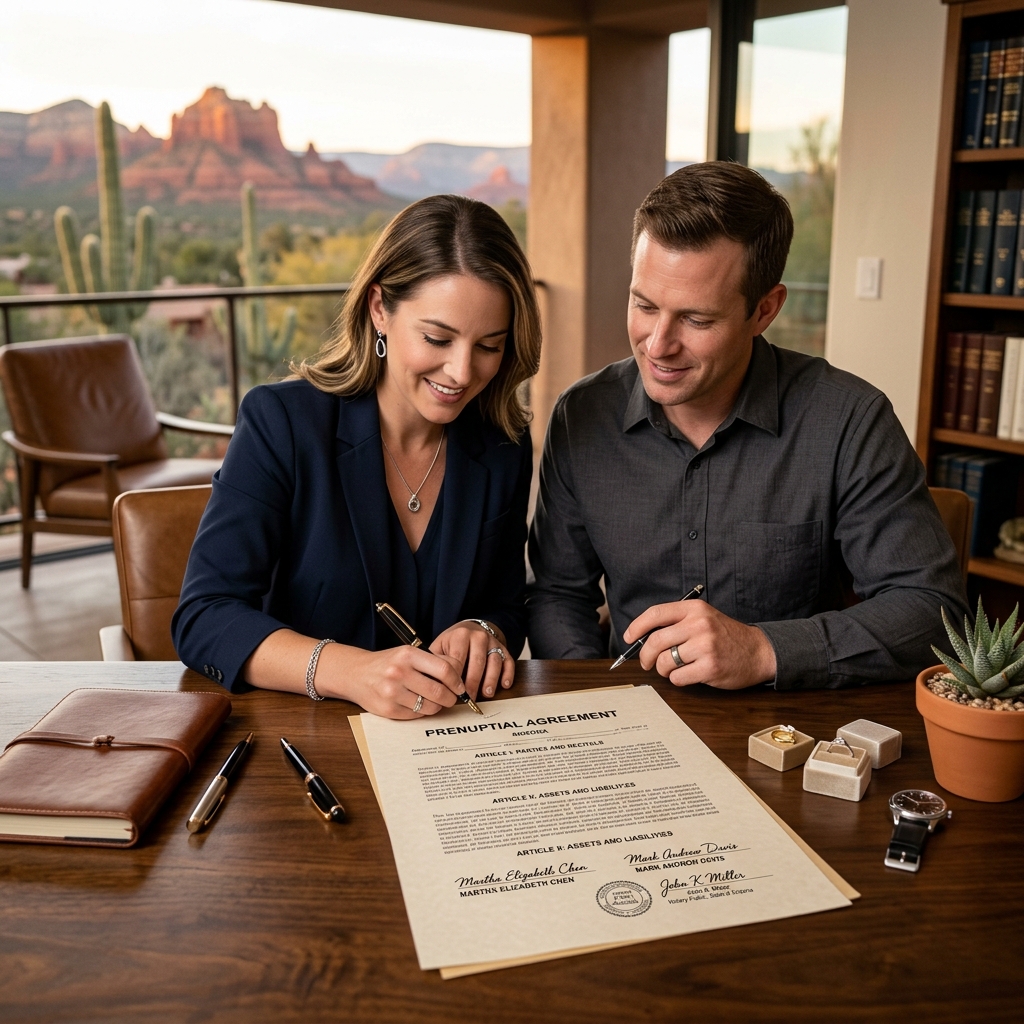
In Arizona, a prenuptial agreement (often called a premarital agreement or prenup) is a written contract that couples sign before marriage to define their financial rights and responsibilities during the marriage and if the relationship ends through divorce or death. Arizona law recognizes and enforces these agreements when they meet specific statutory requirements and basic fairness standards.
This guide explains how prenups work under Arizona law, what they can and cannot do, how they interact with community property rules, and practical steps for preparing a valid agreement that courts are more likely to uphold.
Overview: What a Prenup Does in Arizona
Arizona is a community property state, which means that, by default, most property and income acquired during marriage belongs equally to both spouses, regardless of who earned or titled it. A prenuptial agreement allows couples to change these default rules by deciding in advance how assets, debts, and financial obligations will be handled if the marriage ends.
Typical purposes of a prenup include:
- Protecting premarital assets, such as savings, real estate, or investments.
- Clarifying responsibility for premarital and future debts.
- Defining how income, business interests, and retirement accounts will be treated.
- Supporting estate planning goals, such as providing for children from prior relationships.
- Reducing financial uncertainty and conflict if divorce or death occurs.
| Topic | Without Prenup (Default Law) | With Prenup (If Valid) |
|---|---|---|
| Property acquired during marriage | Generally treated as community property to be divided equitably in divorce. | Can be designated as separate or divided according to agreed percentages. |
| Premarital assets | Usually remain separate, but disputes can arise about increases in value. | Can be clearly confirmed as separate and exclude growth or income from division. |
| Debt responsibility | Debts incurred during marriage may be treated as community obligations. | Prenup can assign responsibility for specific debts to one or both spouses. |
| Spousal support (alimony) | Determined by the court based on statutory factors. | May be limited or waived, subject to fairness and public-assistance rules. |
Core Legal Requirements for Arizona Prenups
Arizona follows the Uniform Premarital Agreement Act (UPAA), codified in Arizona Revised Statutes (A.R.S.) §§ 25‑201 to 25‑205. Under these statutes, several conditions must be met for a prenup to be enforceable.
Writing and Signatures
- The agreement must be in writing; verbal understandings are not enforceable.
- Both parties must sign the agreement before the marriage occurs.
- The contract becomes effective only when the couple marries.
Voluntary Agreement
Courts will not enforce a prenup that was signed because of duress, coercion, or other forms of pressure. The spouse who wants to challenge the agreement must prove they did not sign voluntarily.
Indicators of a voluntary agreement typically include:
- Reasonable time to review the document before the wedding.
- Opportunity to consult independent legal counsel.
- Absence of threats, ultimatums, or deception.
Fair and Reasonable Financial Disclosure
Arizona law requires a fair and reasonable disclosure of property and financial obligations before signing. Alternatively, a party can expressly waive additional disclosure in writing, but they must still have adequate knowledge of the other party’s finances.
Disclosure typically covers:
- Income from employment and investments.
- Real estate and major personal property.
- Business ownership interests.
- Existing debts, such as loans, credit cards, and tax liabilities.
- Retirement accounts and expected inheritances, if significant.
Unconscionability and Fairness
Even when formal requirements are met, a court can refuse to enforce a prenup if it was unconscionable—that is, extremely one‑sided or unfair—at the time it was signed. The issue of unconscionability is decided by the court as a matter of law.
Common risk factors for unconscionability include:
- Leaving one spouse with almost no property or support after a long marriage.
- Eliminating spousal support in a way that forces a spouse to rely on public assistance.
- Combining severely limited property rights with very limited support.
What Arizona Prenups Can Address
Within these statutory boundaries, couples have broad flexibility to tailor their financial arrangements. The law specifically allows prenups to control property rights and obligations during marriage and upon separation, divorce, or death.
Property and Income
- Classification of property as community or separate.
- Ownership of income earned during the marriage.
- Treatment of increases in value of premarital assets and business interests.
- Division of real estate, investments, and bank accounts if the marriage ends.
Debts and Financial Obligations
- Responsibility for existing debts at the time of marriage.
- Allocation of new debts incurred during the relationship.
- Protection from a spouse’s business or professional liabilities.
Spousal Support (Alimony)
Arizona law allows parties to modify or eliminate spousal support in a premarital agreement, but with a critical limitation: if the waiver or reduction of support would make one spouse eligible for public assistance at the time of divorce or separation, the court may require the other spouse to provide support to avoid that outcome.
In practice, this means that aggressive waivers of alimony may be partially or fully overridden if they create severe hardship.
Estate Planning Coordination
Many couples use prenups alongside wills, trusts, and beneficiary designations to achieve estate planning goals. A prenup can:
- Clarify what each spouse’s children will inherit.
- Ensure particular assets stay within one family line.
- Coordinate with trusts to manage business or investment property.
Important Limits: What a Prenup Cannot Do
Arizona law imposes several critical limits on premarital agreements. Attempting to include prohibited terms increases the risk that a court will disregard part or all of the contract.
Child Support and Child Custody
Parents cannot use a prenup to limit, waive, or predetermine child support or child custody rights and responsibilities. Courts must decide these issues based on the best interests of the child and statutory child support guidelines at the time of separation, not on the parents’ prior private agreement.
Terms Encouraging Divorce
Clauses that appear to encourage separation or divorce—for example, providing large financial bonuses if one spouse files for divorce—risk being struck down. Courts generally favor agreements that promote clarity and stability rather than incentivize marital breakdown.
Illegal or Public‑Policy‑Violating Provisions
No contract, including a prenup, can require conduct that violates law or strong public policy. Examples include:
- Waiving all rights to seek legal protection from domestic violence.
- Requiring unlawful tax schemes or hiding assets from creditors.
- Restricting a spouse’s right to seek child support.
Interaction with Arizona Community Property Law
Without a prenup, Arizona’s community property framework governs how assets and debts are classified and divided if a marriage ends. With a valid prenup, couples may override many of these default rules.
Key points about community property and prenups include:
- Property acquired during marriage is presumed community, but a prenup can change this presumption.
- Separate property generally remains separate, but a prenup can clarify gray areas, such as commingled funds.
- Courts will still review the agreement for validity and unconscionability before enforcing it.
Process: How Couples Typically Create an Arizona Prenup
While the statutes focus on enforceability rather than procedure, Arizona practitioners commonly recommend a structured approach to reduce later challenges.
Step 1: Decide Whether a Prenup Makes Sense
Couples often consider a prenup when any of the following apply:
- One or both spouses have substantial premarital assets or business interests.
- There are children from prior relationships to be provided for.
- One spouse expects a large inheritance or has complex family property.
- There is a significant imbalance in income or wealth between the partners.
Step 2: Consult Family Law Attorneys
Arizona law does not require each party to have a lawyer, but independent legal advice makes it easier to show that both understood the agreement and signed voluntarily. Separate counsel helps avoid conflicts of interest and can strengthen the agreement’s credibility in court.
Step 3: Exchange Full Financial Information
Before drafting terms, each partner should assemble and share a detailed picture of their financial situation:
- Recent tax returns and pay stubs.
- Bank, brokerage, and retirement account statements.
- Property deeds and loan documents.
- Lists of debts and contingent liabilities.
This exchange supports the statutory requirement of fair and reasonable disclosure and reduces the chance of later claims of concealment.
Step 4: Negotiate and Draft Terms
With full information on the table, the parties and their lawyers negotiate key provisions, such as:
- Division of property if the marriage ends within different time frames.
- Treatment of future business growth and investment gains.
- Limitations or waivers of spousal support, within legal constraints.
- Coordination with estate planning documents.
Clear language, internal consistency, and avoidance of overly complicated structures help make the agreement easier to understand and enforce.
Step 5: Execute the Agreement Properly
To align with Arizona law and best practices:
- Finalize and sign the agreement well before the wedding date, not at the last minute.
- Ensure it is in writing and signed by both parties.
- Consider having signatures notarized and witnessed, even though notarization is not strictly required by statute, as this can improve evidentiary reliability.
Challenging or Enforcing an Arizona Prenuptial Agreement
Disputes about prenups typically arise in divorce or legal separation. One spouse may seek enforcement, while the other argues that the agreement is invalid or unfair.
Grounds to Challenge a Prenup
Common arguments used to attack a prenup include:
- Lack of voluntary execution (coercion, pressure, or misunderstanding).
- Insufficient financial disclosure or lack of adequate knowledge of the other spouse’s assets and obligations.
- Unconscionability at the time the contract was signed.
- Procedural defects, such as signing after marriage instead of before.
Court Review and Partial Enforcement
Arizona courts may enforce part of an agreement even if they find certain provisions invalid. For example, a problematic spousal support clause may be severed while property division provisions remain effective, provided the rest of the agreement meets legal standards.
When a marriage is found void (for example, due to a legal impediment), a premarital agreement that would otherwise be valid may be enforced only to the extent necessary to avoid an inequitable result.
Frequently Asked Questions (FAQs)
Do Arizona prenups have to be notarized?
Arizona statutes require that a prenup be in writing and signed by both parties, but they do not explicitly mandate notarization. Nonetheless, many lawyers recommend notarization and witnesses to strengthen proof of execution and voluntariness.
Can we change our prenup after we get married?
Once married, couples cannot “redo” the original prenup, but they can enter into a postnuptial agreement to modify their financial arrangements going forward, subject to similar requirements of writing, voluntariness, disclosure, and fairness.
Will a prenup affect child support or custody in Arizona?
No. Arizona courts determine child support and custody based on current statutory guidelines and the child’s best interests, not on prior agreements between parents. Any attempt to restrict child support or custody in a prenup is likely to be disregarded.
Is a prenup right for couples with few assets?
Even couples without significant wealth sometimes use prenups to clarify expectations and protect against future disputes. However, the value of a prenup tends to increase as assets, debts, or legal complexity grow. A consultation with a family law attorney can help decide whether the benefits outweigh the time and cost in a particular situation.
What happens if we do not have a prenup?
If there is no prenup, Arizona’s community property laws and general divorce statutes will govern division of property and debts, as well as spousal maintenance decisions. Courts apply these default rules on a case‑by‑case basis, which can create less predictability than a well‑drafted agreement.
References
- Arizona Revised Statutes § 25-202: Enforcement of Premarital Agreements — Arizona State Legislature. 2024-01-01. https://www.azleg.gov/ars/25/00202.htm
- Understanding Prenuptial Agreements in Arizona Divorce Law — Turner Law Firm. 2023-09-15. https://turnerlawaz.com/blog/how-does-arizona-law-treat-prenuptial-agreements-in-divorce-proceedings/
- Top 5 Things To Know About Getting a Prenuptial Agreement in Arizona — Cohen Family Law. 2025-05-30. https://www.cohenfamilylaw.com/2025/05/30/top-5-things-to-know-about-getting-a-prenuptial-agreement-in-arizona/
- The Process of Getting a Prenup in Arizona — The Valley Law Group. 2024-03-10. https://thevalleylawgroup.com/blog/prenup-in-arizona/
- What Can (and Can’t) Be Included in an Arizona Prenup? — Stuart & Blackwell. 2025-04-10. https://stuartandblackwell.com/2025/04/10/what-can-and-cant-be-included-in-an-arizona-prenup/
- Arizona Prenup (Prenuptial) Agreement – EXPLAINED — eForms / YouTube. 2023-08-01. https://www.youtube.com/watch?v=Kx18sqBZsiY
- Free Arizona Prenuptial Agreement Template — eForms. 2024-06-01. https://eforms.com/prenuptial-agreement/az/
Similar Articles








Read full bio of medha deb


