
Are Small Businesses Exempt From OSHA Rules?
Understand when OSHA applies to your small business and which safety, reporting, and recordkeeping rules you can’t ignore.
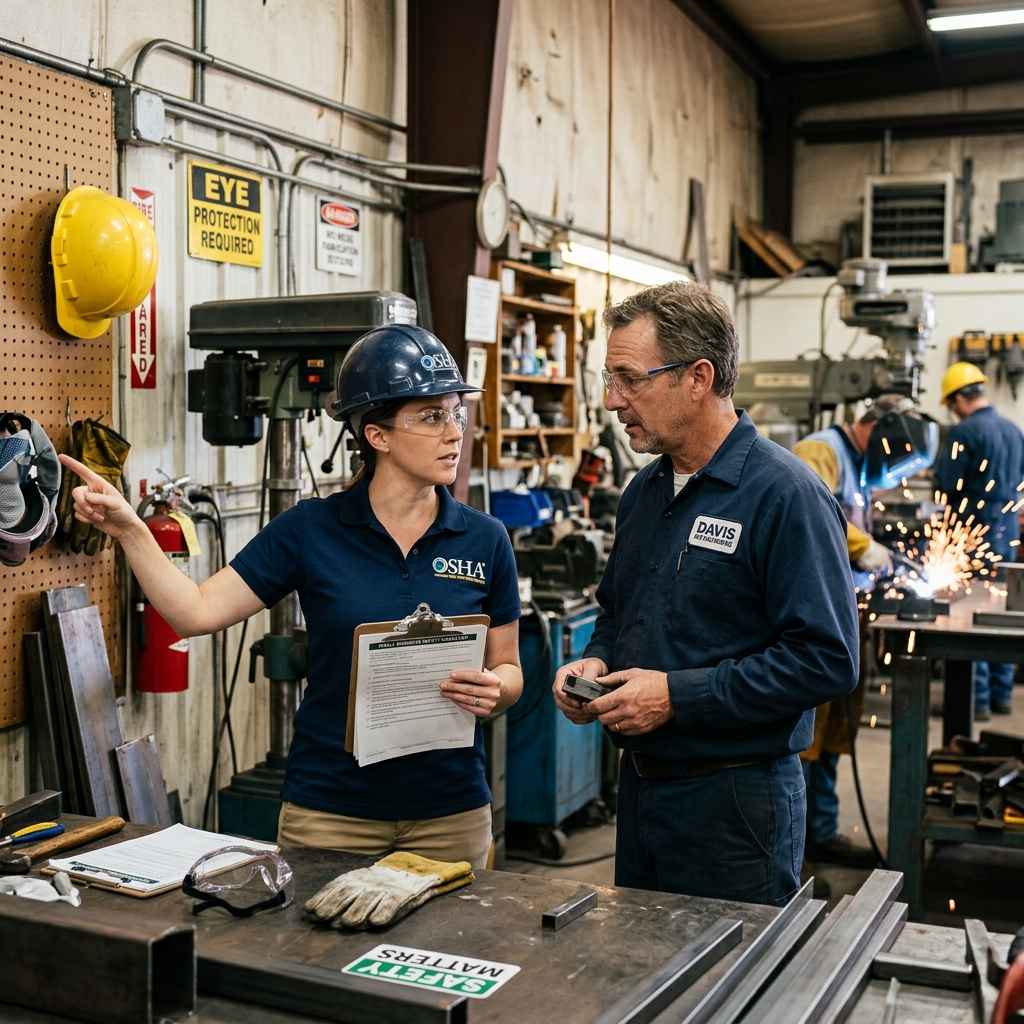
Many small business owners assume that federal workplace safety rules only apply to large companies. In reality, the Occupational Safety and Health Act (OSH Act) reaches most employers in the United States, including very small firms, although some enjoy partial exemptions from specific requirements such as injury and illness recordkeeping. Understanding where your business fits in this framework is essential to avoiding penalties and, more importantly, protecting employees from harm.
What OSHA Does and Why Small Businesses Should Care
The Occupational Safety and Health Administration (OSHA) sets and enforces workplace safety and health standards for private-sector employers and some public-sector workplaces. Even when certain small businesses have reduced recordkeeping duties, OSHA still expects them to provide a workplace “free from recognized hazards” under the Act’s general duty clause. That obligation does not depend on company size.
OSHA also offers guidance, consultation, and training materials designed specifically for small employers, reflecting the agency’s view that small businesses are a critical part of overall national safety and health performance.
When Size Matters: The 10-Employee Partial Exemption
OSHA’s rules distinguish between employers based on the number of employees, especially for injury and illness recordkeeping requirements. Federal regulation 29 C.F.R. 1904.1 provides that employers who had no more than 10 employees at any time in the last calendar year qualify for a partial exemption from routine recordkeeping duties.
If you meet this threshold, you are generally not required to maintain the OSHA injury and illness logs (such as Form 300) unless OSHA, the Bureau of Labor Statistics (BLS), or a similar authority asks you to do so in writing. However, this exemption does not remove your obligation to follow OSHA safety standards or to report serious incidents.
| Employer Size | Recordkeeping Duties | Safety Standards |
|---|---|---|
| 10 or fewer employees | Generally exempt from maintaining routine injury and illness logs, unless specifically requested. | Must still comply with OSHA standards and the general duty clause. |
| More than 10 employees | Usually required to keep OSHA injury and illness records, subject to industry-based exemptions. | Must comply with all applicable OSHA standards. |
Industry-Based Partial Exemptions
OSHA also recognizes that some industries pose relatively low risk of serious workplace injury. Certain employers classified in specific North American Industry Classification System (NAICS) codes are partially exempt from keeping routine injury and illness records. These low-hazard categories can include retailers such as bookstores, florists, and shoe stores, as well as some office-based services.
Even when your NAICS code appears on OSHA’s partially exempt list, the exemption usually applies only to recordkeeping. Businesses must still:
- Comply with applicable OSHA safety and health standards.
- Report severe injuries, certain hospitalizations, and fatalities.
- Provide a workplace free from recognized hazards.
Businesses Completely Outside OSHA’s Coverage
While most small businesses fall under the OSH Act, a few categories are explicitly excluded from OSHA coverage. These are not just exempt from recordkeeping; OSHA standards generally do not apply to them at all.
Employers who are typically outside OSHA’s jurisdiction include:
- Self-employed individuals who have no employees.
- Farms that employ only immediate family members, with no non-family workers.
- Household employers who hire domestic workers such as housekeepers or childcare workers in a private home.
- Churches and religious organizations and certain workplaces governed by other federal agencies, such as specific transportation or mining operations.
- State and local government employees in states without OSHA-approved state plans (these workers may be covered by state law rather than federal OSHA).
Even in these exempt categories, other safety-related laws or regulations may still apply—for example, industry-specific rules for aviation or mining enforced by different federal agencies.
State Plans and Location-Based Differences
The OSH Act permits states to run their own occupational safety and health programs, known as state plans, which must be at least as effective as federal OSHA. Currently, OSHA has approved state plans in multiple states and territories. Employers in these jurisdictions follow state rules rather than federal OSHA standards for most purposes.
Key points about state plans include:
- State rules may mirror federal OSHA standards or introduce additional requirements.
- Some state plans cover state and local government workers, even though federal OSHA does not.
- Small business exemptions in state programs may differ from federal partial exemptions and should be checked directly with the state plan authority.
Core Safety Duties That Still Apply
Partial exemptions can be confusing, but their scope is limited. Whether you have two employees or two hundred, OSHA expects employers to meet certain core safety obligations.
Providing a Safe Workplace
The OSH Act’s general duty clause requires covered employers to keep their workplaces free from recognized hazards that are likely to cause death or serious physical harm. In practice, this means you must:
- Identify foreseeable hazards in your operations.
- Implement reasonable controls, such as engineering safeguards, administrative procedures, or personal protective equipment (PPE).
- Monitor conditions and update safety measures as needed.
Following Specific OSHA Standards
Beyond the general duty clause, OSHA publishes detailed standards on topics such as hazard communication, machine guarding, fall protection, respiratory protection, and emergency preparedness. These standards apply to small businesses whenever their work activities fit the scope of the rules—for example, when employees are exposed to hazardous chemicals or operate powered industrial equipment.
Reporting Serious Incidents
Even if you are exempt from maintaining routine records, you still must report severe cases to OSHA. Covered employers must report work-related fatalities and certain serious injuries within specified time frames.
- Work-related fatalities must be reported within a short period (typically hours) after the employer learns of the incident.
- Severe injuries such as in-patient hospitalizations, amputations, or loss of an eye must also be reported within defined deadlines.
These reporting obligations apply regardless of company size or industry risk level.
Recordkeeping Rules: Who Must Keep OSHA Logs?
OSHA’s recordkeeping system helps employers and regulators track patterns of occupational injuries and illnesses. Whether a small business must maintain full OSHA logs depends on several factors:
- Employee count: Employers with 10 or fewer employees in the previous calendar year are usually partially exempt.
- Industry classification: Certain low-hazard NAICS codes are partially exempt even when the employer has more than 10 employees.
- Written requests: OSHA, BLS, or a state authority can require a partially exempt employer to keep records, at which point the exemption no longer applies.
Where recordkeeping duties apply, businesses must log work-related injuries and illnesses that meet OSHA’s criteria, including cases involving days away from work, restricted duty, or medical treatment beyond first aid.
Training, Communication, and Safety Culture
Even with partial exemptions, small businesses are expected to foster a culture of safety through training and communication. OSHA emphasizes that workers must understand workplace hazards and know how to protect themselves.
Core training responsibilities include:
- Explaining the proper use of machinery and tools.
- Teaching safe handling and storage of hazardous chemicals, consistent with OSHA’s Hazard Communication Standard.
- Reviewing emergency procedures, including evacuation routes and fire safety practices.
- Providing training in first aid or emergency response when needed, especially in locations without nearby medical facilities.
Small businesses should also display the official OSHA poster or equivalent notice in a visible location so employees are aware of their rights and responsibilities under the OSH Act.
Practical Compliance Steps for Small Business Owners
Sorting out exactly which OSHA obligations apply to your business can feel overwhelming. The following practical steps can help owners move from confusion to a manageable compliance plan:
- Confirm coverage: Determine whether your business falls under federal OSHA, a state plan, or an exempt category such as fully self-employed work.
- Count employees: Review peak employment in the prior calendar year to see whether the 10-employee partial exemption applies.
- Identify your NAICS code: Check whether your industry appears on OSHA’s list of low-hazard, partially exempt sectors.
- Review applicable standards: Focus on standards that match your operations, such as hazard communication, electrical safety, or fall protection.
- Implement basic controls: Address obvious risks with guards, PPE, safe work procedures, and housekeeping improvements.
- Plan for emergencies: Create an evacuation and fire safety plan, ensure exits are clearly marked and unobstructed, and stock appropriate first aid supplies.
- Document where required: Maintain records of serious injuries and illnesses and be ready to respond promptly to any OSHA reporting requirements.
Frequently Asked Questions (FAQs)
1. If I have fewer than 10 employees, does OSHA still apply to me?
Yes. The partial exemption for employers with 10 or fewer employees generally applies only to recordkeeping, not to safety standards. You must still provide a safe workplace, follow applicable OSHA rules, and report serious incidents.
2. Are family-only farms completely exempt from OSHA?
Farms that employ only immediate family members and no outside workers are typically outside OSHA’s coverage. When non-family employees are hired, OSHA rules can begin to apply, at least in part.
3. Do self-employed workers need to worry about OSHA rules?
Self-employed individuals without employees are generally not covered by the OSH Act. However, they may be subject to other safety requirements through contracts, state law, or industry-specific regulations.
4. How do I know whether my industry is partially exempt from recordkeeping?
OSHA uses NAICS codes to identify low-hazard industries that are partially exempt from injury and illness recordkeeping. You can look up your NAICS classification and compare it to OSHA’s list; if your code appears, you may have reduced recordkeeping responsibilities but still need to comply with safety standards.
5. Where can small businesses get help with OSHA compliance?
OSHA offers a range of resources for small employers, including free consultation services, e-tools, and guidance documents on its Small Business webpage. State plans and private organizations also publish checklists and training materials tailored to small business needs.
References
- 1904.1 – Partial exemption for employers with 10 or fewer employees — Occupational Safety and Health Administration. 1994-03-30. https://www.osha.gov/laws-regs/regulations/standardnumber/1904/1904.1
- Small Business — Occupational Safety and Health Administration. 2022-04-21. https://www.osha.gov/smallbusiness
- Do Small Businesses Have to Follow OSHA? — Pie Insurance. 2021-06-09. https://www.pieinsurance.com/blog/safety/small-businesses-follow-osha
- OSHA Requirements for Small Business Owners — OSHA Training School. 2023-02-15. https://www.oshatrainingschool.com/blog/osha-requirements-for-small-business-owners
- OSHA Compliance For Small Businesses — Group Management Services. 2023-08-10. https://www.groupmgmt.com/blog/osha-compliance-for-small-businesses/
- OSHA Requirements for Employers: Staying Compliant — Paychex. 2024-01-05. https://www.paychex.com/articles/human-resources/introduction-to-osha-requirements-for-small-businesses
- 6 Must-Know Health & Safety Requirements for Businesses — ProResources HR. 2022-06-30. https://blog.proresourceshr.com/health-safety-requirements-for-small-businesses
Similar Articles








Read full bio of medha deb




