
Divorce Records: What Is Public, What Is Private, Access Tips
Understand when divorce records can be seen by the public, what stays confidential, and how courts balance privacy with open access.
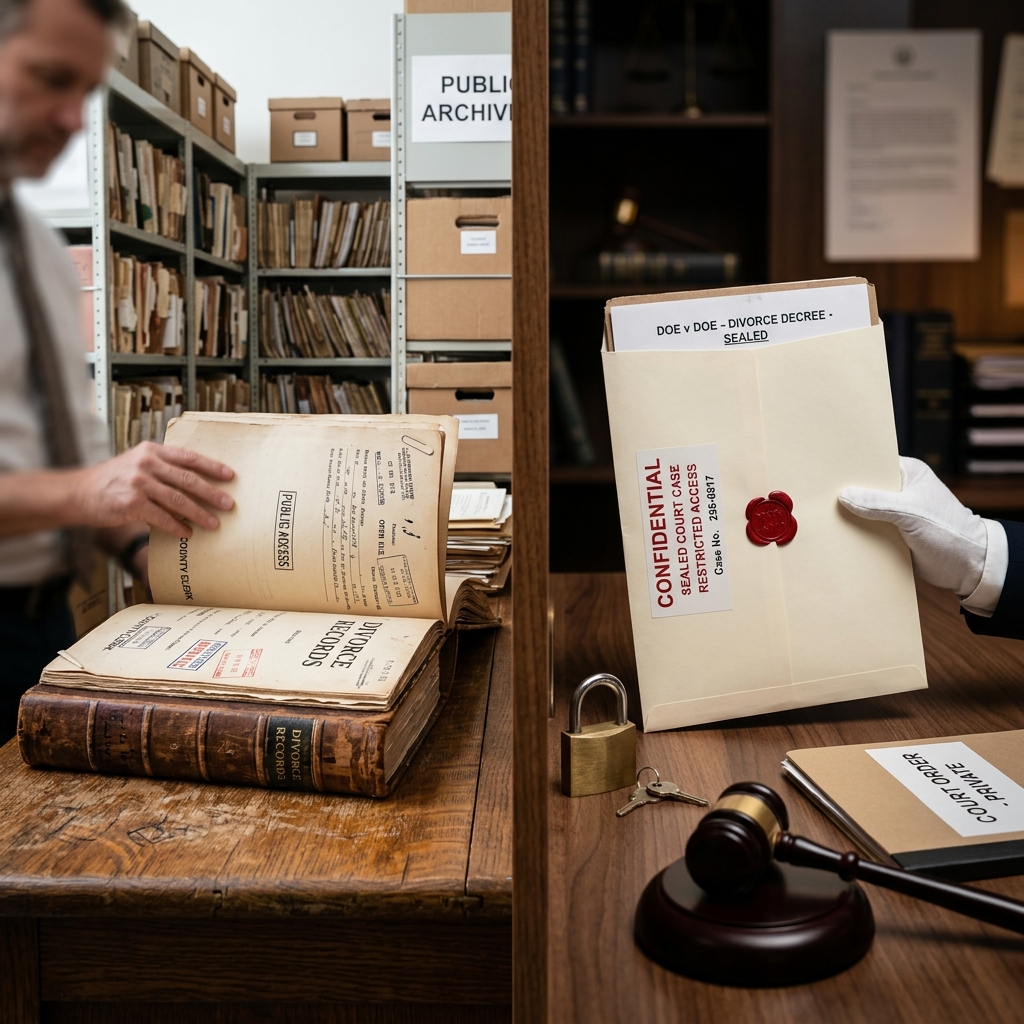
Divorce is not only an emotional and financial transition; it is also a legal process that creates a paper trail in the court system. A common concern is whether those documents are available for anyone to see. In the United States, many court records are presumed to be open to the public, but family-law matters like divorce are treated with heightened sensitivity to protect privacy and safety. Depending on the state, some divorce records are accessible, some are restricted, and some can be sealed entirely.
This article explains how divorce records work, what is typically public, when courts limit access, and how you may obtain or protect information in your own case.
What Counts as a Divorce Record?
When people ask if divorce records are public, they are often talking about several different documents. It helps to distinguish among them because access rules can differ for each category.
Key Types of Divorce-Related Documents
- Case docket or register of actions – A basic index showing that a divorce case exists, the names of the parties, the court, and important case events (filings, hearings, orders).
- Divorce decree or judgment – The final order that legally ends the marriage and addresses issues such as property division, alimony, and parenting arrangements.
- Divorce certificate – A shortened vital record (usually maintained by a state vital-records agency) listing minimal information such as the names of the spouses, date, and place of divorce.
- Pleadings and motions – Documents filed by the parties, like the initial petition, response, and motions about support, discovery, or protective orders.
- Financial disclosures – Statements detailing income, assets, debts, and expenses; these often contain highly sensitive information.
- Evidence and exhibits – Materials submitted during the case, such as appraisals, bank statements, medical records, or school records.
- Transcripts and hearing recordings – Written or electronic records of what was said during court proceedings.
State law and local court rules may treat each of these items differently from an access perspective. For example, a case docket and a divorce certificate might be accessible, while the underlying financial statements could be restricted to the parties and their lawyers.
Public Access vs. Privacy: The Legal Baseline
American courts operate under a strong presumption of openness. The U.S. Supreme Court and state courts have long recognized that public access to judicial proceedings and records promotes accountability, fosters trust, and allows the public to observe how laws are applied. However, this presumption is not absolute, especially in family-law cases where private details are deeply personal and can affect children.
Why Many Court Records Are Public
- Transparency – Open records enable scrutiny of court decisions and ensure that parties are treated fairly.
- Consistency – Lawyers, scholars, and judges rely on prior decisions to argue and decide new cases.
- Public oversight – Media and citizens can monitor how courts handle issues such as domestic violence, custody, or support.
Why Divorce Records Receive Extra Protection
- Protection of minors – Information about children, including addresses, medical history, and school data, can raise safety and privacy concerns.
- Sensitive financial details – Bank account numbers, tax returns, and business valuations are prime targets for identity theft and may reveal trade secrets.
- Domestic violence and stalking risks – Disclosing an abuse survivor’s address or workplace can create real danger.
- Reputation and dignity – Allegations of infidelity, substance misuse, or mental health issues can be deeply stigmatizing if broadly publicized.
Because of these concerns, many states restrict routine access to at least some divorce records and allow further sealing in appropriate circumstances.
How State Rules Differ on Divorce Record Access
There is no single national rule governing whether divorce records are public. Instead, each state sets its own standards through statutes, court rules, and case law. The result is a patchwork of approaches.
| State Approach (Examples) | General Access Policy | Typical Restrictions |
|---|---|---|
| New York | Divorce files are confidential to the parties and their attorneys for 100 years. | Public cannot view case documents or decrees without a court order. |
| Pennsylvania | Many court records, including dockets, are available through an online portal. | Specific personal data is redacted; certain family-law records or portions may be confidential by rule. |
| California (Los Angeles County example) | Divorce case information is maintained by the Superior Court; some records are accessible on request. | Older case files may be in archives; sensitive information can be sealed or redacted. |
Even within a state, access may differ between the vital record (divorce certificate) and the court case file. Vital records are typically available only to the parties, close family, or others with a legal interest, whereas case dockets may be viewable more broadly.
Who Can Usually See Divorce Records?
Access is often defined by who is making the request and what they want to see. While the exact rules vary, the following categories are common:
People With Broadest Access
- The spouses – Parties to the divorce typically have full access to their case file, including sealed or confidential materials, unless a specific order says otherwise.
- Their attorneys – Lawyers of record have access to documents filed in the case so they can represent their clients adequately.
- Court personnel and judges – Court staff need access to process filings, maintain records, and enforce orders.
Others Who May Get Access
- Third parties with a court order – An employer, lender, or insurance company may ask a judge for access if the records are needed for a legal purpose. The judge decides whether to grant limited access.
- Government agencies – Tax authorities, child support enforcement agencies, and law enforcement may obtain necessary information under statutory authority.
- Researchers and media – In some states, journalists or academics may seek access to redacted records when there is an important public interest.
General Public Access
Members of the public sometimes can access:
- Case docket or index showing a divorce case exists and its status.
- Redacted copies of orders or judgments, with personal identifiers removed.
- Historical records, particularly when the case is more than several decades old and the parties are likely deceased.
In other states, such as New York, the public may be entirely barred from viewing divorce files until a long time has passed.
What Information Is Typically Not Public?
Even where divorce records are generally accessible, courts usually shield certain types of information from public view. This may be done through statewide privacy rules, automatic redaction requirements, or protective orders.
Commonly Protected Details
- Social Security numbers and other government ID numbers.
- Financial account numbers, routing numbers, and credit card numbers.
- Children’s identifying information, including addresses and school names, especially in custody disputes.
- Medical and mental health records for spouses or children.
- Domestic violence shelter locations or confidential addresses under state address-confidentiality programs.
Courts may also limit public access to entire filings that are especially sensitive, such as adoption-related documents, certain custody evaluations, or psychological assessments.
Sealed Divorce Records: When and How?
In addition to automatic protections, courts can issue an order to seal part or all of a divorce file. Sealing removes the records from public access; only the court, the parties, and sometimes designated persons may view them.
Reasons a Court Might Seal Divorce Records
- Safety and domestic violence – Where disclosure could endanger a party or child, such as when there is a credible risk of stalking or retaliation.
- Protection of minors – To shield children from publicity regarding abuse allegations, mental health treatment, or contentious custody disputes.
- Business confidentiality – When records include trade secrets or proprietary business information that could harm a company if disclosed.
- Mutual reputation interests – In rare cases, both parties may demonstrate that public access would cause extraordinary harm that outweighs public interest.
The Legal Standard for Sealing
Courts generally do not seal records simply because parties find the information embarrassing. Instead, the person requesting sealing typically must:
- File a written motion explaining what should be sealed and why.
- Show a specific, serious harm that would result from public disclosure.
- Demonstrate that there is no less-restrictive alternative (such as redaction) adequate to protect their privacy.
Judges often balance the stated privacy interests against the public’s right of access. If sealing is granted, the order may cover only certain documents or pieces of information rather than the entire case file.
How to Obtain Copies of Divorce Records
If you need a copy of your divorce records—or are trying to verify that someone else is divorced—the process will depend on where the case was filed and what document you want. The following steps are typical in many jurisdictions.
1. Identify the Correct Court
- Determine the state and county where the divorce was granted.
- In many states, divorces are handled by a specific court level, such as a county-level trial court or a family division.
- Many courts provide online tools or clerk’s offices that can help you locate the relevant case.
2. Determine Whether You Need a Decree or a Certificate
- Divorce decree/judgment – Obtain this from the court where the case was decided. It will contain the full terms of the divorce.
- Divorce certificate – Typically issued by a state vital-records office; often used to prove marital status for administrative purposes.
3. Check Access and Eligibility Rules
- Review state and court websites for access policies and eligibility requirements.
- In states with confidential files (like New York), only parties or their attorneys can request copies without a separate court order.
- Be prepared to provide identification and possibly documentation showing your connection to the case.
4. Submit a Request
- Online – Some court systems allow online case searches and document ordering via an electronic portal.
- By mail – Many vital-records offices and courts accept written requests with a copy of a photo ID and a fee.
- In person – You can typically visit a clerk’s office or records center during business hours to request copies and pay fees.
5. Pay Required Fees
- Expect charges for certified copies, simple photocopies, or electronic downloads.
- Some jurisdictions offer fee waivers for low-income individuals, particularly when records are needed to enforce child support or other rights.
Protecting Your Privacy in a Divorce Case
While you cannot completely control how courts treat records, there are steps you and your attorney can take to reduce unnecessary exposure of sensitive information.
Practical Privacy Strategies
- Use required redaction forms – Courts often require that specific personal identifiers be omitted from public filings or placed on a separate confidential form.
- Limit unnecessary detail – Work with your lawyer to avoid including sensitive information unless it is legally necessary to resolve a dispute.
- Request protective or sealing orders when justified – If safety or serious harm is at stake, your attorney can ask the court to restrict access to specific filings.
- Be cautious with electronic communications – Remember that emails and texts can become exhibits; write with the assumption that they could someday appear in a court file.
- Consider settlement – Resolving issues through negotiation, mediation, or collaborative law can limit the amount of sensitive evidence filed with the court.
Frequently Asked Questions About Divorce Records
Are all divorce records automatically public?
No. While there is a general presumption of public access to court records, many states restrict divorce files or specific portions, especially when they contain children’s information, financial details, or sensitive personal records.
Can I look up someone else’s divorce online?
Sometimes. In states with online court portals, you may be able to see basic case details such as whether a divorce case exists, the parties’ names, and the case status. Access to full documents may be restricted, require payment, or be limited to parties and attorneys.
How long are divorce records kept?
Divorce records are usually preserved permanently or for very long periods because they affect rights to property, benefits, and marital status. Some states transfer older records to archives, where special rules may apply for historical access.
Can I have my divorce record erased?
It is extremely rare for courts to destroy divorce records. In most cases, the best you can request is sealing or redaction of specific information. Even then, you must show a strong justification and that sealing is consistent with the law and public access principles.
Do I need my divorce decree in the future?
Yes, it is wise to keep at least one certified copy of your divorce decree. You may need it to change your name, remarry, refinance a mortgage, divide retirement accounts, or prove that you are legally divorced in other legal or financial matters.
Is a divorce certificate the same as a divorce decree?
No. A divorce decree (or judgment) is a detailed court order describing the outcome of the case, whereas a divorce certificate is a brief vital-records document confirming that the divorce took place, with basic facts such as names, date, and location.
What if I cannot locate the court where the divorce was granted?
You can often start by contacting state or county court information lines or searching centralized court portals where available. For older cases, state archives or county archives may have indexes that help identify the correct court.
References
- Where do I get a copy of a divorce decree? — New York State Archives. 2024-01-01. https://www.archives.nysed.gov/content/where-do-i-get-copy-divorce-decree
- Getting Court Records & Case Information — New York State Unified Court System. 2023-06-01. https://www.nycourts.gov/help/representing-yourself-court/getting-court-records-case-information
- Are Divorce Records Public in New York? — Clark Peshkin (Law Firm). 2023-09-01. https://clarkpeshkin.com/are-divorce-records-public-in-new-york/
- Divorce Record Information — Los Angeles County Superior Court / County Archives (via LA County Registrar-Recorder/County Clerk). 2022-05-01. https://www.lavote.gov/home/county-clerk/marriage-licenses-ceremonies/divorce-record-information/divorce-record-information_
- Public Records — Pennsylvania Unified Judicial System. 2024-03-01. https://www.pacourts.us/public-records
Similar Articles








Read full bio of medha deb


