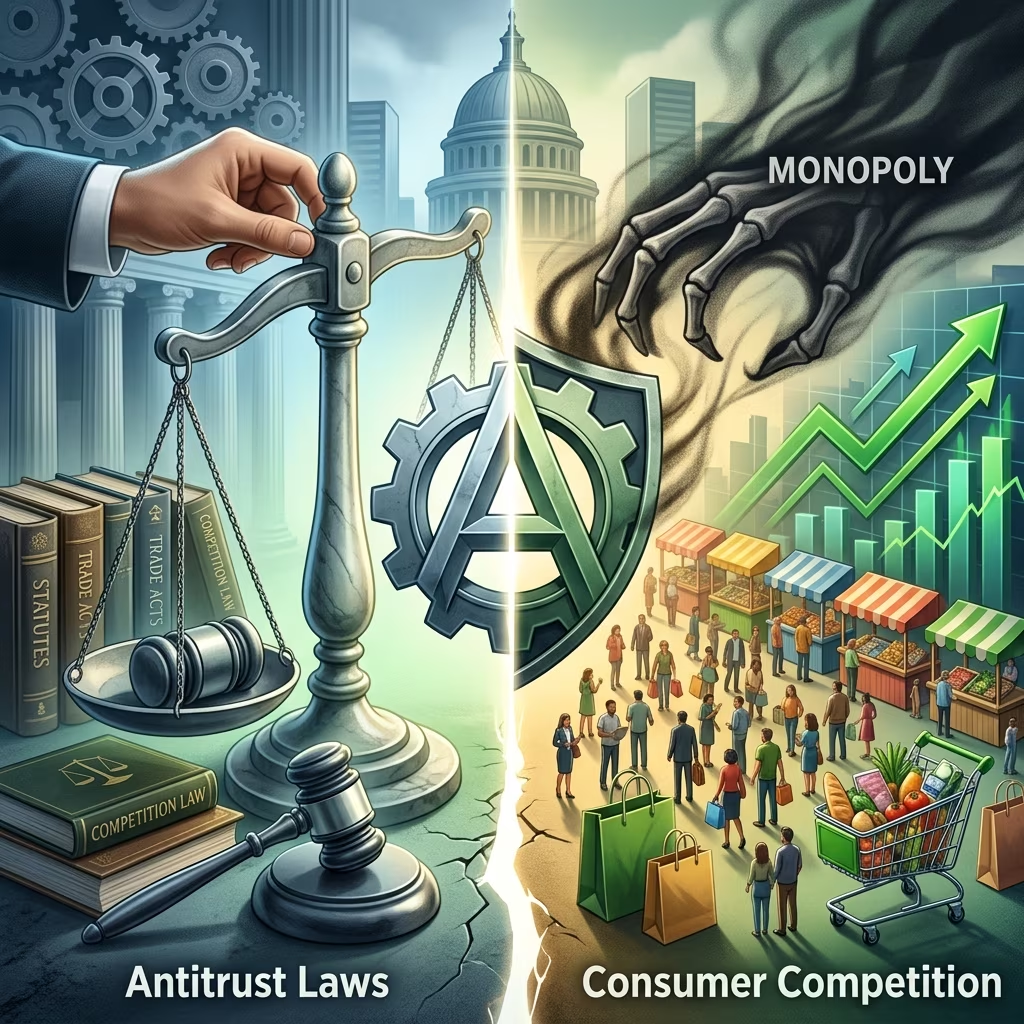
Antitrust law exists to keep markets open, competitive, and fair. In the United States, the core federal framework is built around three major statutes: the Sherman Act, the Clayton Act, and the Federal Trade Commission Act. Together, these laws target conduct that harms competition, raises prices, reduces choices, or makes it harder for new businesses to compete.
Although antitrust rules are often discussed in the context of large corporate mergers or major investigations, they affect everyday consumers as well. When competition is working properly, businesses have stronger incentives to lower prices, improve quality, and offer better service. When competition is suppressed, consumers often pay more and receive less value.
Why Antitrust Law Matters
Competition law is not designed to punish success. A business can become large, profitable, or influential without violating the law. The legal concern arises when a company or group of companies uses anticompetitive conduct to block rivals, coordinate with competitors, or gain market power in ways that unfairly distort the market.
The basic idea is straightforward: markets work best when companies compete on price, quality, innovation, and service. Antitrust laws preserve that process by limiting conduct that would otherwise allow firms to suppress competition rather than earn business through legitimate performance.
- Lower prices: competition discourages price-fixing and other inflated pricing schemes.
- Better quality: firms must improve products and services to win customers.
- More choice: consumers benefit when multiple businesses can enter and remain in a market.
- Innovation: rivalry encourages new ideas, technologies, and business models.
The Three Core Federal Antitrust Statutes
Modern U.S. antitrust law rests on three principal federal statutes. Each one addresses competition concerns in a slightly different way, and courts interpret their broad language based on the facts of each case.
| Statute | Main focus | Typical conduct covered |
|---|---|---|
| Sherman Act | Broad restraints on trade and monopolization | Price fixing, market allocation, monopolization, bid rigging |
| Clayton Act | Specific practices that may lessen competition | Problematic mergers, certain exclusive arrangements, interlocking directorates, discriminatory pricing |
| Federal Trade Commission Act | Unfair methods of competition and deceptive practices | Unfair competition, deceptive acts, conduct also violating Sherman Act standards |
The Sherman Act
The Sherman Act is the oldest and best-known federal antitrust law. Congress enacted it in 1890 to restrain conduct that undermines free competition. Section 1 prohibits contracts, combinations, or conspiracies that unreasonably restrain trade, while Section 2 addresses monopolization, attempted monopolization, and conspiracies to monopolize.
Some forms of coordination among competitors are especially serious. Agreements to fix prices, divide markets, rig bids, or coordinate wages are classic antitrust violations. The Department of Justice also notes that certain competitor agreements can be criminal offenses under the Sherman Act.
The Clayton Act
The Clayton Act was enacted in 1914 to reach conduct that might not fit neatly within the Sherman Act but still threatens competition. It focuses on specific business practices, especially mergers and acquisitions that may substantially lessen competition or tend to create a monopoly.
The statute also addresses issues such as exclusive dealing, tying arrangements, certain price discrimination practices, and interlocking directorates. These rules are important because they can stop anticompetitive harm before it becomes irreversible.
The Federal Trade Commission Act
The Federal Trade Commission Act created the FTC and gave it authority to address unfair methods of competition and unfair or deceptive acts or practices. In practical terms, the Act gives regulators another tool to challenge conduct that harms the competitive process or misleads consumers.
According to the FTC, the goal of these laws has remained consistent for more than a century: protect competition for the benefit of consumers and preserve strong incentives for businesses to operate efficiently.
Common Anticompetitive Practices
Antitrust violations can take many forms. Some are explicit agreements between competitors, while others involve unilateral conduct by a dominant company or a transaction that weakens market competition. The legal analysis depends heavily on the facts and the structure of the market.
- Price fixing: competitors agree on prices instead of setting them independently.
- Bid rigging: businesses manipulate bids so the winner is chosen by agreement rather than competition.
- Market allocation: competitors divide customers, territories, or product lines.
- Monopolization: a firm uses improper conduct to gain or maintain monopoly power.
- Anticompetitive mergers: acquisitions that may substantially lessen competition.
- Discriminatory dealing: certain unfair pricing or terms that distort competitive conditions.
Some business practices are legal in one market setting but unlawful in another. That is because antitrust law does not ban every restraint on trade; instead, courts examine whether the restraint is unreasonable and whether it harms the competitive process.
Who Enforces Antitrust Rules?
Antitrust enforcement in the United States comes from multiple directions. At the federal level, the Department of Justice and the Federal Trade Commission share responsibility for enforcing the main antitrust statutes. The DOJ can bring criminal antitrust cases under federal law, while the FTC focuses on civil enforcement and administrative action.
State governments also play an important role. Many states have their own antitrust laws, and state attorneys general may bring enforcement actions. Private parties can also sue in some situations, especially when they can show harm from unlawful conduct.
- Department of Justice: enforces federal antitrust laws and may pursue criminal cases.
- Federal Trade Commission: investigates unfair competition and deceptive conduct.
- State attorneys general: enforce state antitrust statutes and protect local markets.
- Private plaintiffs: may seek damages or other relief when harmed by anticompetitive conduct.
How Courts Decide Antitrust Cases
Federal antitrust laws are written in broad terms, which means courts play a central role in applying them. Judges consider market structure, business purpose, economic effects, and the actual impact on competition. This case-by-case method allows the law to adapt to changing markets and new business practices.
For many claims, the key question is not whether a practice is unusual or aggressive, but whether it unreasonably restricts competition. That distinction matters because strong competition often looks tough from the perspective of rivals, yet it remains lawful if it benefits consumers and does not rely on improper exclusion or collusion.
Penalties and Legal Consequences
Antitrust violations can trigger serious consequences. Depending on the type of conduct and the enforcement path, businesses may face injunctions, fines, damages, and other remedies. Criminal enforcement is possible for some Sherman Act violations, especially hard-core cartel conduct such as price fixing and bid rigging.
Private lawsuits can also be significant. In some cases, injured parties may recover damages, and antitrust litigation can reshape industry behavior well beyond the original dispute. Because of that, antitrust law operates both as a punishment for wrongdoing and as a deterrent against future misconduct.
Why Mergers Receive Special Attention
Mergers are not automatically illegal. In fact, many combinations of businesses are lawful and may create efficiencies. The concern arises when a merger is likely to reduce competition in a meaningful way. Section 7 of the Clayton Act is designed to stop transactions that may substantially lessen competition or tend to create monopoly power before the damage occurs.
That preventive approach is important because once a market becomes too concentrated, it may be difficult to restore real competition. Regulators therefore look carefully at industry concentration, the potential elimination of a close competitor, barriers to entry, and the transaction’s likely effect on consumers.
Practical Questions Consumers and Businesses Ask
People usually encounter antitrust issues in ordinary situations, even if they do not use legal terminology. A consumer might notice that several competitors seem to charge exactly the same price. A business owner might suspect that rivals are exchanging information or dividing customers. A company considering a merger may want to know whether the deal is likely to attract regulator scrutiny.
- Are competitors independently setting prices, or are they coordinating?
- Does the conduct appear to exclude rivals without a legitimate business reason?
- Could a merger reduce consumer choices or raise prices?
- Is the practice likely to harm the competitive process rather than just one competitor?
Frequently Asked Questions
Is every monopoly illegal?
No. Antitrust law does not ban size by itself. A company becomes a legal problem when it acquires or maintains monopoly power through improper conduct rather than through superior products, innovation, or efficient business operations.
Do antitrust laws only apply to big corporations?
No. While large firms are often involved in major cases, antitrust rules can apply to businesses of many sizes. What matters is the effect on competition, not simply the size of the company involved.
Can a state bring an antitrust case?
Yes. State attorneys general commonly enforce state antitrust laws, and some state actions may run alongside federal investigations or lawsuits.
What conduct is most likely to draw criminal attention?
Hard-core agreements among competitors, especially price fixing, bid rigging, market allocation, and some wage-fixing arrangements, are among the clearest examples of conduct that can lead to criminal enforcement under federal law.
How Antitrust Law Affects Everyday Markets
Antitrust law is not just a technical subject for regulators and corporate lawyers. It helps shape the price of groceries, the availability of services, the fairness of online marketplaces, and the pace of innovation across the economy. When competition is healthy, businesses must compete for customers; when it is distorted, consumers often absorb the cost.
For that reason, antitrust law remains one of the most important tools in consumer protection and market regulation. Its core promise is simple: markets should reward competition, not collusion or abuse of power.
References
- The Antitrust Laws — Federal Trade Commission. 2024-01-01. https://www.ftc.gov/advice-guidance/competition-guidance/guide-antitrust-laws/antitrust-laws
- The Antitrust Laws and You — U.S. Department of Justice, Antitrust Division. 2024-01-01. https://www.justice.gov/atr/antitrust-laws-and-you
- US Antitrust Laws: A Primer — Mercatus Center. 2023-01-01. https://www.mercatus.org/research/policy-briefs/us-antitrust-laws-primer
- Understanding Federal Antitrust Laws — Greenspoon Marder LLP. 2024-01-01. https://www.gmlaw.com/news/understanding-federal-antitrust-laws/
- Antitrust Law: An Introduction — Congress.gov. 2024-01-01. https://www.congress.gov/crs-product/IF11234