
Annulment vs. Divorce: A Clear Legal Guide
Understand how annulment and divorce end a marriage differently, when each is available, and what they mean for money, children, and your legal status.
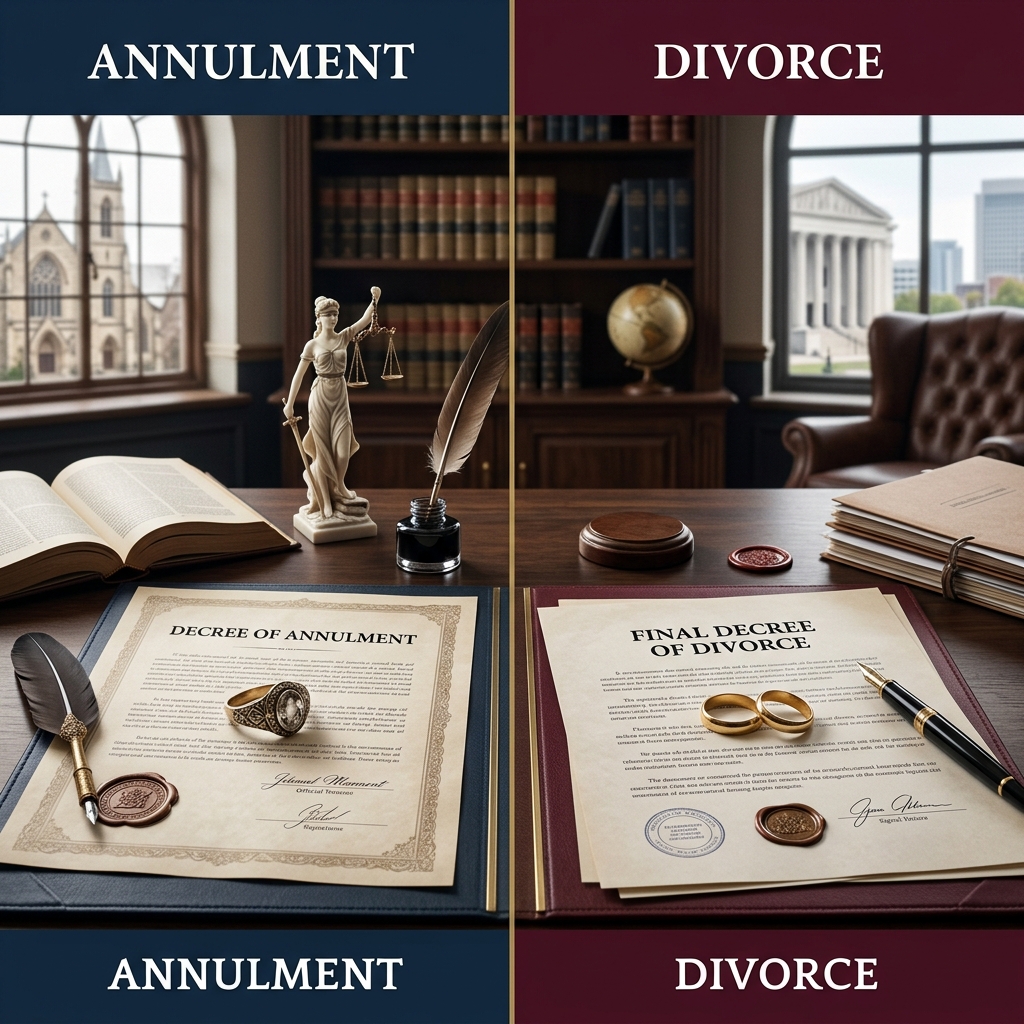
When a marriage breaks down, the law offers more than one way to end the relationship. The two most common paths are divorce and annulment. Both are court processes that dissolve a marital union, but they do so in fundamentally different ways and under different conditions.
This guide explains what annulment and divorce mean legally, who can qualify for each, how they affect property and children, and how to think about which option may be more appropriate in your situation. It is general information, not personal legal advice; specific rules vary by jurisdiction, so you should always consult a local family law attorney.
Big Picture: How Annulment and Divorce Differ
At the most basic level, the difference is about whether the marriage is treated as having been legally valid in the first place.
| Aspect | Annulment | Divorce |
|---|---|---|
| Legal view of the marriage | Declares the marriage invalid or void from the start, as if it never legally existed. | Recognizes the marriage as valid, then formally ends it. |
| Core legal action | Court issues an order stating the marriage was null and void. | Court issues a decree of dissolution ending a valid marriage. |
| General availability | Only available when specific legal defects existed at the time of the wedding. | Widely available; in many places, no-fault divorce is granted when the marriage is irretrievably broken. |
| Marital history | Legally treated as though the marriage should never have happened. | Legally treated as a past marriage that has now ended. |
| Future status | Parties are considered single, not divorced, after annulment. | Parties are considered divorced after the decree. |
What Is an Annulment?
An annulment is a court ruling that a marriage was never legally valid to begin with. In legal terms, an annulled marriage is treated as void or voidable, meaning the union lacked a key requirement such as consent or capacity when the couple said their vows.
Even though court and vital records may still show that a ceremony took place, the annulment order tells the law to behave as if no valid marriage was created. This can have important consequences for property rights, spousal support, and personal status.
Typical Grounds for Annulment
Because annulment is reserved for defective or unlawful marriages, you generally must prove one or more legally recognized problems existed at the time of the wedding.
- Fraud or deception — One spouse misrepresented essential facts (for example, hiding a prior existing marriage, serious criminal history, or intention never to live as a married partner).
- Duress or coercion — The marriage occurred because one party was threatened, pressured, or forced and did not freely consent.
- Lack of capacity — A spouse lacked mental capacity or was too intoxicated to understand and consent to marriage.
- Underage marriage without proper consent — One or both spouses were below the legal marriageable age and did not have required parental or court approval.
- Bigamy — One spouse was already legally married to someone else when the ceremony took place.
- Incestuous marriage — The spouses are closely related in a way that the law prohibits.
- Non-consummation in some jurisdictions — The couple never engaged in sexual relations after the wedding, which remains a recognized ground for annulment in certain legal systems.
These grounds, and the evidence needed to prove them, vary significantly by state or country. For example, some jurisdictions impose time limits such as requiring an annulment claim within a fixed number of days or months after discovering the problem.
Legal Consequences of an Annulment
Because an annulment treats the marriage as never having been valid, its legal consequences differ from divorce in several ways.
- Property rights — In many cases, there is less emphasis on dividing “marital” property because the law does not recognize a valid marital estate in the same way it does in divorce. However, courts can still allocate assets based on contract, equity, or domestic partnership principles.
- Spousal support — Alimony or spousal maintenance may be limited or unavailable after an annulment, since the marriage is deemed void. Whether support is possible depends on local law and individual circumstances.
- Prenuptial agreements — Prenups typically presuppose a valid marriage; if the marriage itself is invalid, those agreements may also lose legal effect.
- Children — Annulment does not erase the legal status of children. Courts still make orders regarding custody, parenting time, and child support, and children are usually treated as born in a union the law recognizes for their protection.
- Civil status — After annulment, parties are generally recorded as single rather than divorced, which can matter for religious practice, future marriage licenses, or certain benefits programs.
What Is a Divorce?
A divorce (often called “dissolution of marriage”) is the standard legal process for ending a valid marriage. The court accepts that all legal requirements for marriage were met, then issues an order that terminates that union and sets new rights and responsibilities going forward.
Divorce is available in every jurisdiction, and in many places spouses do not need to prove fault-based wrongdoing. For example, U.S. no-fault divorce laws allow a divorce when the marriage is “irretrievably broken” or when there are “irreconcilable differences,” without assigning blame.
Common Grounds and Types of Divorce
Modern divorce systems typically include both no-fault and, in some locations, fault-based grounds.
- No-fault divorce — The spouses state that the marriage has broken down beyond repair. No proof of misconduct is required.
- Fault-based divorce (where still available) — One spouse alleges specific misconduct such as adultery, cruelty, abandonment, or serious financial irresponsibility.
Even where fault grounds exist, many people choose no-fault divorce because it can be less adversarial, cheaper, and quicker than litigating blame.
Key Legal Outcomes of Divorce
Because divorce dissolves a valid marriage, courts must unwind shared life and obligations that have built up over time.
- Property division — Marital assets and debts are allocated between the spouses. Depending on jurisdiction, courts may follow equitable distribution (fair, but not necessarily equal) or community property (more equal sharing).
- Spousal support — Courts may order ongoing payments from one ex-spouse to the other based on factors like income, earning capacity, health, and the length of the marriage.
- Child custody and support — Parenting arrangements and child support obligations are determined based on the child’s best interests, regardless of which spouse sought divorce.
- Legal status — After divorce, each person is considered divorced and free to remarry, subject to any local waiting periods.
Annulment vs. Divorce: Practical Differences
For someone deciding between annulment and divorce, several practical distinctions matter beyond the legal definitions.
Eligibility and Ease of Obtaining
- Annulment is harder to obtain because you must show qualifying grounds and often meet specific deadlines.
- Divorce is widely available and usually does not require proving fault or wrongdoing in no-fault systems.
As a result, people who simply grew apart, experienced ongoing conflict, or faced irreconcilable differences typically must use divorce rather than annulment.
Timing Considerations
Annulments are more commonly sought relatively soon after the wedding, especially when the defect becomes obvious early on. Many laws limit annulment to a short period after discovering the problem. By contrast, divorce can usually be filed at any point during the marriage, whether after months or decades.
Financial and Property Implications
The way the court views property and financial obligations can differ.
- Annulment
- May mean fewer automatic rights to the other spouse’s earnings and assets as “marital property,” since the marriage was void.
- Spousal support can be limited or unavailable, though courts may still address fairness where one party is economically vulnerable.
- Prenuptial agreements may not apply if they were premised on a valid marriage that never legally existed.
- Divorce
- Treats property and debts acquired during the marriage as subject to division under the jurisdiction’s family law rules.
- Spousal support is more routinely considered and awarded where appropriate.
- Prenuptial agreements are analyzed and enforced or invalidated under the usual contract and family law standards.
Impact on Children
From the child’s perspective, the distinction between annulment and divorce is largely irrelevant. Courts prioritize children’s best interests in both processes.
- Children of an annulled marriage are still legally recognized and entitled to support and inheritance.
- Custody, parenting time, and child support are determined similarly whether the parents divorce or obtain an annulment.
Personal, Religious, and Social Considerations
Some people seek annulment for reasons beyond the purely legal framework:
- Religious practices — Certain faith traditions treat annulment differently from civil divorce when it comes to remarriage or participation in religious life.
- Personal identity — Saying the marriage was never valid can feel emotionally different from acknowledging a past marriage that ended.
- Social perception — Being “single” after annulment may carry different connotations than being “divorced,” though attitudes vary widely.
How to Decide Which Path to Pursue
Whether annulment or divorce makes sense depends on both legal eligibility and personal priorities.
Questions to Discuss With a Lawyer
- Do you have recognized grounds for annulment?
Did fraud, coercion, incapacity, underage status, bigamy, or another legally significant defect exist at the time of marriage? - Are you within any required time limits?
Has too much time passed since you discovered the issue for an annulment to be available in your jurisdiction? - How would each option affect your finances?
Would property division, spousal support, or enforcement of a prenuptial agreement look different under annulment versus divorce? - What matters most to you personally?
Is your priority speed, minimizing conflict, honoring religious teachings, or protecting long-term financial stability? - How complex are child-related issues?
If children are involved, what parenting and support arrangements are realistic and in their best interests?
In many situations, even when people are initially drawn to the idea of annulment, the more practical and available route is divorce. Annulment remains a specialized remedy for marriages that were defective from the start.
Frequently Asked Questions (FAQs)
1. Does an annulment erase all records of the marriage?
No. Court and vital records typically still show that a ceremony occurred and that an annulment was granted. However, the legal effect is that the marriage is treated as never valid, which can change rights related to property and support.
2. Can any unhappy spouse choose annulment instead of divorce?
Not usually. Annulment is reserved for marriages that were legally flawed from the beginning, such as those involving fraud, coercion, incapacity, underage parties, or bigamy. If a marriage was valid but later breaks down, divorce is the appropriate remedy.
3. Are children born in an annulled marriage considered illegitimate?
Modern family law systems take care to protect children’s legal status. Courts still recognize parentage, order child support, and safeguard children’s rights regardless of whether the parents end their relationship through annulment or divorce.
4. Is annulment faster or cheaper than divorce?
It depends. Annulment can be quicker when grounds are clear and undisputed, but proving those grounds can be complex and contested, increasing time and expense. No-fault divorce may be simpler in many cases because it does not require litigating whether the marriage was valid.
5. Do religious annulments and civil annulments mean the same thing?
No. A civil annulment is a court process governed by state or national law. A religious annulment is handled by a religious body and affects religious status, not civil rights. Some people seek both, but they are distinct procedures.
Key Takeaways
- Annulment declares that a marriage was never legally valid, available only when specific legal defects existed at the time of the wedding.
- Divorce ends a valid marriage and is broadly accessible, particularly in no-fault systems where irretrievable breakdown is sufficient.
- Financial and property consequences can differ significantly between annulment and divorce, especially regarding spousal support and marital property.
- Children’s rights and welfare are protected in both processes; courts continue to address custody and child support regardless of how the parents’ union is dissolved.
- Because rules vary by jurisdiction, personalized legal advice from a qualified family law attorney is essential before choosing a path.
References
- Annulment vs. Divorce: What Are the Differences? — Verywell Mind. 2022-10-19. https://www.verywellmind.com/difference-between-divorce-and-annulment-2302038
- Annulment vs. Divorce: Similarities and Differences — MetLife. 2023-06-01. https://www.metlife.com/stories/legal/annulment-vs-divorce/
- Understanding the Difference Between Annulment and Divorce — Lepley, Engelman & Yaw, LLC. 2023-05-10. https://www.lepleylaw.com/understanding-the-difference-between-annulment-and-divorce
- Annulment vs. Divorce: What’s the Difference? — Fisher Law LLC. 2022-09-15. https://fisherlawkc.com/annulment-vs-divorce-whats-the-difference/
- Is It Better To Get a Divorce or an Annulment? — Super Lawyers (Thomson Reuters). 2024-02-20. https://www.superlawyers.com/resources/divorce/divorce-alternatives/is-it-better-to-get-a-divorce-or-an-annulment/
- What’s the difference between a divorce, a dissolution of marriage, a legal separation, and an annulment? — State of Connecticut Judicial Branch, CTLawHelp. 2021-07-01. https://ctlawhelp.org/divorce-separation-annulment
Similar Articles








Read full bio of medha deb


