
The Blueprint Against Autocracy: How America’s Constitution Rejects Absolute Power
Discover how the United States Constitution was designed to prevent a monarchy and ensure accountability for everyone, including the President.
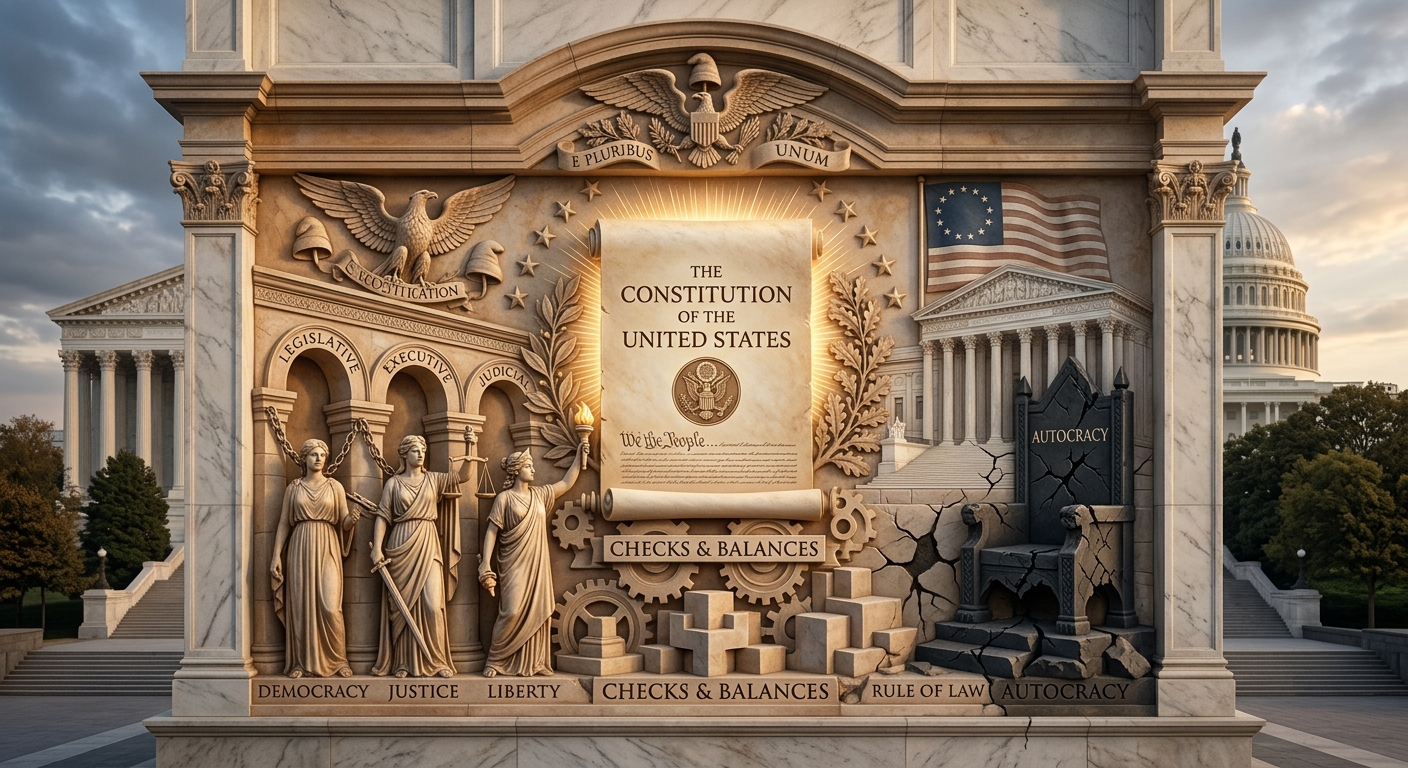
In 1776, a group of colonial delegates committed an act of unprecedented political defiance against the British Crown. The signing of the Declaration of Independence was not merely a severance of geopolitical ties; it was a profound, philosophical declaration of war against the very concept of a monarchy. For centuries, the “divine right of kings” dictated that rulers were chosen by God, placing them entirely above the legal statutes governing the common people. The founders of the United States, scarred by the abuses of King George III, sought to build a nation where the law itself was supreme. This fundamental rejection of autocracy became the beating heart of the United States Constitution.
Today, understanding America’s historic aversion to kingship is much more than an academic exercise in remembering the Revolutionary War. It remains a critical lens through which we view ongoing debates about civil liberties, executive overreach, and the boundaries of presidential power. By replacing a monarchical system with a democratic republic, the architects of the American government laid down a complex architectural blueprint designed specifically to prevent any single individual from holding absolute power.
The Enlightenment Echoes: Shaking Off the Divine Right of Kings
To grasp the magnitude of the American rejection of kings, we must examine the prevailing norms of the 18th century. Across the globe, political power was heavily concentrated in the hands of hereditary monarchs. The idea that a nation could govern itself without a sovereign ruler acting as the ultimate arbiter of truth, law, and military might was largely untested and widely viewed by European elites as a recipe for chaotic anarchy.
However, political philosophers had begun to articulate an alternative vision. John Locke championed the concept of the “social contract,” arguing that governments derive their just powers solely from the consent of the governed, not from divine inheritance. Charles-Louis de Secondat, Baron de La Brède et de Montesquieu introduced the vital concept of separating government powers into distinct branches to prevent tyranny.
The framers of the U.S. Constitution internalized these Enlightenment philosophies, transforming them from theoretical ideals into an operational framework of governance. They recognized a profound human truth: power tends to corrupt, and absolute power corrupts absolutely. To safeguard the nascent republic, they had to design a system that actively worked against human nature’s inclination toward dominance. The result was a radical new system of governance where institutional ambition was made to counteract personal ambition.
Structuring the Republic: The Separation of Powers
The cornerstone of America’s anti-monarchical design is the separation of powers. Rather than vesting all authority in a single sovereign entity, the framers deliberately fractured the powers of the federal government into three co-equal branches. This division ensures that the power to make, enforce, and interpret laws is never consolidated in one set of hands.
The Legislative Branch: The Voice of the People and the Purse Strings
Article I of the Constitution establishes Congress, comprising the House of Representatives and the Senate. The framers intentionally made the legislative branch the most powerful and directly accountable to the public. Congress holds the authority to draft laws, declare war, and, crucially, control the federal budget—often referred to as the “power of the purse.” By keeping financial and legislative control firmly in the hands of elected representatives, the Constitution prevents any executive from unilaterally imposing taxes or funding personal wars, a common abuse among European monarchs.
The Executive Branch: A Manager, Not a Monarch
Article II outlines the powers of the President of the United States. Unlike a king, the President is not a sovereign ruler but a public servant elected for a fixed term. The executive branch is tasked with faithfully executing the laws passed by Congress, acting as the commander-in-chief of the armed forces, and conducting foreign diplomacy. Because the framers were acutely terrified of creating an elected king, they placed stringent limits on the President’s authority. The President cannot create laws out of thin air, nor can they arbitrarily suspend the Constitution. Their power is temporary, bounded by law, and entirely subject to the oversight of the other branches.
The Judicial Branch: The Ultimate Check on Power
Article III establishes the federal judiciary, capped by the Supreme Court. The primary role of the courts is to interpret the laws and ensure they align with the Constitution. Through the power of judicial review (a principle firmly cemented in early American jurisprudence), the courts can strike down legislative acts or executive orders that violate constitutional limits. Independent, lifetime appointments for federal judges were established to shield them from the political pressures of the executive or the changing whims of the legislative branch, allowing them to remain impartial defenders of the rule of law.
The Mechanics of Checks and Balances
While the separation of powers divides the government, the system of “checks and balances” intertwines the branches, ensuring they must cooperate to function. The Legal Information Institute at Cornell Law School defines checks and balances as a mechanism that provides each branch of government with individual powers to limit the actions of the others, preventing any single entity from gaining excessive dominance.
- Veto Power and Legislative Overrides: The President can veto legislation passed by Congress, acting as a check on legislative overreach. However, Congress can override a presidential veto with a two-thirds majority in both chambers, ensuring the President cannot simply stonewall the collective will of the people.
- Advice and Consent: The President has the power to appoint federal judges, cabinet members, and ambassadors. Yet, these appointments require the “advice and consent” (confirmation) of the Senate. This prevents the executive from packing the government with unqualified loyalists or cronies.
- Impeachment Mechanisms: Perhaps the ultimate anti-monarchy tool is the power of impeachment. Congress has the authority to investigate, impeach, and remove a sitting President, Vice President, or federal judge for “Treason, Bribery, or other high Crimes and Misdemeanors.” A king is virtually untouchable; a President is always subject to removal for abusing their office.
The Emoluments Clause: Shielding the Republic from Foreign Influence
Beyond separating powers, the framers were deeply concerned about foreign interference. They knew that European kings frequently used wealth and titles to bribe foreign officials and subvert rival governments. To prevent this, they included the Foreign Emoluments Clause in Article I, Section 9 of the Constitution. This clause strictly prohibits any federal officeholder from accepting gifts, titles, offices, or emoluments (payments) from any foreign state or monarch without the explicit consent of Congress.
This provision acts as a direct firewall against the aristocratic practices of the Old World. It ensures that the loyalties of the President and other federal officials remain strictly tied to the American public, rather than to foreign powers offering financial favors. It is yet another structural mechanism ensuring the executive does not morph into an unaccountable sovereign.
The Rule of Law: Why No Official is Above Accountability
At the very core of this constitutional architecture is the principle of the “Rule of Law.” This principle asserts that no individual, regardless of their wealth, status, or political office, is immune to the law. In a monarchy, the sovereign is the source of the law and is therefore exempt from it. In the United States, the Constitution is the supreme law, and the President is merely a citizen entrusted temporarily with executive duties.
This foundational concept has been repeatedly tested throughout American history, particularly during moments of national crisis when executives attempt to cloak their actions in the guise of absolute authority.
The Steel Seizure Case: Restraining Wartime Power
During the Korean War in 1952, a labor dispute threatened to shut down the nation’s steel mills. Believing that a strike would cripple the war effort, President Harry S. Truman issued an executive order directing the federal government to seize and operate the steel mills. In the landmark case Youngstown Sheet & Tube Co. v. Sawyer, the Supreme Court ruled that the President did not have the constitutional authority to seize private property without Congressional approval, even during a wartime emergency. The ruling firmly established that the President’s role as commander-in-chief does not grant unchecked power over domestic affairs.
The Watergate Tapes: Defeating Absolute Privilege
Another monumental test occurred during the Watergate scandal. In 1974, the Supreme Court heard United States v. Nixon. President Richard Nixon argued that the concept of “executive privilege” gave him absolute, unqualified immunity from judicial subpoenas, allowing him to withhold audio tapes related to a criminal investigation.
The Supreme Court unanimously rejected this monarchical assertion. The Court acknowledged that while a limited executive privilege exists for military or diplomatic affairs, it cannot be used to thwart the fundamental demands of due process in the fair administration of criminal justice. By forcing the President to turn over the tapes, the Supreme Court decisively reaffirmed that the President cannot use the Oval Office as an impenetrable shield against criminal accountability.
Contemporary Challenges to Constitutional Guardrails
The fight to preserve the republic against autocratic tendencies did not end in 1776, nor did it conclude with the Watergate scandal. In the modern era, the principles of separation of powers face new, evolving challenges. As the federal bureaucracy has grown in size and complexity, power has increasingly shifted toward the executive branch.
Modern presidents frequently utilize executive orders, national emergency declarations, and expansive interpretations of administrative law to bypass a gridlocked Congress. While executive orders are a legitimate tool for managing federal agencies, they become constitutionally problematic when used as a substitute for legislative action. Unilateral attempts to rewrite sweeping national policies or appropriate funds not authorized by Congress push the boundaries of Article II powers and encroach upon the legislative domain.
Debates over absolute presidential immunity from criminal prosecution also test the republic’s guardrails. Arguing a President cannot be investigated or indicted echoes the discarded doctrine of sovereign immunity—the very concept the framers fought to escape. Protecting civil liberties requires constant vigilance from the courts, civil rights organizations, and the public.
Why the Framers’ Vision Matters Today
The American system of government was born from a profound distrust of unchecked authority. By firmly rejecting the concept of a king, the framers of the Constitution created a robust, albeit complex, machinery designed to frustrate tyranny at every turn. The separation of powers, the meticulous system of checks and balances, and the unwavering commitment to the rule of law serve as the nation’s primary defense against autocracy.
However, the Constitution is not a self-executing document. The guardrails it establishes are only as strong as the institutions and individuals willing to uphold them. Maintaining a republic free from monarchical overreach requires an informed citizenry, a courageous judiciary, and a legislative branch willing to assert its constitutional prerogatives. The history of America’s rejection of kings is not merely a chapter in a textbook; it is a continuous, living mandate to protect democratic liberties from the encroaching shadows of absolute power.
Frequently Asked Questions (FAQs)
What is the main difference between a monarch and the U.S. President?
A monarch typically inherits their position, rules for life, and historically held absolute, unchecked power over the state and its laws. The U.S. President is an elected official who serves a limited term (a maximum of two four-year terms as per the 22nd Amendment). The President’s powers are strictly enumerated by the Constitution, bounded by the law, and subject to the constant oversight of the legislative and judicial branches.
How does the separation of powers protect civil liberties?
The separation of powers protects civil liberties by ensuring that the government cannot easily consolidate enough power to oppress the public. If a single entity could write the laws, enforce them with the police, and judge violations in court, there would be no institutional defense against tyranny. Dividing these powers ensures that each branch acts as a watchdog over the others.
What was the significance of the United States v. Nixon decision?
The 1974 Supreme Court case United States v. Nixon was a defining moment for the rule of law. President Nixon attempted to use “executive privilege” to ignore a subpoena for criminal evidence. The Supreme Court ruled unanimously that the President does not possess an absolute, unqualified privilege against the judicial process, cementing the legal reality that the President is not above the law.
Can a sitting U.S. President be removed from office, and how?
Yes, the U.S. Constitution provides a specific mechanism for removing a President to ensure they cannot act as an untouchable king. Through the impeachment process, the House of Representatives can vote to impeach a President for “Treason, Bribery, or other high Crimes and Misdemeanors.” If two-thirds of the Senate votes to convict during the subsequent trial, the President is immediately removed from office.
What is an executive order, and can it be overturned?
An executive order is a directive issued by the President that manages operations of the federal government. While they have the force of law, they are not legislation and must fall within the authority granted to the President by the Constitution or Congress. Executive orders can be overturned by a subsequent President, struck down by federal courts if deemed unconstitutional, or overridden by Congress through new legislation.
References
- Constitutional Issues – Separation of Powers — National Archives. 2016-10-10. https://www.archives.gov/education/lessons/separation-powers
- United States v. Nixon, 418 U.S. 683 (1974) — Oyez, Chicago-Kent College of Law. https://www.oyez.org/cases/1973/73-1766
- checks and balances — Legal Information Institute (LII), Cornell Law School. 2024-07. https://www.law.cornell.edu/wex/checks_and_balances
- Youngstown Sheet & Tube Co. v. Sawyer, 343 U.S. 579 (1952) — Oyez, Chicago-Kent College of Law. https://www.oyez.org/cases/1940-1955/343us579
Similar Articles








Read full bio of medha deb


