
Alexa in the Courtroom: Smart Speakers, Privacy, and Criminal Evidence
How voice-activated smart speakers became potential witnesses in serious criminal investigations and what that means for privacy and the law.
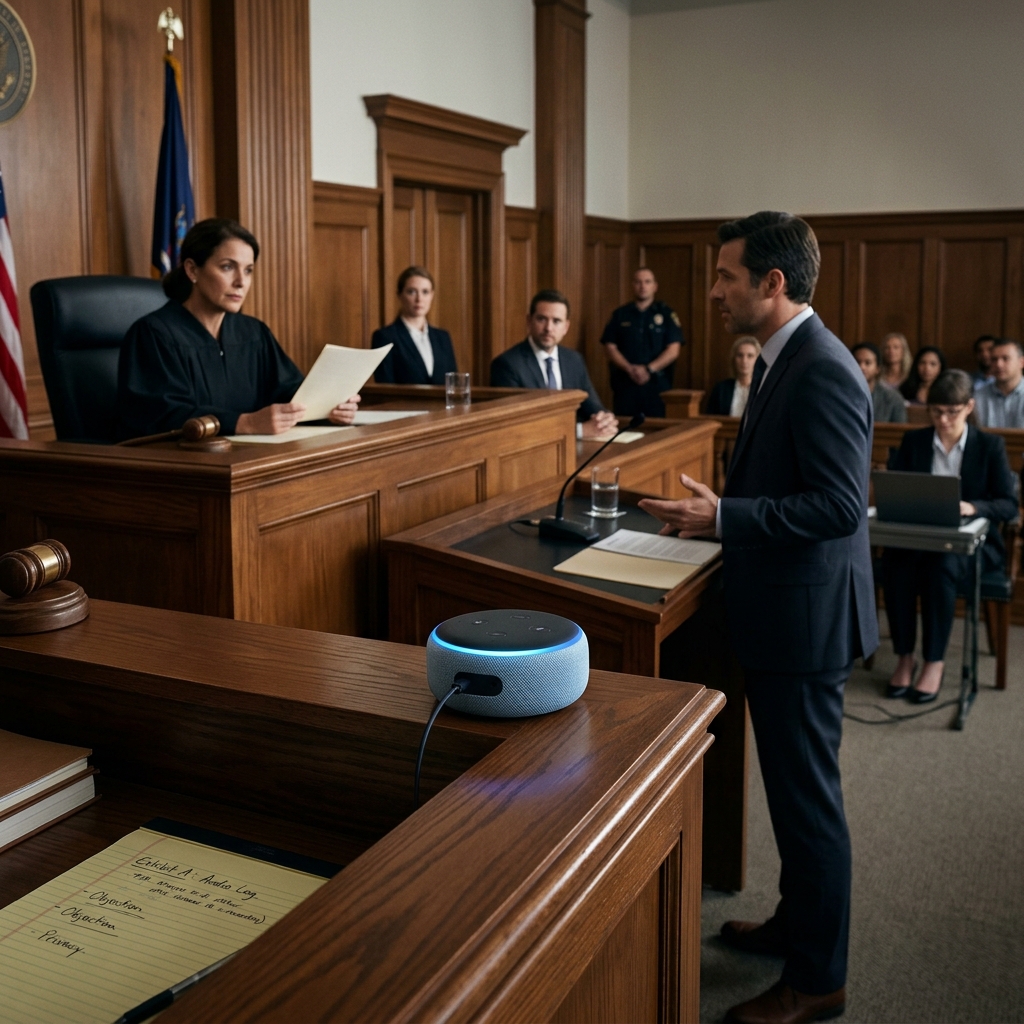
Smart speakers were sold as convenient digital assistants, but in recent years they have also appeared in a very different setting: the criminal courtroom. In a New Hampshire double homicide investigation, an Amazon Echo device became a potential witness, prompting a judge to order Amazon to produce any recordings that might capture the attack or its aftermath. This development raises difficult questions about how the law should treat voice data, what happens to privacy in a connected home, and how companies respond when prosecutors demand access to customer recordings.
This article examines how smart speaker data entered a double homicide case, how courts evaluate such evidence, and the broader implications for privacy, technology companies, and criminal investigations. It does not repeat the original reporting word-for-word; instead, it builds a structured, original analysis based on the known facts and wider legal context.
From Living Room Assistant to Potential Witness
The New Hampshire case illustrates how quickly everyday technology can be drawn into serious criminal investigations. According to court records and news reports, authorities were investigating the killings of two women at a home in Farmington, New Hampshire, when they discovered an Amazon Echo in the kitchen, near the alleged crime scene. Prosecutors argued that the device might have captured audio during the attack or the removal of one victim’s body and sought access to any recordings stored on Amazon’s servers.
- Location of the device: The Echo was reportedly located in the kitchen, the place where investigators believe one of the victims was attacked.
- Time window: The court’s order covered several days around the alleged crimes, instructing Amazon to provide any Echo recordings from that period.
- Scope of data: Authorities wanted not only potential audio recordings but also information about any cell phones paired with the device, which could link specific users to the Echo at relevant times.
The judge found probable cause to believe the Echo might contain evidence of crimes and directed Amazon to produce any relevant recordings “forthwith” to the court. Probable cause is a legal standard requiring reasonable grounds to think that evidence or contraband will be found in a particular place, and it is central to search warrants and related orders.
How Amazon Echo Records and Stores Voice Data
To understand why prosecutors believed the Echo could hold evidence, it helps to know how the device operates. Amazon Echo speakers are designed to respond to a “wake word” such as “Alexa” and, when triggered, record and transmit short snippets of audio to Amazon’s servers to process commands. They use multiple microphones and can capture a short buffer of audio immediately before and after the wake word is detected.
| Feature | Function in Normal Use | Relevance as Evidence |
|---|---|---|
| Wake word detection | Listens for “Alexa” and activates recording briefly when heard. | Recordings may capture voices, sounds, or statements during or near a critical event. |
| Cloud processing | Audio sent to Amazon servers to interpret user commands. | Potential evidence is stored remotely, requiring legal demands to access. |
| Persistent logs | Past Alexa interactions typically stored in an account history unless manually deleted. | Investigators might reconstruct a timeline of activity before, during, and after a crime. |
| Device pairing data | Echo can be linked to phones and user accounts. | Pairing information can connect specific individuals to the device at critical times. |
Importantly, Amazon has repeatedly stated that it only saves audio after the wake word is detected and for limited circumstances, such as improving services and providing user history.[10] However, even if the device records only in short bursts, those snippets can be significant if they coincide with a violent event or incriminating statements.
Legal Demands for Smart Speaker Data
In the New Hampshire double homicide investigation, prosecutors did not simply ask Amazon informally; they sought a judicial order compelling the company to turn over data. The judge granted the state’s motion, directing Amazon to provide any Echo recordings and related pairing information during the specified time frame. This mirrors other cases where law enforcement has tried to obtain voice data from smart speakers, such as an Arkansas case involving a death in a hot tub where prosecutors pursued Alexa recordings as potential evidence.
Amazon’s public position has been cautious. In statements to the press and in other cases, the company has emphasized that it does not release customer information without a “valid and binding legal demand” and may object when requests are overly broad or inappropriate. That stance reflects the growing tension between:
- Law enforcement interests: Access to voice data may help clarify what happened, corroborate witness accounts, or identify suspects.
- User privacy expectations: Customers may not anticipate that their home assistant could later provide evidence about private conversations or activities.
- Corporate responsibility: Technology companies must balance compliance with lawful orders against protection of user data and adherence to privacy policies.
In practice, these conflicts are resolved through legal processes, including subpoenas, search warrants, and motions to compel production. Courts weigh the relevance of the data, constitutional protections, statutory privacy rules, and company objections before deciding whether and how the data should be disclosed.
Smart Speakers and the Fourth Amendment
In the United States, the Fourth Amendment protects against unreasonable searches and seizures by the government. A key question in cases involving smart speakers is whether users have a “reasonable expectation of privacy” in the data their devices collect.
Traditional doctrine, including the so-called “third-party doctrine,” holds that people may lose some privacy expectations when voluntarily sharing information with a company. However, recent Supreme Court decisions have narrowed that rule in the context of highly revealing digital data. In Carpenter v. United States, the Court held that police generally need a warrant to obtain extensive cellphone location records, recognizing that such data can provide a detailed, intimate portrait of a person’s life.[11]
Smart speaker data similarly may expose sensitive details about what happens inside the home. The home has historically received the highest level of Fourth Amendment protection, and courts typically require warrants based on probable cause to search a residence or seize digital devices. When it comes to cloud-stored audio from a device like an Echo, the law is still evolving, but many prosecutors proceed by seeking judicial authorization rather than relying solely on subpoenas.
Privacy Risks in the Always-Listening Home
Beyond legal standards, there are practical privacy risks in having an always-listening device in the home. Multiple microphones can pick up background conversations, and accidental activations may lead to recordings users never intended to store. Consumer regulators and privacy advocates have raised concerns about the security and handling of such data.[12][13]
Key privacy issues include:
- Unintended recording: The device may misinterpret similar-sounding words as the wake word, capturing unexpected segments of audio.
- Data retention: Voice recordings can be stored until deleted, creating a long-term archive of interactions inside the home.
- Secondary uses: Data might be used to improve algorithms, develop new features, or, if mismanaged, be exposed in security incidents.
- Access by third parties: With proper legal process, law enforcement can seek access to this data; in some jurisdictions, civil litigants may also request it in lawsuits.
Regulators have started to respond. The U.S. Federal Trade Commission has scrutinized companies’ handling of voice data and, in some enforcement actions, required deletion of certain audio recordings, emphasizing the need to honor user controls and consent.[12] The European Union’s General Data Protection Regulation (GDPR) likewise imposes obligations to limit data collection, respect deletion requests, and ensure transparency about how personal data is used.[13]
Corporate Policies and User Controls
Technology companies have introduced user controls to address some of these concerns. Amazon, Google, and other smart speaker providers now typically allow users to:
- View and delete past voice recordings associated with their account.
- Adjust settings to limit data retention or disable certain uses of voice data.
- Turn off microphones physically or via software when they do not want the device to listen.
While these features can reduce the volume of stored audio, they also intersect with legal processes. For instance, if a user deletes recordings before any investigation, those files may no longer be available for law enforcement, even if a warrant is later issued. On the other hand, companies may maintain some metadata or logs necessary for system security and auditing.
In the New Hampshire case, one reason the Echo was of interest is that recordings are typically stored on Amazon’s servers rather than solely on the device itself. That means investigators could seek data even if they did not physically seize the Echo or if the device had limited storage capacity. Company policies about retention and deletion therefore directly affect how much information may be available years after an alleged crime.
Why Investigators Pursue Smart Speaker Evidence
Law enforcement agencies increasingly treat digital devices as potential sources of evidence because they can provide objective, time-stamped data. In the context of smart speakers, investigators hope to obtain:
- Audio of the incident: If the wake word was used during an altercation, the device might have captured fragments of the attack or verbal exchanges.
- Statements before or after the crime: Recorded commands could show what occupants were doing shortly before or after a critical moment.
- Presence and identity: Device usage patterns and paired phone data can suggest who was home and interacting with the Echo.
In the New Hampshire double homicide investigation, prosecutors believed the Echo might contain recordings of the attack on one victim and the removal of her body, making the device potentially crucial to reconstructing the events. Whether such recordings ultimately exist, and whether they are admissible, depends on technical and legal factors, including device activation, audio quality, authenticity, and chain of custody.
Admissibility and Reliability of Voice Data
Even if smart speaker recordings are obtained, they must meet evidentiary standards to be used in court. Judges consider whether the recordings are authentic, whether they have been altered, and whether their probative value outweighs any unfair prejudice.
Technical questions may include:
- How does the system timestamp and store recordings?
- Can logs demonstrate that the audio came from a particular device and account?
- Have any filters, compression, or processing steps affected clarity or content?
Courts have already grappled with similar issues for other types of digital evidence, such as phone records, emails, social media posts, and surveillance footage. Voice recordings are another piece of this expanding digital landscape. Legal practitioners and scholars note that as devices become more integrated into daily life, evidentiary questions will only grow more complex.
Balancing Safety and Privacy: Practical Considerations
For individuals who own smart speakers, the prospect of those devices becoming witnesses in serious criminal cases may be unsettling. Yet there are practical ways to navigate this landscape responsibly:
- Review privacy settings: Understand what your device records, how long data is kept, and what controls you have for deletion or limiting retention.
- Use physical controls: When discussing sensitive matters, consider muting the microphone or unplugging the device.
- Stay informed: Follow company notices and regulatory developments that may change how your data is handled.
For policymakers and courts, the challenge is to strike a balance in which technology can assist in solving serious crimes without eroding core privacy protections in the home. This involves updating legal doctrines, clarifying standards for access to cloud-stored data, and ensuring that companies follow clear, transparent rules when responding to government demands.
Frequently Asked Questions (FAQs)
Does Alexa record everything I say?
Smart speakers like Amazon Echo are designed to record primarily when they detect a wake word such as “Alexa.” According to technical descriptions, they maintain a short buffer of audio and send snippets to the cloud only after activation, though accidental activations can occur.[10] Users can review and delete many of these recordings through account settings.
Can police get my Echo recordings without my consent?
Law enforcement can seek access to Echo recordings through legal processes such as warrants, subpoenas, or court orders. In the New Hampshire double homicide case, a judge ordered Amazon to provide any relevant recordings, finding probable cause that they might contain evidence. Companies typically state that they require valid, binding legal demands before releasing customer data.
Have smart speaker recordings been used in other criminal cases?
Yes. Prosecutors in Arkansas sought Alexa data in a case involving a death at a private residence, and Florida authorities have examined smart speaker recordings in an alleged murder investigation. These cases show a growing trend of treating smart speakers as potential sources of digital evidence.
What protections does the law offer for my smart speaker data?
Constitutional protections, such as the Fourth Amendment in the U.S., and statutory privacy rules, as well as regulations like the GDPR in the EU, limit how governments and companies can access and use personal data.[11][13] Courts often require probable cause and judicial authorization to obtain highly intrusive digital information, and regulators have pushed companies to provide clearer controls and safeguards for users.[12][13]
Should I stop using smart speakers because of these legal issues?
Whether to use a smart speaker is ultimately a personal choice. Understanding how the technology works, what data it collects, and how that data might be accessed or used can help you make an informed decision. Many people continue to use such devices after adjusting settings, using microphone controls, and staying aware of privacy implications.
References
- Judge orders Amazon to hand over Echo recordings in double murder case — ABC News. 2018-11-09. https://abcnews.go.com/US/judge-orders-amazon-hand-echo-recordings-double-murder/story?id=59100572
- Judge orders Amazon to produce Echo recordings in double murder case — CBS News. 2018-11-12. https://www.cbsnews.com/news/amazon-echo-judge-orders-company-produce-alexa-recordings-double-murder-case-2018-11-12/
- Alexa, Testify — State Bar of Texas. 2019-01-01. https://www.texasbar.com/AM/Template.cfm?Section=articles&Template=/CM/HTMLDisplay.cfm&ContentID=46469
- Alexa, Are You Listening? — Wolf & Shore Law. 2019-11-14. https://www.wolfandshorelaw.com/alexa-are-you-listening/
- Did Amazon Echo record a double homicide? — CNN Video. 2018-11-11. https://www.cnn.com/videos/us/2018/11/11/amazon-echo-recordings-double-homicide-charge-sot-vpx.hln
- Amazon’s Alexa may have witnessed alleged Florida murder — NBC News. 2019-11-14. https://www.nbcnews.com/news/us-news/amazon-s-alexa-may-have-witnessed-alleged-florida-murder-authorities-n1075621
- Carpenter v. United States, 138 S. Ct. 2206 — Supreme Court of the United States. 2018-06-22. https://www.supremecourt.gov/opinions/17pdf/16-402_h315.pdf
- FTC Takes Action Against Company for Misleading Consumers About Privacy of Voice Data — Federal Trade Commission. 2022-08-04. https://www.ftc.gov/news-events/news/press-releases/2022/08/ftc-takes-action-against-company-misleading-consumers-about-privacy-voice-data
- Guidelines on Automated individual decision-making and Profiling — European Data Protection Board. 2018-02-06. https://edpb.europa.eu/sites/default/files/files/file1/20171017_guidelines_automated_decsion_profiling_en.pdf
Similar Articles








Read full bio of Sneha Tete


