
Alcohol Metabolism and DUI: What Drivers Need to Know
Understand how your body processes alcohol, how BAC is measured, and why metabolism rate can be critical in a DUI investigation.
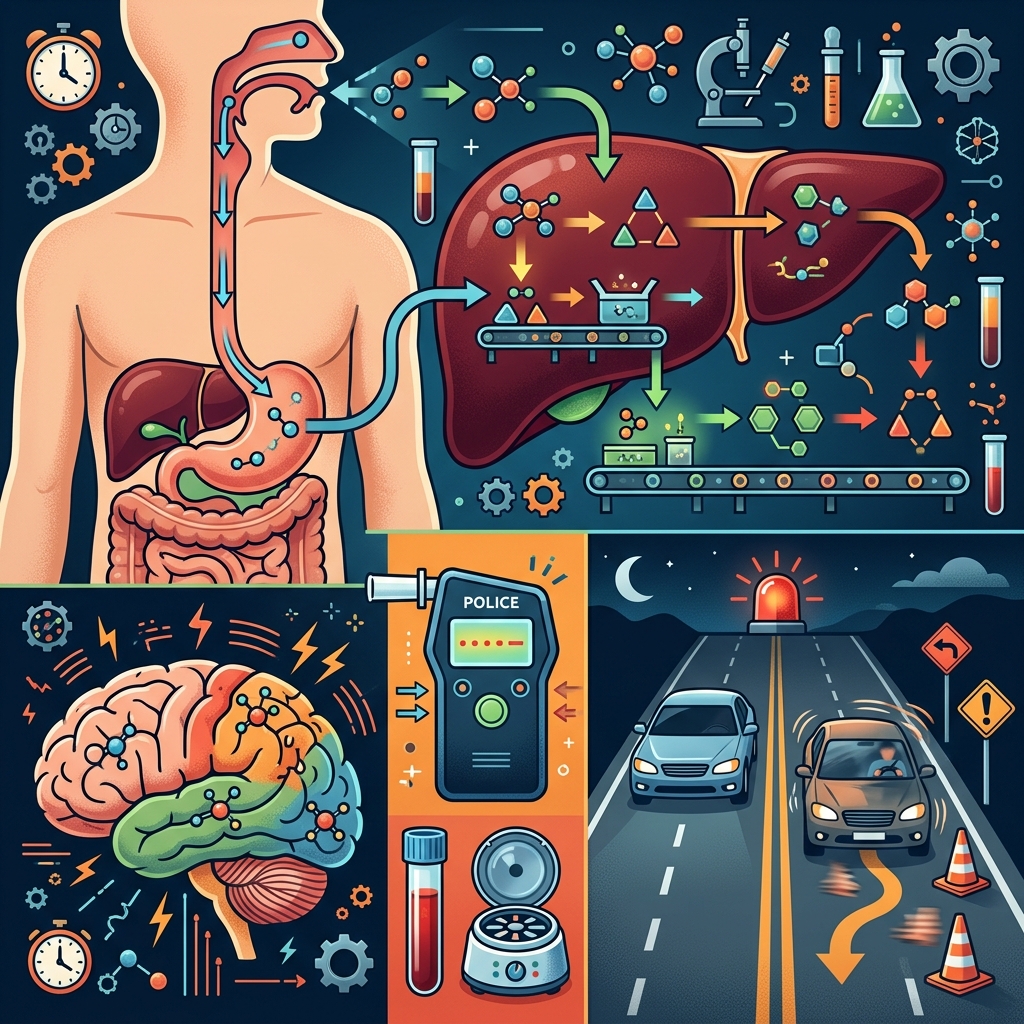
Driving after drinking alcohol is not simply a matter of how you feel. Modern DUI laws are based on measurable levels of alcohol in your body and on well-understood science about how alcohol is absorbed, distributed, and eliminated. Understanding alcohol metabolism and blood alcohol concentration (BAC) can help you make safer choices and also explain why DUI charges can arise even when a driver believes they were sober enough to drive.
Why Alcohol Metabolism Matters in DUI Cases
When law enforcement investigates suspected drunk driving, they are typically focused on two questions: whether you were impaired and whether your BAC was at or above your state’s legal limit. How quickly your body metabolizes alcohol directly affects both of these issues because it determines how long alcohol remains in your system at levels that can impair driving.
Most jurisdictions in the United States rely on per se DUI laws that make it illegal to drive with a BAC at or above a specified threshold, commonly 0.08% for drivers over 21, with lower limits for commercial drivers and underage drivers. The relationship between what you drink, your body’s metabolism rate, and the time at which your BAC crosses this threshold is often central in DUI prosecutions.
How Alcohol Enters and Leaves Your System
After you consume an alcoholic beverage, ethanol is absorbed through the digestive system into the bloodstream, distributed throughout body water, and then gradually broken down by enzymes, primarily in the liver. Different stages of this process are relevant to DUI law because they influence when your BAC rises, when it peaks, and how long it remains elevated.
Absorption: From Drink to Bloodstream
Alcohol absorption begins in the stomach and continues more efficiently in the small intestine. Several factors influence how quickly alcohol enters the bloodstream:
- Stomach contents: Drinking on an empty stomach generally leads to faster absorption and higher peak BAC because alcohol quickly passes into the small intestine, where absorption is more rapid.
- Type of beverage: Drinks with higher alcohol concentration, such as spirits, can raise BAC more rapidly than lower-concentration beverages like beer or wine.
- Rate of drinking: Consuming multiple drinks in a short period can cause BAC to climb quickly, often faster than the body can metabolize alcohol.
These absorption dynamics mean that a person might have a relatively low BAC shortly after starting to drink, but experience a sharp rise in BAC over the next 30 to 90 minutes even if they stop drinking.
Distribution: Why Body Size and Composition Matter
Once absorbed, alcohol disperses in body water, not fat. People with more body water tend to have lower BAC after consuming the same amount of alcohol compared to those with less body water. This is why body composition plays a role:
- Individuals with higher muscle mass and lower body fat generally distribute alcohol across a larger volume of water, leading to lower BAC.
- Individuals with higher body fat have relatively less body water, which can result in higher BAC from the same amount of alcohol.
Gender differences also matter. On average, women often reach higher BACs than men after consuming equal amounts of alcohol due to differences in body composition and alcohol-metabolizing enzymes.
Elimination: The Metabolism Rate of Alcohol
Alcohol elimination is largely controlled by the liver enzyme alcohol dehydrogenase, which converts ethanol to acetaldehyde and then to acetate. These reactions occur at what is effectively a fairly fixed rate for a given individual. Research and educational materials commonly estimate that alcohol is eliminated at about 0.015% BAC per hour, which corresponds roughly to one standard drink per hour for many people.[10]
Important characteristics of alcohol elimination:
- The rate is relatively constant and not significantly sped up by coffee, cold showers, water, or sleep.[10]
- Most people fall within a range of approximately 0.010% to 0.020% BAC reduction per hour, but individual differences exist.
- Only time, liver metabolism, and minor routes such as breath, sweat, and urine decrease BAC.[10]
Because elimination is slow compared to typical drinking rates, a person’s BAC can remain over the legal limit for several hours after their last drink.
Understanding Blood Alcohol Concentration (BAC)
BAC represents the percentage of alcohol in a person’s bloodstream. A BAC of 0.08% means there are 0.08 grams of alcohol per 100 milliliters of blood. This standardized measurement allows police and courts to apply legal thresholds uniformly.
Legal BAC Limits in the United States
Although exact rules differ among states, common per se limits include:
- 0.08% BAC for most adult drivers (21 and older).
- 0.04% BAC for commercial drivers operating vehicles requiring a commercial driver’s license.
- 0.01% to 0.05% BAC for drivers under 21 or those on DUI probation, depending on the state.
Some states also have stricter limits; for example, one state has adopted a per se limit of 0.05% for adult drivers, meaning a lower BAC can still trigger a DUI charge.
Standard Drinks and Approximate BAC Changes
A standard drink in the United States is typically defined as about 14 grams of pure alcohol, which is roughly:[10]
- 12 ounces of regular beer (around 5% alcohol).
- 5 ounces of wine (around 12% alcohol).
- 1.5 ounces of 80-proof distilled spirits (around 40% alcohol).
As a rough rule of thumb from legal and forensic references, one standard drink can raise an average person’s BAC by about 0.02 to 0.025 percentage points, though this varies by body size and sex. When you combine this typical increase with the average elimination rate of about 0.015% per hour, you can see how multiple drinks in a short time frame can quickly push BAC above legal limits and keep it there.
Illustrative BAC and Metabolism Table
The following table provides approximate values to show how BAC might decrease over time assuming no additional drinking and an elimination rate of 0.015% per hour. These values are not exact; individual variation can be significant.
| Initial BAC | After 1 hour | After 3 hours | Estimated time to drop below 0.08% |
|---|---|---|---|
| 0.10% | 0.085% | 0.055% | About 1.5 hours |
| 0.15% | 0.135% | 0.105% | About 4.5 hours |
| 0.20% | 0.185% | 0.155% | About 7.5 hours |
These examples demonstrate why a person can still be legally intoxicated long after they stop drinking, even if they feel subjectively more alert.
Factors that Influence Your Alcohol Metabolism Rate
Although the average elimination rate is often described as roughly one standard drink per hour, several factors can cause individual variation. Recognizing these can help explain why two people can drink the same amount but have very different BAC readings.
Biological and Lifestyle Factors
- Genetic differences: Variations in genes encoding alcohol dehydrogenase and aldehyde dehydrogenase enzymes affect how quickly alcohol is metabolized.
- Liver health: Chronic heavy drinking, liver disease, or certain medications can change metabolism rates, sometimes slowing elimination or, in some cases, increasing metabolic tolerance.
- Body weight and composition: Greater body mass and more lean tissue generally increase the distribution volume for alcohol, affecting peak BAC.
- Sex and hormones: On average, women tend to have lower levels of some alcohol-metabolizing enzymes and less body water than men of similar weight, which can lead to higher BACs for the same amount of alcohol.
- Food intake: Eating, especially high-protein meals, before or during drinking can slow absorption, potentially lowering peak BAC, although it does not change the rate at which the liver ultimately eliminates alcohol.
Myths About Sobering Up
Many popular strategies for “sobering up” quickly are ineffective. Scientific and educational sources emphasize that only time lowers BAC; other interventions mostly alter how alert a person feels.[10]
- Coffee: Caffeine can increase wakefulness but does not enhance alcohol elimination or reduce BAC.[10]
- Cold showers: These may make a person feel more invigorated but do not change blood alcohol levels.[10]
- Drinking water: Hydration can alleviate some symptoms of alcohol use but does not significantly accelerate the liver’s metabolic processes.[10]
- Sleep: While resting may improve subjective feelings of recovery, alcohol continues to metabolize at its usual rate; a person can wake up still over the legal limit.
How Police Measure BAC in DUI Investigations
Law enforcement uses chemical tests to estimate or measure BAC. Understanding these testing methods is important because timing and accuracy can affect how metabolism rate is interpreted in a DUI case.
Common Testing Methods
- Breath tests: Portable breath devices (often used roadside) and more sophisticated breath analyzers at police stations estimate BAC based on alcohol concentration in exhaled air. These tests are frequently used because they are fast and non-invasive.
- Blood tests: A blood draw performed in a controlled environment provides a direct measurement of BAC and is often considered more precise for evidentiary purposes.
- Urine tests: Less commonly used, urine tests can detect alcohol but are generally considered less reliable for establishing exact BAC at a specific time.
In many jurisdictions, refusing a lawful chemical test after a DUI arrest can lead to automatic administrative penalties, such as license suspension, under implied consent laws.
Timing and the “Rising BAC” Issue
A key evidentiary question in some DUI cases is whether the driver’s BAC was at or above the legal limit at the time of driving, not just at the time of testing. Because BAC can continue to rise for some time after drinking stops, a breath or blood test administered later may show a higher BAC than the driver had while operating the vehicle.
Conversely, if significant time passes between driving and testing, the measured BAC might be lower than it was when the person was behind the wheel due to ongoing metabolism. In contested DUI cases, experts may use known elimination rates and estimates of consumption to reconstruct likely BAC at the time of driving.
Legal Consequences of High BAC and DUI
When a driver’s BAC meets or exceeds the per se limit, prosecutors do not need to prove actual impairment; the BAC number itself is sufficient to establish a violation of the per se DUI statute in many jurisdictions. However, even BACs below the per se limit can result in charges if the driver’s ability to safely operate a vehicle appears impaired.
Typical Penalties for DUI Convictions
While penalties vary by state and by the driver’s history, common consequences of a DUI conviction include:
- License suspension or revocation for a set period.
- Fines, court fees, and administrative costs.
- Probation and possible jail time, particularly for high BAC or repeat offenses.
- Mandatory education or treatment programs related to alcohol misuse.
- Ignition interlock devices, which require a clean breath test before the car will start.
- Long-term collateral effects such as increased insurance premiums and limitations on certain employment opportunities.
In many jurisdictions, higher BAC readings can trigger enhanced penalties, such as longer license suspensions or mandatory jail time. Some states have specific thresholds (for example, 0.15% or higher) that qualify as “high BAC” offenses, recognizing the heightened risk associated with more substantial intoxication.
Practical Guidance for Safer Decisions
Because individual metabolism varies and legal limits are strict, relying on subjective feelings of sobriety is risky. The safest approach is to separate drinking from driving altogether. However, understanding the science can still help people recognize that “waiting an hour” is often insufficient after heavy drinking.
Key Safety Takeaways
- Assume your BAC decreases slowly, at roughly 0.015% per hour, and understand that several hours may be needed to return to legal levels after heavy drinking.[10]
- Remember that physical size, sex, and body composition can significantly change how much a given amount of alcohol raises your BAC.
- Do not rely on coffee, showers, or short naps to make yourself legally safe to drive; they do not lower BAC.[10]
- Plan transportation in advance—such as using a designated driver, public transit, or ride-hailing services—whenever you expect to drink.
- If you face a DUI investigation or charge, consult a qualified attorney who can explain how metabolism rate and testing procedures may be relevant to your specific case.
Frequently Asked Questions (FAQ)
How many drinks does it take to reach the legal limit?
There is no universal number of drinks that guarantees you will be under or over the legal limit. For some individuals, a relatively small number of drinks consumed rapidly can push BAC above 0.08%, particularly for smaller individuals or those with lower alcohol tolerance. Because of individual differences, it is unsafe to rely on simple drink-count rules.
Can I speed up the rate at which my body metabolizes alcohol?
No practical method significantly accelerates the liver’s breakdown of alcohol. Scientific and educational sources consistently state that BAC declines at a fairly steady rate and that strategies such as drinking coffee, exercising, or taking cold showers do not materially change the metabolism rate.[10]
Why might my BAC be higher when tested than I expected?
If you drank shortly before driving, ongoing absorption can cause your BAC to continue rising even after you leave the bar or restaurant. By the time a breath or blood test is administered, your BAC may have reached a peak higher than it was while you were driving. Conversely, if substantial time passes before testing, metabolism may have lowered your BAC from its level at the time of driving.
Is it possible to be arrested for DUI with a BAC below 0.08%?
Yes. Per se limits simplify proof of a DUI offense at or above the specified BAC, but many states also allow DUI charges for drivers below 0.08% if there is evidence that alcohol impaired their ability to drive safely. For underage drivers, probationary drivers, and commercial drivers, the legal BAC thresholds are lower as well.
Does eating a big meal guarantee I will be under the legal limit?
No. Food can slow the absorption of alcohol and may reduce peak BAC, but it does not prevent alcohol from eventually entering the bloodstream nor change the eventual amount absorbed. A substantial meal may delay and somewhat moderate peak BAC, but heavy drinking can still produce illegal and unsafe BAC levels.
References
- Section 9: Alcohol and Drugs — California Department of Motor Vehicles. 2023-01-01. https://www.dmv.ca.gov/portal/handbook/california-driver-handbook/alcohol-and-drugs/
- Alcohol Metabolism — Bowling Green State University Wellness Connection. 2022-01-01. https://www.bgsu.edu/recwellness-connection/alcohol-education/alcohol-metabolism.html
- ALCOHOL METABOLISM — Lieber CS. Alcohol Research & Health (NIH). 2012-11-01. https://pmc.ncbi.nlm.nih.gov/articles/PMC3484320/
- Alcohol Metabolism Rate and Your DUI — FindLaw. 2021-06-01. https://www.findlaw.com/dui/arrests/alcohol-metabolism-rate-and-your-dui.html
- Alcohol Metabolism Changes Considerably After Gastric Bypass — State Appellate Defender Office (SADO). 2014-03-01. https://www.sado.org/articles/Article/134
- Los Angeles DUI and Alcohol Metabolism — Kraut Law Group. 2019-05-01. https://www.losangelescriminallawyer.pro/los-angeles-dui-and-alcohol-metabolism.html
- The Connection Between Alcohol Metabolism Rate and a DUI — The Law Offices of Howard Kitay. 2018-10-01. https://www.duiease.com/blog/2018/october/the-connection-between-alcohol-metabolism-rate-a/
Similar Articles








Read full bio of Sneha Tete




