
Alaska Traffic Laws: A Practical Guide for Drivers
Understand key Alaska traffic rules, licensing, safety requirements, and penalties so you can drive legally and confidently on the Last Frontier’s roads.
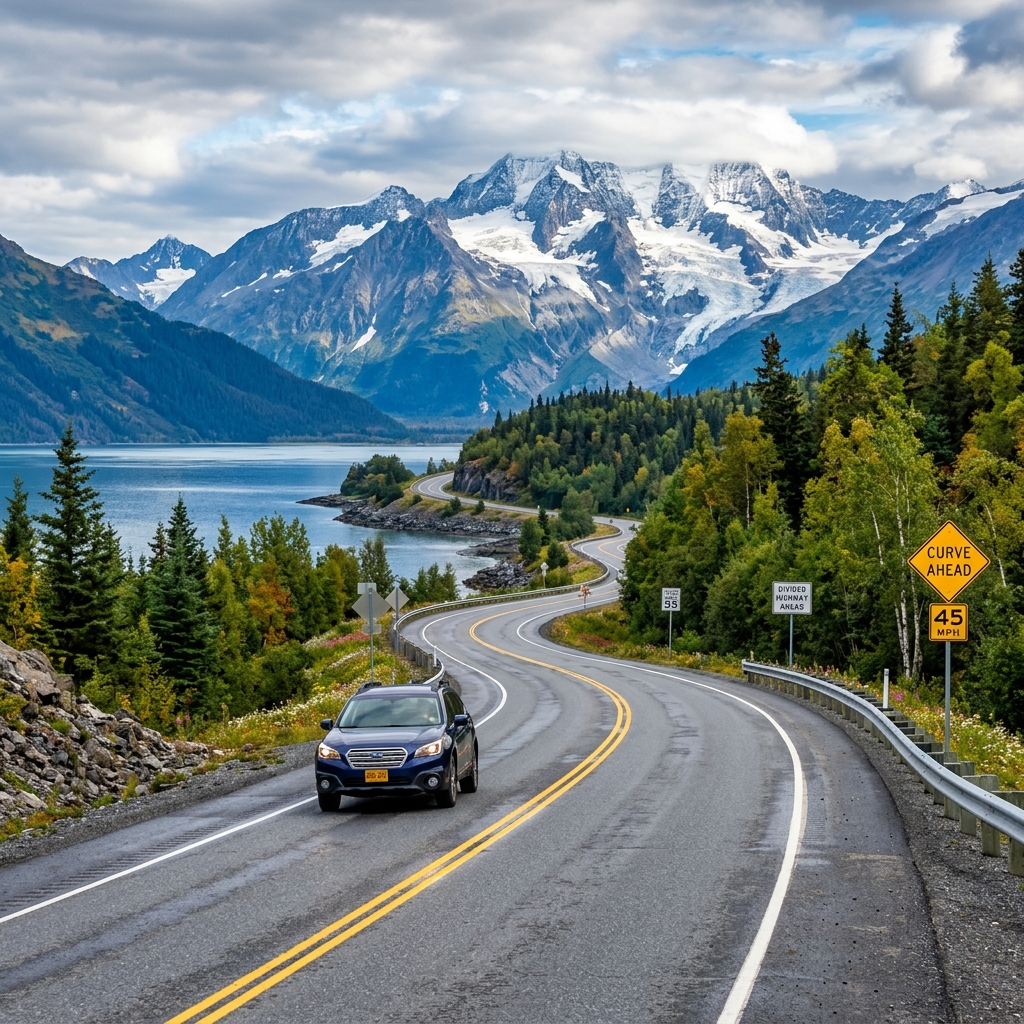
Driving in Alaska presents unique challenges, from long stretches of rural highways to rapidly changing weather and wildlife on the road. Understanding the state’s traffic laws is essential not only to avoid tickets, but to stay safe in these demanding conditions. This guide explains the most important rules about driver licensing, roadway behavior, safety requirements, penalties, and what to do after a crash, with a focus on practical information that everyday drivers can use.
1. Who May Drive in Alaska?
Every driver in Alaska must hold a valid license appropriate to the type of vehicle they operate. Different rules apply to new drivers, out-of-state visitors, and those operating commercial or specialized vehicles.
1.1 Basic license types
Alaska issues several classes of driver’s licenses, including standard noncommercial licenses, commercial driver’s licenses (CDLs), and various restricted licenses for younger drivers. While the exact class needed depends on the size and use of the vehicle, most personal drivers fall under a standard noncommercial license.
- Instruction permit (learner’s permit) – For new drivers learning to drive under supervision.
- Provisional license – For 16–17 year olds who have met practice requirements but are still subject to restrictions.
- Regular driver’s license – Full privileges once age and record requirements are met.
According to Alaska youth law guidance, a person must generally be at least 16 to qualify for a provisional driver’s license and must have held an instruction permit for at least six months with at least 40 hours of driving experience, including night or adverse weather driving.
1.2 Graduated licensing for young drivers
Alaska uses a graduated licensing approach for teen drivers to help them gain experience under lower-risk conditions.
- New drivers under 18 start with an instruction permit and must be supervised by a qualified licensed adult in the vehicle.
- After meeting age, practice, and time requirements, they may apply for a provisional license.
- Provisional license holders face restrictions such as:
- No passengers under 21 (other than siblings) unless a licensed adult is present.
- No driving between 1:00 a.m. and 5:00 a.m., except for limited exceptions (such as work) allowed by law.
Violating provisional license restrictions may lead to fines and points on the driving record, which can delay the transition to a full license.
1.3 When a minor becomes a fully licensed driver
Once a young driver has held a provisional license for at least six months without traffic, drug, or alcohol convictions, they can typically graduate to a regular license with parental consent if they are still under 18. If the driver is under 21, the state issues a minor’s license that expires shortly after the 21st birthday, at which point a drug and alcohol awareness test is required for renewal and issuance of a standard license.
2. Core Rules of the Road in Alaska
Alaska follows many of the same driving principles as other states, but its laws also address the realities of rural, two-lane roads and long distances between towns.
2.1 Lane use and staying in your lane
State regulations require drivers to travel as nearly as practicable within a single lane and prohibit changing lanes until the driver has first ensured that the movement can be made safely. This rule is especially important on icy or narrow roads, where abrupt lane changes can lead to loss of control.
| Situation | Lane Rule in Alaska |
|---|---|
| Standard multi-lane highway | Stay in your lane; change lanes only when safe and necessary. |
| Three-lane two-way road | Center lane generally reserved for passing or turning; continuous use is limited. |
| Two-lane rural road | Pass only when oncoming traffic is clear and passing is allowed by markings. |
2.2 Passing and rural traffic flow
Many Alaska highways are two-lane roads outside urban areas. When traffic builds up behind a slower vehicle, frustration and risky passing can occur. To reduce this danger, state law requires a driver on a two-lane roadway outside an urban area to pull off the road at the first safe opportunity if five or more vehicles are directly behind them.
Key points for slower vehicles:
- Check your mirrors regularly to monitor traffic behind you.
- If five or more vehicles are closely following on a two-lane rural road, you must safely use the next turnout or suitable shoulder area to let them pass.
- Failure to do so is an infraction that can carry a fine of at least $100 under Alaska statutes.
Faster drivers should only pass when visibility and road markings make passing clearly safe; wildlife, curves, and weather can quickly turn a seemingly open stretch into a hazardous situation.
2.3 Traffic control devices and intersections
The Alaska Driver Manual explains that drivers must obey traffic signals, signs, and pavement markings, and must have their vehicles under control when approaching intersections. Drivers must reduce speed to a reasonable and proper rate when approaching and crossing intersections and be prepared to yield where required.
In general:
- Stop signs require a complete stop before the crosswalk, stop line, or the near edge of the intersecting roadway, whichever comes first.
- At a green signal, drivers must still yield to pedestrians and vehicles already in the intersection before proceeding.
- Drivers entering from alleys or driveways must stop and yield to traffic and pedestrians on the main roadway.
3. Safety Requirements: Seat Belts, Devices, and School Buses
Alaska law includes strict rules about seat belt use, electronic devices, and behavior around school buses to protect drivers, passengers, and children.
3.1 Mandatory seat belt use
Alaska law requires seat belt use by all occupants of a motor vehicle. The state legislature adopted a seat belt requirement in the late 1980s, and failure to wear a seat belt is a traffic offense for occupants over age 16. Proper restraint significantly reduces the risk of serious injury or death in a crash.
Practical implications:
- Drivers are responsible for ensuring they are properly buckled before driving.
- Occupants 16 and older can be cited individually for not wearing seat belts.
- Younger children are subject to child restraint and booster seat requirements under separate provisions, which may vary based on age, weight, and height.
3.2 Electronic device and screen laws
Alaska law restricts texting and the use of visual display devices visible to the driver while a vehicle is in motion. Under Alaska Statute 28.35.161, a driver commits an offense if, while driving, they are reading or typing a text message or other nonvoice electronic communication that is visible in their normal driving position, or if a television, monitor, or similar screen device is operating in view of the driver.
- Texting while driving is prohibited when the vehicle is in motion.
- Drivers may not install or alter in-vehicle screens so that they can be viewed by the driver while driving, except for permitted uses such as navigation or certain vehicle information displays.
- Violations can be criminal offenses, and if distracted driving causes serious injury or death, the driver may face felony charges.
3.3 Stopping for school buses
The Driver Manual outlines strict requirements when a school bus is stopped with red lights flashing and the stop arm extended. Drivers must stop and remain stopped until the lights and stop arm are deactivated, then proceed with caution.
- Vehicles traveling in either direction on an undivided roadway must stop when a school bus is displaying its stop signal.
- On divided highways with a physical separation, drivers on the opposite side may not be required to stop, depending on the specific configuration and state law interpretations, but must still proceed with extreme caution.
- Failing to stop for a school bus is a serious traffic offense and may carry significant fines and points.
4. Speeding, Points, and Traffic Penalties
Because conditions can be dangerous, Alaska treats certain moving violations seriously. Speeding, failure to yield, and similar infractions can quickly add up to license consequences.
4.1 Speed limits and speeding enforcement
Speed limits vary by area and road type, with lower limits in urban areas and higher limits on certain highways. Exceeding the posted speed limit or driving too fast for conditions can result in fines and demerit points. The Alaska Court System publishes a vehicle and traffic offenses booklet that includes bail and fine schedules for many traffic violations, including speeding.
Under Alaska Administrative Rule 43.1, the maximum penalty for traffic infractions defined in the state’s traffic regulations (13 AAC) is generally $300, with higher penalties for violations of Alaska Statutes (AS 28) and doubled penalties in some special zones.
4.2 Work zones and safety corridors
Alaska increases penalties for certain violations committed in highway work zones or designated traffic safety corridors. For example, the maximum fine amounts for speeding and other specified offenses may be doubled when they occur in these areas under applicable rules and statutes. Signs typically alert drivers when they are entering or leaving a work zone or safety corridor.
4.3 Points and license consequences
The Alaska Driver Manual explains that certain traffic violations carry points, and accumulating enough points within a set period can trigger license suspension or revocation. For example, the manual notes that accumulating 12 points in 12 months or 18 points in 24 months results in mandatory license action.
- More serious violations (such as reckless driving) carry higher point values.
- Moderate violations (such as certain speeding offenses) carry intermediate points.
- Minor violations still add up and can eventually affect license status.
Drivers may be eligible to reduce points or mitigate consequences by completing an approved defensive driving course, depending on current Alaska DMV policies.
5. Traffic Infractions, Fines, and Local Adoption
Traffic violations in Alaska can be state-level offenses or municipal offenses, but many local governments adopt state traffic rules and fine schedules to ensure consistency.
5.1 State traffic infractions and bail forfeiture
The Alaska Supreme Court is required by statute to set bail amounts for state traffic offenses, which function as standard amounts for paying tickets without contesting them in court. The Vehicle and Traffic Offenses booklet lists these bail amounts for a wide range of violations such as speeding, failure to stop, or equipment violations.
Paying bail for many minor traffic infractions is often considered a forfeiture, meaning the driver does not contest the charge and the conviction appears on the driving record.
5.2 Municipal adoption of state schedules
Many Alaska municipalities adopt, by ordinance, the state’s traffic bail forfeiture schedule and related regulations as their own fine schedule for state offenses enforced locally. For example, a city may adopt the Traffic Bail Forfeiture Schedule and Oversize Vehicle Parole/Probation schedules as its enforcement framework for state traffic offenses within city limits.
This approach creates more uniform penalties across the state and helps drivers know what to expect, regardless of which local authority issues the ticket, though some local differences may still exist.
6. Accidents and Driver Responsibilities
Alaska law imposes specific duties on drivers involved in traffic collisions, especially when injuries or significant property damage occur.
6.1 Immediate obligations at the crash scene
Drivers involved in a collision must stop at or near the scene, provide identifying information, and render reasonable assistance to injured persons where required by law. When bodily injury or substantial property damage occurs, Alaska law requires notification to authorities and, in many cases, a written report.
6.2 Accident reporting to the state
The University of Alaska Police outline that drivers involved in an accident that results in bodily injury, death, or significant property damage are required to submit a written report to the Alaska Department of Administration within a specified period, often within 10 days of the accident. This citizens report form collects details about the collision, vehicles, and insurance information.
Failure to submit a required report may lead to administrative consequences, including possible license suspension, in addition to any criminal or civil liability arising from the crash itself.
7. Special Vehicle Types and Low-Speed Transportation
In addition to standard passenger vehicles, Alaska traffic laws address motorcycles, motor-driven cycles, low-speed vehicles, and other alternative transportation devices. While details can be complex, a few general principles apply:
- Low-speed vehicles may be limited to roads with lower posted speed limits, typically around 35 mph or less, for safety reasons.
- Motor-driven cycles, e-bikes, and scooters may be subject to special licensing, equipment, or roadway restrictions depending on their engine power and speed capabilities.
- Local ordinances can further restrict where certain devices may be operated (for example, on sidewalks or bike paths).
Drivers should consult the Alaska Driver Manual and local law for precise rules before operating non-standard vehicles on public roads.
8. Practical Tips for Driving Legally and Safely in Alaska
Beyond the black-letter law, Alaska’s climate and geography call for extra caution and planning. Combining legal compliance with practical safety habits is the best way to avoid violations and collisions.
- Adjust speed for conditions – Even when you are under the posted limit, snow, ice, fog, or wildlife can make a legal speed unsafe. The law expects a “reasonable and proper” speed for conditions.
- Use turnouts and be courteous – If traffic builds behind you on a two-lane rural road, use turnouts to let faster vehicles pass as required by law.
- Stay off your phone – Avoid texting or interacting with screens while driving; Alaska statutes treat serious crashes caused by distracted driving harshly.
- Buckle everyone up – Make seat belts and proper child restraints non-negotiable for every trip.
- Know your license status – Keep track of points, pay tickets promptly if you do not contest them, and follow up with the DMV if you receive notices about potential suspension.
9. Frequently Asked Questions About Alaska Traffic Laws
Q1. Do I have to pull over if several cars are behind me on a rural road?
Yes. On a two-lane roadway outside an urban area, if five or more vehicles are directly following you, you are required to pull off the road at the first safe opportunity to allow them to pass. Failing to do so is an infraction and can result in a fine.
Q2. How many points can I receive before my license is in danger?
The Alaska Driver Manual specifies that accumulating 12 or more points within 12 months, or 18 points within 24 months, triggers mandatory action against your license, such as suspension. Serious violations carry higher point values.
Q3. Is texting while driving always illegal in Alaska?
Alaska law generally prohibits reading or typing text messages and similar nonvoice communications while driving a moving vehicle. There are limited exceptions, but as a practical matter, drivers should assume that texting while driving is unlawful and highly dangerous.
Q4. When do I need to file a written accident report?
If a crash results in bodily injury, death, or significant property damage, Alaska law requires the driver to submit a written report to the appropriate state agency (typically within 10 days). The exact thresholds and forms are detailed in state regulations and guidance documents.
Q5. Do all passengers have to wear seat belts?
Yes. Alaska law requires seat belt use by all vehicle occupants, and occupants over 16 can be cited for failing to buckle up. Child passengers must also comply with separate child restraint and booster seat rules based on age and size.
References
- 13 AAC 02.085 – Driving on roadways laned for traffic — Alaska Administrative Code. Current through 2025-02-24. https://regulations.justia.com/states/alaska/title-13/part-1/chapter-02/article-2/section-13-aac-02-085/
- Alaska Traffic Laws — FindLaw. 2024-05-13 (last updated). https://www.findlaw.com/state/alaska-law/alaska-traffic-law.html
- Alaska Driver Manual — Alaska Division of Motor Vehicles. 2022-01-01 (edition date). https://dmv.alaska.gov/media/t5ef5vi2/dlman.pdf
- Use turn outs if you have 5 or more behind you. It’s the law! — Reddit summary citing AS 28.35.140. 2019-07-08. https://www.reddit.com/r/alaska/comments/cds8bv/use_turn_outs_if_you_have_5_or_more_behind_you/
- Vehicle and Traffic Offenses Booklet (PUB-131) — Alaska Court System. 2019-07-01. https://public.courts.alaska.gov/web/forms/docs/pub-131.pdf
- Vehicle safety and laws — University Police Department, University of Alaska Fairbanks. 2019-01-01. https://www.uaf.edu/police/forms-requests/vehicle-safety.php
- Kinds of Driver’s Licenses – Alaska Youth Law Guide — Alaska Bar Association. 2020-06-01. https://alaskabar.org/youth/cars-and-weapons/driving-in-alaska/kinds-of-drivers-licenses/
Similar Articles








Read full bio of medha deb


