
Airport Body Scanners and Your Privacy Rights
Understand how modern airport body scanners work, what they can see, and the legal protections that shape your privacy and safety.
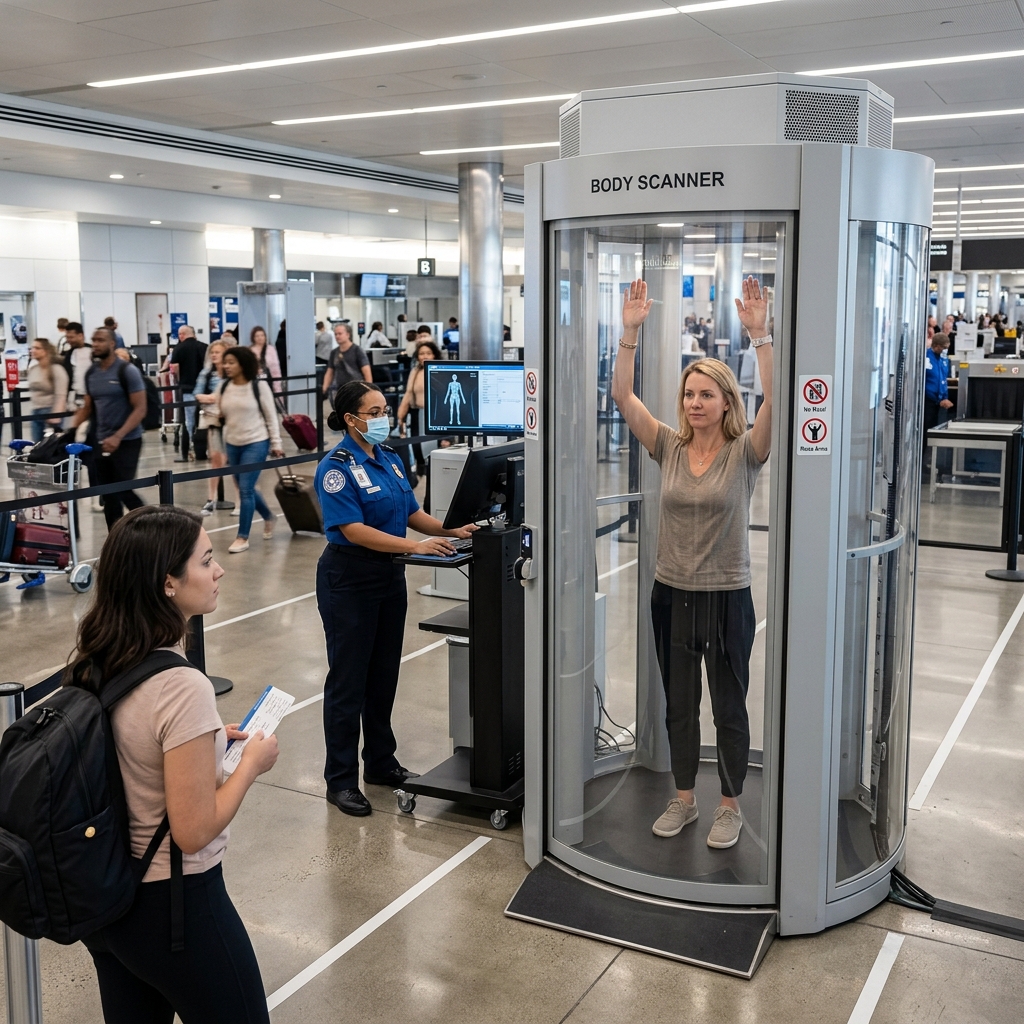
Airport security has changed dramatically in the past two decades. Advanced imaging technology (AIT), often called full-body scanners, now screens millions of passengers each year before they reach the boarding gate. These machines are designed to detect concealed weapons or explosives, but they also raise serious questions about privacy, data protection, and health. Understanding how these scanners work and what rules govern them can help you make informed choices and assert your rights when you travel.
From Metal Detectors to Full-Body Imaging
Traditional walk-through metal detectors were once the primary tool for passenger screening. They could detect metallic objects but were largely ineffective against non-metallic threats such as plastic explosives or ceramic knives. As aviation security concerns grew, security agencies introduced whole-body imaging technologies capable of revealing objects hidden under clothing, regardless of material.[10]
Modern body scanners used in U.S. airports are part of the Transportation Security Administration’s (TSA) advanced imaging technology program. They aim to improve threat detection while incorporating built-in privacy safeguards. However, public debate continues about whether these safeguards are sufficient and how far government agencies may go in the name of security.
Types of Airport Body Scanners
There are two main categories of airport body scanners that have been used in recent years:
- Backscatter X-ray scanners – devices that use low-dose ionizing radiation to create an image based on X-rays that scatter off the body surface.
- Millimeter wave scanners – devices that use non-ionizing radiofrequency waves to detect objects on the body without using X-rays.
Due to privacy and health concerns, backscatter X-ray scanners were removed from U.S. airports and replaced with millimeter wave systems equipped with privacy software. Millimeter wave scanners are now the primary technology used for passenger screening in many countries, including the United States.
What the Scanners Actually See
Early generations of body scanners produced detailed images that resembled a virtual nude of the person being scanned, revealing contours of breasts, buttocks, genitalia, and even medical devices. These images triggered widespread concern over dignity and bodily privacy.
In response, regulators and manufacturers developed automatic target recognition (ATR) software. Instead of displaying a passenger’s actual body image, the scanner now shows a generic outline or avatar, often described as resembling a simple “gingerbread” figure. Areas requiring further inspection appear as highlighted boxes on this generic figure, allowing officers to focus on potential threats rather than the person’s anatomy.
| Feature | Purpose | How It Protects Passengers |
|---|---|---|
| Generic avatar image | Displays a non-personal outline instead of real body | Prevents screeners from viewing anatomical details. |
| Automatic target recognition (ATR) | Highlights suspicious areas only | Focuses on objects, not the person’s physical features. |
| No image storage capability | Disables saving or transmitting images | Reduces risk of misuse, leaks, or unauthorized copying. |
| Separate viewing from checkpoint | Limits contact between viewer and passenger | Helps reduce potential for harassment or discrimination. |
Privacy Concerns: What Could Go Wrong?
Even with technical safeguards, whole-body imaging technologies raise important privacy and civil liberties issues. These concerns center on:
- Exposure of intimate body details, especially in earlier systems without strong privacy filters.
- Potential misuse of images, such as saving, sharing, or leaking scans despite official policies prohibiting storage.
- Intrusive search experience, particularly when scans lead to targeted pat-downs of sensitive areas.
- Impact on vulnerable groups, including children, people with disabilities, or those with medical devices, who may feel singled out or humiliated.
Independent privacy authorities have stressed that privacy must be built into the design and deployment of these systems. This includes activating privacy filters by default, limiting the number of personnel who can view scan results, and establishing clear rules on use and retention of any data generated during screening.
Image Storage and “TSA Porn” Fears
One of the most controversial topics is whether airport scanners can store or transmit images. Official TSA documentation states that AIT devices in airports do not have the ability to save, print, or export images, and that only transient generic outlines are displayed until an alarm is resolved.
However, technical specifications of many scanners used for testing and training show that they are capable of image storage and export in non-operational modes. Advocacy groups worry that misconfigured devices, improper access controls, or intentional misuse could allow images to be captured or leaked, fueling public concern about so-called “TSA porn”—the idea that intimate images could be shared or abused.
To reduce these risks, regulators and privacy commissioners have urged:
- Strict configuration of scanners to disable image storage functions in airports.
- Regular audits to ensure no images are retained beyond the immediate screening process.
- Clear penalties for staff who attempt to override privacy protections or misuse equipment.
Health and Radiation Questions
In addition to privacy, travelers often ask whether body scanners are safe. Health concerns are mainly associated with backscatter X-ray devices, which use ionizing radiation. Ionizing radiation has enough energy to damage DNA and potentially increase cancer risk.
Radiation Dose and Risk
Peer-reviewed studies indicate that the radiation dose from a single backscatter X-ray scan is extremely low, measured in fractions of a microsievert (μSv). One analysis estimated exposure in the range of about 0.03–0.1 μSv per scan. For context, a typical six-hour flight exposes a passenger to approximately 14.3 μSv of cosmic radiation, meaning the scan adds less than 1% to the dose received during the trip.
Based on current scientific evidence, many experts conclude that the individual health risk from occasional scans is trivial, especially compared to the unavoidable radiation from flying. Nonetheless, radiation scientists have emphasized that even very small risks may become significant when multiplied across millions of passengers, and they have raised concerns about vulnerable populations such as children, pregnant people, and frequent flyers.
Safety Oversight and Criticism
Oversight of scanner safety has not always been clear. For example, internal U.S. government documents obtained through litigation revealed that some employees reported clusters of cancer cases among staff working with scanning equipment, yet were not consistently provided with dosimeters to monitor their exposure. In addition, the National Institute of Standards and Technology (NIST) clarified that it did not certify the scanners as “safe” because it does not perform product safety testing, despite public claims by the Department of Homeland Security suggesting otherwise.
These disclosures highlight why ongoing independent assessment and transparent safety testing are essential, particularly for technologies involving radiation. The move away from backscatter X-ray scanners toward millimeter wave systems, which do not use ionizing radiation, has reduced many of these health concerns.
Your Legal and Practical Rights at the Airport
Passengers often wonder what choices they have when confronted with a body scanner. According to TSA’s own privacy impact assessments, most individuals undergoing AIT screening generally have the option to decline and request physical screening instead, such as a pat-down. However, TSA reserves the authority to mandate AIT screening for some passengers when warranted by security considerations.
Key Rights and Options
- Right to request alternative screening
In many situations, you may decline a body scan and choose a physical pat-down. Be prepared for this process to take longer and be more intrusive. - Right to respectful treatment
Security officers must follow established procedures and treat passengers with dignity, regardless of age, gender, disability, or medical condition. - Protection of personal information
TSA states that AIT screening does not store personally identifiable information and that generic images are cleared once any alarm is resolved. - Ability to raise complaints
If you believe your privacy rights were violated, you can file complaints with the airport authority, TSA, or relevant national privacy or civil rights offices.
Practical Tips for Travelers
To navigate airport scanners more confidently:
- Arrive early so you have time to request alternative screening if desired.
- Inform officers politely if you have implants, medical devices, or conditions that may affect scans.
- Ask whether millimeter wave scanners are used and whether you may choose a pat-down instead.
- Keep calm and document details (time, checkpoint, officer names) if you feel mistreated or if procedures seem inconsistent with published policies.
Balancing Security and Privacy: Policy Considerations
Governments and regulators face a complex task: they must reduce aviation security risks while respecting privacy, bodily autonomy, and health. Policy discussions around body scanners typically focus on three main themes:
- Necessity – whether full-body imaging is genuinely needed compared with less intrusive alternatives.
- Proportionality – whether the level of intrusion is proportionate to the security benefits.
- Transparency – whether passengers receive clear information about how the technology works and what rights they have.
Privacy commissioners and civil liberties organizations recommend that airports implement strong default privacy settings, provide visible signage explaining the process, and regularly review guidelines in light of new technology and social expectations.
FAQs About Airport Body Scanners
1. Can airport body scanners see me naked?
Modern scanners in U.S. airports do not show an actual image of your naked body. They use automatic target recognition software to display a generic avatar with highlighted areas if something suspicious is detected. Earlier generations did produce more revealing images, but those systems have been replaced or upgraded with privacy filters.
2. Do scanners store or save my images?
According to TSA, the devices used in airport checkpoints are configured so that they cannot store, print, or transmit images. The generic outline remains on screen only long enough to resolve any alarm, then it is cleared. While some non-operational modes used for training and testing may technically allow storage, airport-deployed units are required to disable these features.
3. Are airport body scanners dangerous because of radiation?
Millimeter wave scanners, now commonly used, do not emit ionizing radiation and are considered safe in that respect. Backscatter X-ray scanners, which did use ionizing radiation, exposed passengers to very low doses—less than 1% of the radiation received during a typical flight. Most scientific analyses judge the individual risk to be very small, but some experts remain cautious, especially for frequent flyers and vulnerable groups.
4. Can I refuse to go through a body scanner?
In many cases, you may decline AIT screening and request an alternative, such as a pat-down, though this may be more time-consuming and intrusive. TSA indicates that it can require AIT screening for certain passengers in specific security situations, so your options may be limited in rare high-risk contexts.
5. What if I have a medical device or prosthesis?
Body scanners may highlight medical devices, prostheses, or implants as areas for further inspection. You should inform the officer about your device and can request that any follow-up search be conducted discreetly. Privacy-oriented deployment guidelines emphasize minimizing embarrassment and ensuring respectful treatment of passengers with medical conditions.
How to Stay Informed and Protect Your Rights
Technology and security policies evolve quickly. Travelers concerned about privacy and health should consult official resources, civil liberties organizations, and privacy regulators to stay up to date. When you understand the capabilities and limits of airport body scanners, you are better positioned to:
- Assess whether you are comfortable with AIT screening.
- Exercise your options for alternative screening.
- Recognize when procedures deviate from stated policies.
- Raise informed complaints or questions to relevant authorities.
Ultimately, the challenge for policymakers is to maintain effective security while respecting fundamental rights. Strong privacy filters, transparent rules, independent oversight, and meaningful passenger choice are central to achieving that balance.
References
- Full Body Scanner Radiation Risks – EPIC — Electronic Privacy Information Center. 2011-06-24. https://epic.org/documents/epic-v-department-of-homeland-security-full-body-scanner-radiation-risks/
- Airport Full Body Screening: What Is the Risk? — M. A. Korreman et al., Journal of Patient Safety (via PubMed Central). 2014-01-29. https://pmc.ncbi.nlm.nih.gov/articles/PMC3936792/
- What Do Airport Body Scanners Really See? — Reader’s Digest. 2020-10-19. https://www.rd.com/article/what-do-airport-body-scanners-see/
- Whole Body Imaging in Airport Scanners: Activate Privacy Filters to Protect Passengers — Information and Privacy Commissioner of Ontario. 2010-01-01. https://www.ipc.on.ca/en/media/1524/download?attachment
- DHS/TSA/PIA-032(d) Advanced Imaging Technology — U.S. Department of Homeland Security, Privacy Impact Assessment. 2015-06-01. https://www.dhs.gov/sites/default/files/publications/privacy-tsa-pia-32-d-ait.pdf
- Travel Tips: Advanced Imaging Technology — Transportation Security Administration. 2019-04-10. https://www.tsa.gov/videos/travel-tips-advanced-imaging-technology
- Radiation Exposure and Privacy Concerns Surrounding Full-Body Scanners in Airports — S. M. Qureshi, Journal of Radiation Research and Applied Sciences. 2014-01-01. https://www.sciencedirect.com/science/article/pii/S1687850714000168
Similar Articles








Read full bio of Sneha Tete


