
Airport Body Scanners and the Rise of Privacy Protection Gear
How travelers, regulators, and technology vendors are reshaping airport body scanner privacy with filters, policies, and protective products.
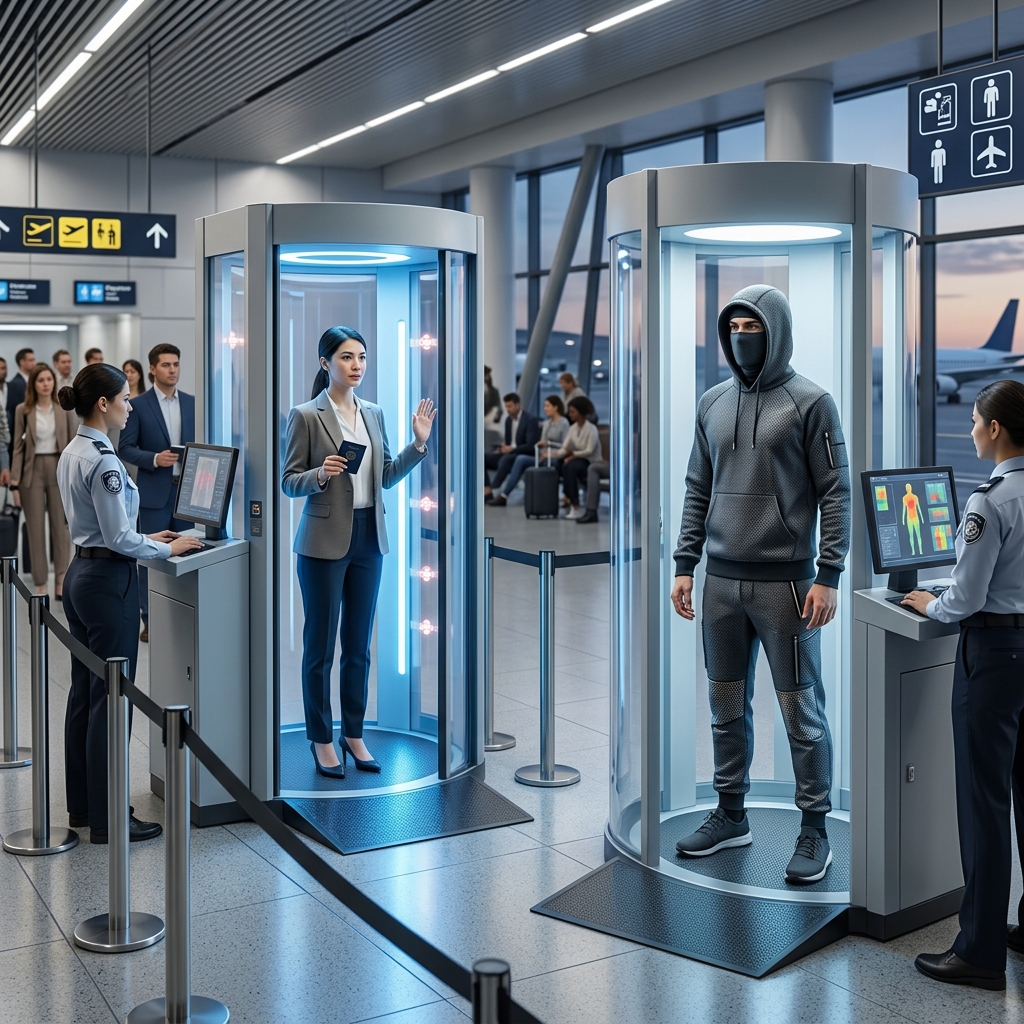
Full-body scanners have become a routine part of air travel, but the detailed images they can generate continue to spark debate about privacy, dignity, and civil liberties. While governments and scanner manufacturers have introduced software filters and policy safeguards, a small market of privacy-focused clothing and accessories has emerged to give passengers a sense of control over how they are seen at the checkpoint.
This article examines how airport body scanners work, the nature of the privacy concerns they create, the legal and policy responses that followed, and the role of consumer products designed to shield or blur intimate details. It also looks at how security agencies and technology vendors are attempting to preserve safety without sacrificing basic rights.
From Metal Detectors to Full-Body Imaging
For decades, airport security relied on walk-through metal detectors and physical pat-downs to detect weapons or contraband. Rising concerns over non-metallic explosives and concealed items led governments, especially in North America and Europe, to install full-body imaging systems that could see beneath clothing.
These scanners use two main imaging technologies:
- Backscatter X-ray: Emits low-level X-rays that reflect off the surface of the body, producing an image that can show objects hidden under clothing.
- Millimeter-wave radar: Uses radio-frequency waves to map the contours and reflectivity of the body and any concealed items.
Early deployments often produced images with a high level of anatomical detail, which quickly raised public alarm. Civil liberties groups likened the images to virtual strip searches, and passengers questioned whether airport security should require such invasive technology as the default screening option.
Why Airport Body Scanners Raise Privacy Concerns
Although security agencies frame full-body scanners as a way to detect threats that traditional metal detectors miss, the same capability that makes them powerful also makes them controversial. Several distinct privacy risks have been identified.
Detailed Imaging of the Human Body
In their early form, scanner outputs could reveal breast contours, genital outlines, medical appliances, and other sensitive bodily details. Even when images are viewed by security staff in a separate room, many passengers are uncomfortable with the idea that strangers may see intimate aspects of their bodies simply to board a plane.
Image Storage and Transmission Risks
Security agencies initially claimed that scanners would not store images, but subsequent disclosures revealed that procurement specifications sometimes required devices to include storage and export functionality, to be disabled in operational use. This disconnect between public assurances and technical capabilities fueled distrust and contributed to fears that images could be saved, shared, or leaked.
The risk is not purely theoretical. In several jurisdictions, investigations have confirmed that test or training images were saved and that misconfigured systems could retain data longer than policy allowed. Privacy regulators argue that the ability to store images should be tightly constrained or removed altogether.
Linking Images to Personal Identity
Even when images are anonymized on screen, they can be linked to specific individuals through the context of a screening lane, timestamps, or other identifiers. The European Council has therefore required that personnel who analyze images be located separately and that images not be linked to personally identifiable information. Privacy advocates point out that any link between detailed body images and passenger identities heightens the potential harm of misuse or breach.
Cultural and Psychological Impacts
Policies around modesty and privacy differ widely across cultures and individuals. Some passengers, including survivors of sexual trauma and those with particular religious beliefs, experience scanner use as invasive or distressing. Others may feel discriminated against if they are more frequently directed to secondary screening. These broader psychological and social concerns reinforce calls for less intrusive technologies and clearer opt-out options.
Legal and Policy Responses to Scanner Privacy Issues
Governments and regulators have attempted to balance the need for security with the protection of privacy through a mix of technical requirements and operational policies. Key responses include limitations on image detail, strict handling rules, and data minimization.
Privacy Filters and Software-Based Protections
Privacy commissioners and data protection authorities have advocated the use of strong software filters that transform raw scanner images into abstract outlines. Under these systems, front-line screeners do not see anatomical detail. Instead, they see a generic body template on which potential threat areas are highlighted using boxes or icons.
Millimeter-wave scanners in many countries now use software that displays a uniform, cookie-cutter silhouette for all passengers, regardless of gender or body type. The system automatically identifies unusual items hidden under clothing and marks only those areas for further inspection. This change was introduced specifically to reduce privacy concerns and has become the global norm for many deployments.
Rules on Viewing, Storage, and Retention
Regulators have also defined how scanner images may be viewed and handled. Some of the commonly adopted safeguards include:
- Only trained personnel may access scanner output, often in a separate room away from the screening lane.
- Images must not be linked to passenger identity or boarding data.
- Storage and transmission functions must be disabled during operational use, except where strictly necessary and regulated.
- Any retained images may only be used for testing, calibration, or legal investigations under defined oversight.
Data protection law in regions such as the European Union reinforces these rules by requiring that any personal data processing be limited to the minimum necessary and that privacy-friendly settings be enabled by default.
Opt-Out Options and Alternative Screening
In many jurisdictions, passengers who decline to use a full-body scanner may request an alternative such as a pat-down or metal detector screening. While this preserves some autonomy, privacy advocates note that the alternative is often more time-consuming and may itself feel invasive. They argue that truly privacy-protective security should not force a choice between technological exposure and physical contact.
The Emergence of Privacy Protection Clothing and Accessories
Public unease about scanner imaging has given rise to niche products marketed as ways to protect modesty or disrupt what the scanner reveals. These items range from humorous novelty designs to technically sophisticated garments incorporating shielding materials.
Novelty and Symbolic Protection Gear
Shortly after full-body scanners became prominent in news coverage, entrepreneurs began selling underwear and stickers featuring strategically placed graphics, such as fig leaves or opaque shapes. The products serve partly as satire and protest, calling attention to the perceived intrusiveness of the technology, and partly as an attempt to cover sensitive areas during screening.
While many of these products have limited practical impact on actual scanner imaging, they highlight the discomfort some travelers feel and act as visible signals of objection to what they perceive as virtual strip searches. The blend of mockery and self-protection illustrates how consumer markets can become a forum for privacy debates.
Shielding Fabrics and Technical Countermeasures
More sophisticated privacy clothing uses materials that interact with X-ray or millimeter-wave signals. Some garments incorporate metallic fibers or conductive meshes designed to obscure or attenuate scanner penetration. Depending on the local rules and scanner type, these materials may appear as anomalies or may partially mask details under the surface.
Such countermeasures raise complex issues. Security agencies may prohibit items that deliberately block imaging or treat them as suspicious, which could lead to extra screening or even denial of boarding. Vendors must therefore tread carefully, often emphasizing that their products do not interfere with detection of weapons but merely add a layer of modesty.
Limitations of Consumer Privacy Products
Even when privacy clothing is allowed, it cannot solve all concerns. Key limitations include:
- Scanner software may highlight any unusual material, leading to more secondary searches.
- Products are often expensive relative to casual travel needs.
- Their effectiveness varies with scanner type and local policy, and is rarely independently verified.
- They address only visual aspects of privacy and not data retention or identity linkage.
As a result, privacy-focused gear tends to function more as an expression of protest and personal preference than as a comprehensive technical solution.
Balancing Security and Privacy: Technology’s Role
Security agencies insist that full-body scanners are necessary to detect modern threats, while privacy regulators emphasize the importance of minimizing intrusiveness. Technology vendors are increasingly attempting to reconcile these positions through privacy-by-design approaches.
Privacy-Preserving Algorithms
Modern people-screening systems now integrate algorithms that automatically remove or blur anatomical detail while retaining the ability to highlight anomalies. This includes:
- Rendering every passenger as the same abstract silhouette.
- Restricting outputs to simple icons indicating where a potential threat may be located.
- Embedding controls to ensure that raw images cannot be accessed by front-line staff.
Some privacy commissioners argue that such filters can turn otherwise privacy-invasive surveillance tools into more acceptable, transformative technologies that meet security needs without exposing sensitive information.
Operational Efficiency vs. False Alarms
Privacy filters can sometimes increase false alarms, because the algorithm must decide whether a particular anomaly is a threat without relying on detailed visual cues. Higher false positives mean more secondary inspections and can reduce throughput at busy checkpoints. Vendors are therefore investing in more advanced detection models, including artificial intelligence techniques, to improve accuracy without sacrificing privacy.
At the same time, markets for airport scanning technologies continue to grow as air travel recovers and security standards tighten. Industry research notes steady increases in demand for advanced screening systems at checkpoints worldwide. This growth reinforces the importance of embedding privacy protections into design rather than treating them as optional add-ons.
Regulatory Pressure and Data Protection Law
Data protection frameworks such as those in the European Union require that body scanner deployments comply with principles of necessity, proportionality, and data minimization. Where scanners generate personal data, operators must demonstrate that no less intrusive means can achieve the same security goals and that privacy-friendly settings are enabled by default.
These legal obligations encourage airports and vendors to adopt anonymized imaging, short retention times, strong access controls, and clear transparency policies about how scanners work and what passengers can expect.
Traveler Strategies for Maintaining Privacy
Individual passengers cannot redesign airport security, but they can take steps to better understand and manage their privacy exposure. Common strategies include:
- Learning local rules: Regulations and practices vary by country; knowing whether scanners use filtered images or allow opt-out requests helps travelers make informed choices.
- Using alternative screening: Where permitted, passengers can request a pat-down instead of a scan, though this may be more time-consuming and intrusive in other ways.
- Choosing clothing thoughtfully: While no outfit can fully defeat scanner imaging, some travelers select garments that make them personally more comfortable with the process.
- Evaluating privacy-focused products: Those particularly concerned about modesty may consider specialized garments or accessories, keeping in mind local rules and potential secondary screening.
- Engaging in policy discussions: Providing feedback to regulators and participating in public consultations can influence how future systems are designed and governed.
Privacy and Airport Body Scanners: A Comparative Overview
The table below summarizes how different scanner approaches and mitigation strategies address privacy and security objectives.
| Approach | Privacy Impact | Security Effectiveness | Typical Use |
|---|---|---|---|
| Unfiltered body imaging | High; detailed anatomy visible, risk of misuse or leakage. | Strong detection of concealed items, including non-metallic. | Early deployments; largely replaced by filtered systems in many regions. |
| Filtered silhouette imaging | Moderate to low; anatomy obscured, images anonymized. | Good; relies on algorithmic detection and highlighting anomalies. | Common in millimeter-wave scanners at modern checkpoints. |
| Pat-down alternative | Varies; physical contact may feel intrusive but avoids imaging. | Effective if conducted thoroughly, but slower and labor-intensive. | Offered to passengers who decline scanning in many jurisdictions. |
| Privacy clothing and accessories | Symbolic protection; may cover areas but can trigger alarms. | Neutral or negative if materials interfere with imaging. | Niche market; used by privacy-conscious or protesting travelers. |
Frequently Asked Questions About Airport Scanner Privacy
Do airport body scanners show a naked image of my body?
Early scanner systems could produce images that resembled a nude outline, displaying contours and certain physical features. Most modern scanners in major airports now use software that shows only a generic silhouette and highlights potential threat areas, so front-line screeners do not see detailed anatomy.
Can airport scanners store or share images of passengers?
Security agencies have generally committed to disabling image storage in routine operations, and many regulations prohibit linking images to identifiable passengers. However, some scanner hardware includes storage and transmission capabilities for testing or training, which has led privacy authorities to call for strict controls and independent oversight.
Am I allowed to refuse a body scan?
In several jurisdictions, passengers may opt out of full-body scanning and request alternative screening, often a pat-down. The exact options and consequences vary by country and airline, so travelers should check local policies before departure.
Do privacy protection garments really work?
Some products can change how scanners display certain areas or materials, but their effectiveness is highly dependent on the technology used at a specific airport and on local rules. They may also lead to more secondary screening if they create anomalies in the image. These garments are best seen as a personal comfort measure rather than a guaranteed technical solution.
How are regulators addressing scanner privacy concerns?
Data protection authorities advocate privacy filters that remove anatomical detail, strict limits on image storage, separation between screeners and passengers, and clear opt-out procedures. They also encourage airports and vendors to design systems that collect the least amount of personal data necessary to achieve security goals.
References
- Full body scanner — Various contributors (summarizing regulatory and technical developments). Last substantial update 2023-07-15. https://en.wikipedia.org/wiki/Full_body_scanner
- Whole Body Imaging in Airport Scanners: Activate Privacy Filters to Turn a Privacy-Invasive Technology into a Privacy-Protective Transformative Technology — Information and Privacy Commissioner of Ontario. 2010-06-01. https://www.ipc.on.ca/en/media/1524/download?attachment
- People Screening — Leidos. Last accessed 2026-07-09. https://www.leidos.com/markets/aviation/security-detection/aviation-checkpoint/people-screening
- Airport Scanners Market Size, Share & Trends Report — Mordor Intelligence. 2024-03-30. https://www.mordorintelligence.com/industry-reports/airport-scanners-market
- Commercial Airport Full Body Scanner Market — Market Research Future. 2024-11-15. https://www.marketresearchfuture.com/reports/commercial-airport-full-body-scanner-market-24540
Similar Articles








Read full bio of Sneha Tete


