
Air Travel Rules for Unaccompanied Minors
A practical legal and safety guide for parents planning airline travel for children flying without an adult companion.
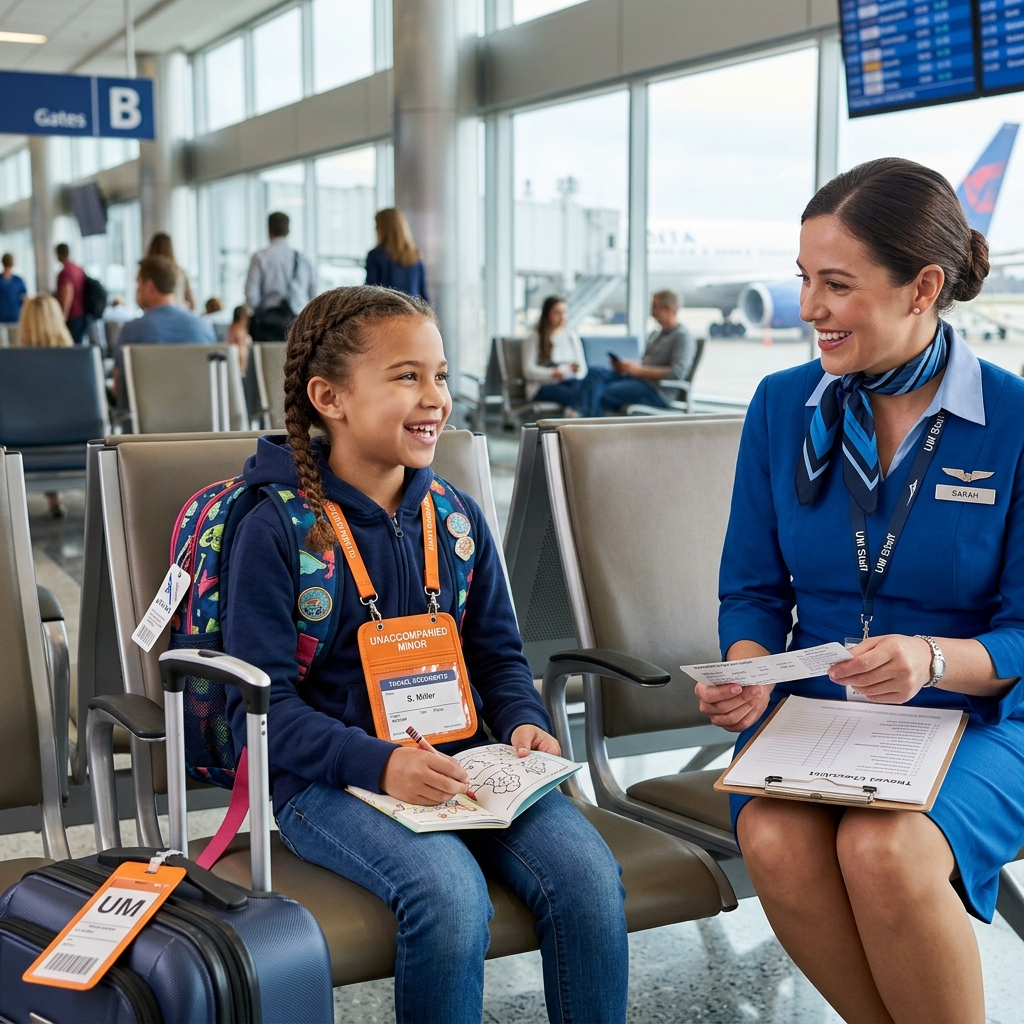
When a child travels by air without a parent or guardian, airlines classify them as unaccompanied minors and apply special rules, fees, and safety procedures. Parents considering solo air travel for their children need to understand both airline policies and basic legal responsibilities to ensure a safe and compliant trip.
This guide explains how major airlines handle unaccompanied minors, typical age limits and fees, what forms and documents are required, and practical steps parents can take before, during, and after the flight to protect their child.
What Does “Unaccompanied Minor” Mean?
In airline practice, an unaccompanied minor (UM) is generally a child who travels on a flight without an adult companion, or whose accompanying adult is not seated in the same cabin. While specific rules differ by airline, common features include:
- Age-based classification — Most airlines treat children between about 5 and 14 as unaccompanied minors when they travel alone.
- Mandatory service — For younger children, enrollment in an unaccompanied minor program is often required if they are not flying with an adult of a specified age (commonly 15 or 18).
- Special handling — Airline staff supervise check-in, boarding, in-flight monitoring, and handoff at arrival to an authorized adult.
Parents should treat unaccompanied minor programs not just as customer service options, but as structured safety systems designed to reduce risk when children travel alone.
Typical Age Limits and Eligibility Rules
Although each carrier sets its own policy, there are consistent patterns in how airlines accept children traveling alone.
General Age Categories
| Age Range | Typical Treatment | Common Requirements |
|---|---|---|
| Under 5 years | Usually not allowed to travel alone. | Must travel with an adult; no UM service offered. |
| 5 – 11 years | Generally must use UM service when traveling alone. | Mandatory escort procedures, limited to nonstop or specific itineraries. |
| 12 – 14 years | Often still classified as UM if not with an adult of required age. | UM program usually required or strongly recommended. |
| 15 – 17 years | Commonly allowed to travel alone without UM service. | UM service optional; parents may request extra supervision. |
Some airlines set narrower windows — for example, limiting UM service to 5–14 and treating older teens as regular passengers. A few carriers do not offer any UM service and simply prohibit children below a certain age from traveling alone.
Examples from Major U.S. Airlines
Official policies illustrate how age rules operate in practice:
- American Airlines — Requires children aged 5–14 traveling alone to use the UM service; children 15–17 may enroll optionally for an extra fee.
- Delta Air Lines — Its UM program covers ages 5–17 when traveling alone or in a different cabin from their adult; enrollment is mandatory for ages 5–14 and optional for 15–17.
- United Airlines — Accepts unaccompanied minors from 5–14 and does not permit children under 5 to fly without an adult.
Parents should always confirm the latest rules directly with the airline before booking, particularly for international routes or flights involving connections.
Service Fees and Cost Considerations
Unaccompanied minor services almost always involve a separate fee in addition to the ticket price. Independent analyses of airline policies indicate that fees often fall between $50 and $150 one way, depending on the carrier, route, and whether the flight is nonstop or connecting.
How Airlines Charge for UM Services
- Flat per-direction fee — Many airlines charge a single fee each way per child, such as $150 each direction.
- Sibling or group coverage — Some carriers allow multiple children on the same reservation to share one fee, covering siblings traveling together.
- Variation by flight type — Fees can differ for nonstop versus connecting flights or for domestic versus international travel.
Parents should factor these service charges into the overall cost and compare them with alternatives such as traveling with the child or selecting a nonstop route with simpler handling requirements.
Common Safety and Supervision Procedures
Airlines design unaccompanied minor procedures to manage risk from check-in through arrival. While the details vary, there are standard steps parents can expect.
Before Departure at the Origin Airport
Most carriers require the accompanying adult to arrive well before departure (often at least two hours) and complete specialized documentation.
- Check in at the ticket counter; online or kiosk check-in is usually not allowed for UM bookings.
- Provide the child’s proof of age, such as a birth certificate or passport.
- Supply government-issued photo ID and current address for the adult dropping off the child.
- List contact information and full details for the adult who will meet the child on arrival.
- Fill out an unaccompanied minor form that stays with the child during the trip.
Once documentation is complete, the adult typically receives a security pass to escort the child to the boarding gate and remain there until the flight departs.
Boarding and In-Flight Care
Unaccompanied minors are usually boarded early and introduced to the cabin crew.
- The gate agent alerts flight staff to the presence of an unaccompanied minor on board.
- The child meets the crew and is briefed on basic safety features of the aircraft.
- Crew members monitor the child during the flight and assist with practical needs such as seat changes or comfort issues.
Some airlines emphasize that this monitoring is periodic rather than continuous, so children must have sufficient maturity to follow instructions and manage short periods without direct supervision.
Arrival and Handoff to the Designated Adult
At the destination, airline staff escort the child from the aircraft to the arrival gate or another designated meeting point.
- The adult meeting the child must present valid photo identification and match the information listed on the UM form.
- Airline staff will not release the child to anyone whose details do not match the documented recipient.
- Parents are often advised to arrive at the destination airport well before scheduled arrival to secure a gate pass and position themselves at the meeting location.
Parents should coordinate closely with the receiving adult, confirming arrival times and allowing for delays, as the airline focuses on custody transfer rather than extended supervision after the child exits the secure area.
Legal and Practical Responsibilities for Parents
While airlines operate UM programs as a safety measure, parents retain primary responsibility for deciding whether solo air travel is appropriate for their child. Key legal and practical considerations include maturity, documentation, and emergency planning.
Assessing Whether a Child Is Ready to Fly Alone
Age limits are minimum thresholds, not guarantees of readiness. Parents should consider:
- Maturity level — Can the child follow instructions, ask for help, and handle unexpected changes calmly?
- Health and special needs — Children with medical conditions or disabilities may need additional support beyond standard UM services.
- Travel complexity — Nonstop daytime flights are typically less demanding than late-night trips or itineraries involving multiple segments.
Key Documents and Information to Prepare
Even when not legally mandated, having complete documentation reduces the risk of delays or miscommunication.
- Government ID for all adults involved in drop-off and pickup.
- Child’s passport for international travel or birth certificate for age verification where required.
- Printed itinerary and emergency contact list for the child.
- Copies of any custody orders or consent letters if relevant to who may receive the child.
Route Restrictions and Flight Types
Airlines often impose route and flight-type limits on unaccompanied minors to reduce risk.
Nonstop vs. Connecting Flights
Carriers commonly restrict young unaccompanied minors to nonstop flights to avoid the complexity of transfers between planes. Some explicitly prohibit UMs on connecting or direct flights that involve intermediate stops.
Where connections are allowed, they may be limited to older children and require special approval or additional fees.
Domestic vs. International Travel
Unaccompanied minor rules can be more restrictive for international journeys due to border controls, immigration procedures, and varying legal requirements in destination countries. Parents should confirm:
- Whether the airline accepts UMs on specific international routes.
- Any additional forms required for cross-border travel, such as notarized consent to travel.
- Language considerations for children arriving in countries where they may not speak the local language.
Practical Tips to Improve Safety and Comfort
Beyond following airline rules, parents can take extra steps to make solo air travel safer and more comfortable for their child.
Planning the Itinerary
- Choose daytime flights when possible, which are generally easier for children.
- Favor nonstop routes to reduce the complexity of transfers.
- Avoid tight connections and risky weather seasons when possible.
Preparing the Child
- Explain the travel steps: check-in, security, boarding, and arrival.
- Rehearse how to ask airline staff for help if the child feels uncomfortable or confused.
- Pack simple comfort items (book, small toy, snacks if allowed) and label bags clearly with contact information.
Communication During the Trip
- Ensure the child knows how to reach both the departing and receiving adults.
- Share flight status updates between adults at both ends of the journey.
- Keep phones available and charged in case airline staff need to reach parents.
Frequently Asked Questions (FAQs)
Can a child under 5 ever fly alone?
Generally, no. Many major airlines do not accept children under 5 as unaccompanied minors and require them to travel with an adult on the same flight. Parents should assume that solo travel is not permitted at this age.
Is the unaccompanied minor fee optional?
For children in the mandatory UM age range (commonly 5–14), the fee is typically required when they travel alone. For older teens, enrollment in the UM program — and the associated fee — may be optional.
Can I book an unaccompanied minor ticket online?
Some airlines allow initial booking online but still require in-person check-in at the airport. Others may require reservations to be made by phone so staff can verify eligibility and explain the specific procedures.
Who is allowed to pick up the child at the destination?
Only the adult listed on the UM paperwork and verified with photo ID can receive the child. Airlines will not release the child to anyone whose identity does not match the documentation provided at check-in.
Are unaccompanied minors supervised constantly?
No. Airlines emphasize that unaccompanied minors are not watched every moment; staff monitor them at key points and are available if needed, but children must be able to function independently for short periods. Parents should consider this when deciding if their child is ready.
References
- Unaccompanied minor (passenger) — Wikipedia. 2024-03-01. https://en.wikipedia.org/wiki/Unaccompanied_minor_(passenger)
- Guide to Unaccompanied Minor Policies for U.S. Airlines — Upgraded Points. 2026-01-10. https://upgradedpoints.com/travel/airlines/unaccompanied-minor-policies-guide/
- Flying solo: Airline unaccompanied minor policies and fees in the US — The Points Guy. 2023-08-15. https://thepointsguy.com/news/airline-unaccompanied-minor-policies-and-fees-in-the-united-states/
- Unaccompanied Minors | Delta Air Lines — Delta Air Lines. 2025-06-01. https://www.delta.com/us/en/children-infant-travel/unaccompanied-minor-program
- Unaccompanied minors − Travel information — American Airlines. 2025-04-20. https://www.aa.com/i18n/travel-info/special-assistance/unaccompanied-minors.jsp
- Unaccompanied minors – United Airlines — United Airlines. 2025-03-12. https://www.united.com/en/us/fly/travel/accessibility-and-assistance/unaccompanied-minors.html
- Southwest Unaccompanied Minor (ages 5-11) Policy — Southwest Airlines. 2024-11-18. https://support.southwest.com/helpcenter/s/article/unaccompanied-minors-flying-alone
Similar Articles








Read full bio of medha deb


