
AI Data Center Noise: Legal Risks and Resident Rights
How constant noise from AI data centers is sparking lawsuits, reshaping local regulations, and redefining community rights across the U.S.
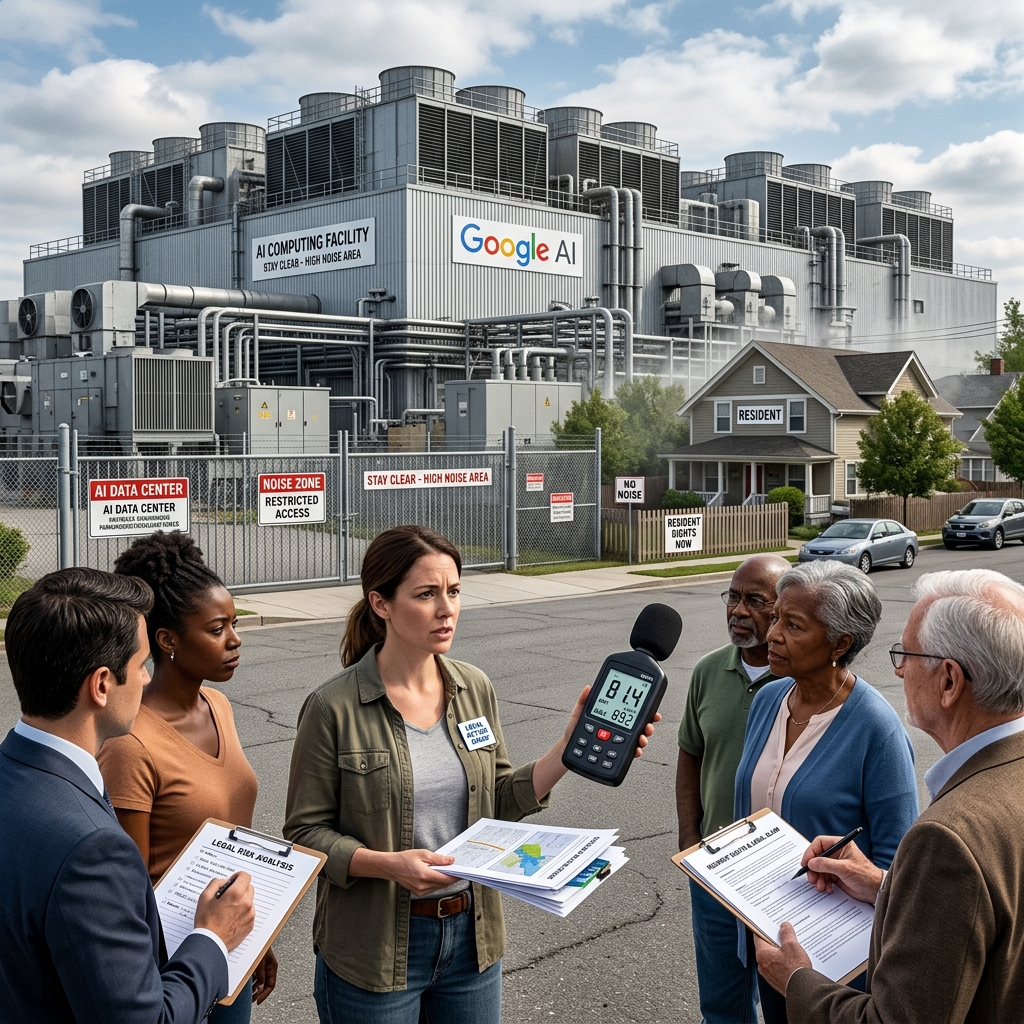
Large-scale AI data centers have become critical infrastructure for cloud computing and machine learning, but their arrival in residential and semi-rural neighborhoods has triggered a growing wave of complaints and lawsuits over noise pollution and related environmental impacts. In many communities, residents now find themselves living next to facilities that operate 24 hours a day, generating a constant mechanical hum that they say interferes with sleep, outdoor activities, and overall quality of life.
This article explains how AI data centers create noise, the legal theories residents are using to challenge that noise, the types of damages they may seek, and practical steps both neighbors and operators can take to prevent or resolve conflicts. It is based on recent cases and investigations but is written in general terms, not as legal advice.
Why AI Data Centers Are So Noisy
Modern AI data centers cluster tens of thousands of servers, each consuming power and producing heat that must be continually removed using cooling systems and backup generators. The scale of these facilities, combined with their always-on operations, can create noise that is markedly different from typical commercial or industrial sites.
Common Sources of Data Center Noise
- HVAC and cooling equipment – chillers, cooling towers, air-handling units, condenser fans, and other components run continuously to keep servers within safe operating temperatures.
- Backup diesel generators – used for power reliability and sometimes tested on a regular schedule, producing low-frequency rumbling and intermittent high noise levels.
- Electrical equipment – transformers and switchgear can emit persistent hums and vibrations.
- Construction and expansion activities – in fast-growing campuses, ongoing building work adds intermittent heavy equipment noise.
Residents living close to these facilities describe the combined effect as a constant droning background sound that is difficult to escape, even indoors with windows closed.[11] In some cases, complaints also include light pollution from bright exterior lighting and visual impacts from large mechanical structures.
How Noise Is Measured and Evaluated
Noise impacts are typically assessed using decibels (dB), often with A-weighting (dBA) to reflect human hearing sensitivity. Many local governments set maximum allowable dBA levels at property lines, with lower limits at night in residential areas. However, legal disputes often focus not just on decibel readings, but on whether the noise is unreasonable or interferes with ordinary use and enjoyment of property.
| Factor | Typical Considerations |
|---|---|
| Intensity | Measured decibel level at nearby homes, especially at night and early morning. |
| Duration | Whether noise is constant, intermittent, limited to daytime, or truly 24/7.[11] |
| Character | Low-frequency humming, tonal noise, or impulsive sounds that may be more annoying than simple volume suggests. |
| Context | Whether the area is residential, mixed-use, or already highly industrial. |
| Mitigation | Existence and adequacy of sound barriers, enclosures, and operational limits. |
Legal Theories Used in Noise Pollution Lawsuits
Residents affected by AI data center noise have increasingly turned to the courts, filing individual cases and class actions that rely on established doctrines of nuisance, negligence, and statutory violations. Although specific laws vary by state, several common themes appear in these claims.
Private Nuisance: Interference with Property Use
Private nuisance is a central theory in many data center noise cases. A private nuisance occurs when a defendant’s activities substantially and unreasonably interfere with a plaintiff’s use and enjoyment of their property. Courts look at the severity, duration, and character of the interference, as well as the nature of the neighborhood.
Typical allegations in AI data center nuisance claims include:
- Unreasonable and excessive noise reaching homes at all hours, including overnight.
- Loss of ability to sleep, relax outdoors, or open windows without disturbance.[11]
- Reduction in property value due to the constant noise and proximity to a large industrial facility.
Residents may argue that even if the data center serves public or economic benefits, its operation is unreasonable when viewed from the standpoint of nearby households.
Negligence and Failure to Mitigate
Many lawsuits also claim that operators are negligent because they did not design, construct, or modify their facilities to adequately control noise, even though such impacts were foreseeable. Negligence claims often highlight:
- Lack of effective acoustic barriers, walls, or enclosures between mechanical equipment and homes.
- Insufficient noise studies before construction or expansion.
- Failure to respond to complaints or to adjust operations after impacts became clear.
In some investigations, plaintiffs’ firms specifically look at whether the operator complied with environmental permitting requirements and local zoning conditions related to noise.
Violations of Local Noise Ordinances and Environmental Rules
Beyond common law claims, lawsuits may allege violations of:
- Municipal noise ordinances that set maximum nighttime and daytime sound levels at property lines.
- Zoning conditions attached to land-use approvals, such as limits on generator testing hours.
- State environmental regulations governing industrial noise and nuisance emissions.
In some cases, residents contact local authorities regularly to document repeated breaches of noise limits, building a record that can later support civil actions.
Recent Examples of Data Center Noise Disputes
Several high-profile disputes illustrate how AI data center noise is moving from a local annoyance into a broader policy and legal issue.
Wisconsin Class Action Against a Major AI Facility
In Wisconsin, residents living near a large AI-focused data center have filed a class action lawsuit alleging substantial and constant noise, combined with extreme light pollution from the multibillion-dollar facility. The complaint cites diesel generators and extensive HVAC equipment as sources of pervasive mechanical sound, and claims the operator failed to install adequate acoustic barriers or shields.
The lawsuit seeks compensation for property damage, loss of enjoyment of homes, emotional distress, and reduction in property values, as well as potential injunctive relief requiring noise mitigation.
Neighborhood Action in New Jersey and Michigan
Similar concerns have arisen in other states. In New Jersey, residents near a data center have reported continuous noise that they say disrupts daily life and community activities, prompting litigation and calls for stronger state-level guardrails on data center development. In Michigan, neighbors living next to a data center have publicly described “never-ending” mechanical noise, emphasizing the difficulty of escaping the sound even indoors.[11]
These cases show that noise disputes are not limited to one company or one region; they reflect a broader tension between rapid digital infrastructure growth and the expectations of communities that did not anticipate living next to quasi-industrial facilities.
Investigations into Noise and Water Impacts
Some law firms are now conducting multi-state investigations into data center noise and related environmental concerns, including water use and potential contamination. These investigations invite residents to share experiences of nonstop noise, degraded water quality, and other harms, with the goal of forming class actions or mass torts that can address systemic issues rather than isolated complaints.
Potential Remedies and Damages
When residents sue AI data center operators, they often seek both financial compensation and operational changes to reduce noise going forward.
Types of Damages Sought
- Property damage and loss of value – claims that constant noise makes homes less desirable and reduces resale prices.
- Costs of mitigation – expenses for installing soundproof windows, insulation, or white-noise devices to cope with the noise.
- Loss of enjoyment of property – compensation for the inability to use outdoor spaces or sleep normally.
- Emotional distress, annoyance, and discomfort – recognition of the psychological and physical strain caused by persistent noise.
In some cases, plaintiffs also request medical monitoring to track potential long-term health effects of chronic noise exposure, such as stress-related conditions or cardiovascular risks, although such claims can raise complex scientific and legal questions.
Non-Monetary Relief
Residents frequently seek injunctive relief requiring operators to implement noise controls, change operating practices, or modify site design. Examples include:
- Installing higher or more effective sound walls and acoustic enclosures around noisy equipment.
- Relocating particularly loud machinery farther from homes.
- Limiting generator testing or other noisy activities to daytime hours.
- Adjusting lighting and visual screening to reduce light pollution.
From a legal risk perspective, such remedies can be as significant as financial damages because they may require substantial capital investments and operational changes.
Local Governments and Emerging Policy Responses
As complaints grow, local and state governments are beginning to reconsider how they regulate data centers, especially those designed for AI workloads that push power and cooling demands higher.
Strengthening Noise Ordinances and Planning Rules
Policy responses may include:
- Updated noise ordinances that explicitly address large mechanical installations and set stricter nighttime limits in residential zones.
- Conditional use permits requiring detailed noise studies, public consultation, and binding mitigation measures.
- Buffer zone requirements that mandate minimum distances between data center equipment yards and homes.
- Monitoring and enforcement mechanisms such as continuous noise monitoring at property boundaries and penalties for non-compliance.
Some officials have publicly discussed creating broader guardrails for data center development, balancing economic incentives with environmental and health protections for neighboring communities.
Practical Steps for Affected Residents
Residents who believe they are impacted by AI data center noise have several options, ranging from informal engagement to formal litigation. While each situation is unique, common steps include:
Documenting the Noise Problem
- Keep a log of noise events noting time, duration, and perceived intensity.
- Record short audio or video clips from typical locations, such as bedrooms and backyards.
- Track any health or lifestyle impacts (sleep disruption, stress, reduced use of outdoor spaces).
- Collect information about property value changes, such as local real estate listings before and after data center construction.
Working with Authorities and Operators
- Review local noise ordinances and zoning conditions to understand applicable limits.
- File complaints with municipal agencies or environmental authorities when noise exceeds expected levels.
- Engage with the data center operator, requesting information on mitigation plans and offering specific suggestions.
- Participate in public hearings or planning processes to shape future expansions.
Considering Legal Action
If informal efforts do not resolve the problem, residents may consult attorneys experienced in environmental, land-use, or class action litigation. Legal counsel can evaluate whether the facts support nuisance, negligence, or statutory claims, and whether a class action structure is appropriate when many neighbors face similar impacts.
Risk Management for AI Data Center Operators
Operators of AI data centers have strong incentives to manage noise proactively, both to maintain community relations and to reduce exposure to costly lawsuits and regulatory scrutiny.
Designing for Noise Control from the Start
- Conduct detailed acoustic modeling during site selection and design, considering nearby homes and sensitive receptors.
- Place noise-intensive equipment (e.g., generators, cooling towers) in locations that maximize distance and shielding from residences.
- Integrate sound walls, enclosures, and vibration controls into initial construction rather than retrofitting later.
Operational Practices to Reduce Impacts
- Schedule generator tests and other intermittent loud activities during daytime hours.
- Monitor noise continuously at key boundaries and respond quickly when levels approach regulatory limits.
- Establish community liaison programs to receive feedback and communicate mitigation efforts.
- Plan for future expansion with noise in mind, avoiding incremental increases that cumulatively push impacts over acceptable thresholds.
By treating noise as a core design and operational issue, rather than an afterthought, operators can better balance AI infrastructure growth with neighborhood livability.
Frequently Asked Questions (FAQ)
Is AI data center noise different from other industrial noise?
Yes. While many industrial facilities produce intermittent or daytime-only noise, AI data centers often operate at high intensity around the clock. The combination of continuous HVAC systems, generators, and electrical equipment can create a persistent mechanical hum that some residents find more intrusive than sporadic industrial noise.[11]
Do I need high decibel readings to bring a nuisance claim?
Not necessarily. Nuisance law focuses on whether the interference with property use is substantial and unreasonable, which can depend on context, duration, and character as much as raw decibel numbers. However, noise measurements can be important evidence when arguing that impacts exceed typical or legal limits.
Can multiple neighbors join together in a lawsuit?
Yes. When many residents experience similar impacts from the same facility, they may pursue a class action or coordinated claims. Recent cases against large AI data centers have used class action structures to address widespread noise and light pollution affecting entire neighborhoods.
What kinds of non-financial outcomes are possible?
Courts can order operators to implement specific noise-control measures, modify generator testing schedules, install sound barriers, or alter lighting practices. In some situations, regulatory agencies may also require mitigation or impose conditions on future expansion.
Are governments changing rules because of these disputes?
In some jurisdictions, yes. As complaints about data center noise and environmental impacts grow, local and state officials have discussed new guardrails for data centers, including stricter noise requirements, buffer zones, and more robust permitting processes that consider community impacts.
References
- The ‘world’s most powerful AI data center’ hit with massive class-action lawsuit — TechRadar Pro. 2026-06-26. https://www.techradar.com/pro/the-worlds-most-powerful-ai-data-center-hit-with-massive-class-action-lawsuit-wisconsin-residents-allege-noise-and-extreme-light-pollution-at-usd7-3-billion-microsoft-mega-facility
- Microsoft’s $7.3 billion AI data centre has been sued by neighbours sick of noise that never stops — The Times of India. 2026-06-26. https://timesofindia.indiatimes.com/world/us/microsofts-7-3-billion-ai-data-centre-has-been-sued-by-neighbours-sick-of-noise-that-never-stops-doesnt-let-them-sleep/articleshow/132257306.cms
- Microsoft’s $7.3 Billion AI Data Center Just Caught a Nasty Lawsuit — Futurism. 2026-06-27. https://futurism.com/artificial-intelligence/microsoft-ai-data-center-lawsuit-neighbors
- Data Center Noise Pollution, Water Contamination Lawsuits — ClassAction.org. 2026-04-15. https://www.classaction.org/data-center-noise-water-pollution-lawsuit
- Vineland, New Jersey, residents file lawsuit over noise from AI data center — CBS Philadelphia (video report). 2026-05-30. https://www.youtube.com/watch?v=HR52jhbt0RY
- Data Center Lawsuit Investigation — Berger Montague. 2024-11-12. https://bergermontague.com/cases/data-center-environmental-investigation/
- Life next to a Michigan data center and its never-ending noise — MLive (video report). 2025-08-19. https://www.facebook.com/mlive/videos/life-next-to-a-michigan-data-center-and-its-never-ending-noise/956426047426330/
Similar Articles








Read full bio of Sneha Tete


