
Advancing LGBTQ+ Civil Rights: Laws & Legal Battles
Explore the ongoing struggle for LGBTQ+ civil rights and grassroots activism.
Introduction to the Modern Civil Rights Landscape
The landscape of LGBTQ+ civil rights in the United States has undergone profound and historic transformations over the past several decades. Achieving equality under the law is rarely a linear journey; instead, it requires constantly moving the proverbial ball forward through persistent, multifaceted strategies. The fight for comprehensive civil rights is not merely a historical event relegated to textbooks, but a dynamic, ongoing struggle that demands vigilance, adaptability, and unwavering commitment from community advocates, legal professionals, and everyday citizens alike.
Today, the movement for LGBTQ+ equality operates simultaneously across several overlapping arenas: grassroots community mobilization, high-stakes legislative battles at both the state and federal levels, and complex litigation within the nation’s courts. Understanding how civil rights advance requires recognizing that legal victories do not occur in a vacuum. They are the hard-won culmination of decades of storytelling, targeted public education, and cultural shifts spearheaded by those who historically refused to remain marginalized.
From the early days of localized, street-level protests to the modern era of highly coordinated national legal strategies, the core mechanisms of societal change remain deeply intertwined. This article explores the strategic pillars that continue to drive the LGBTQ+ civil rights movement forward. By carefully examining the essential interplay between community activism, proposed federal legislation like the Equality Act, and landmark Supreme Court decisions, we can better comprehend the complex roadmap for achieving comprehensive equality and the distinct challenges that still threaten to roll back hard-won progress.
The Foundation: Grassroots Activism and Community Mobilization
At the beating heart of every major civil rights advancement is a sturdy foundation built meticulously by grassroots activism. Long before test cases reach the chambers of the Supreme Court or civil rights bills are debated on the floor of Congress, community organizers and local advocates are the ones doing the grueling, crucial work of shifting public opinion and demanding visibility. Grassroots mobilization acts as the primary engine that powers the broader civil rights vehicle, effectively pushing progress forward when established political and legal institutions are too slow or resistant to respond.
In the digital age, community mobilization has found vital new avenues for impact and organization. Internet forums, independent blogs, and sprawling social media platforms have provided marginalized individuals with unprecedented tools to share their lived experiences, document real-time instances of discrimination, and organize collective action without relying on traditional media gatekeepers. This highly decentralized form of activism allows for a remarkably rapid response to localized injustices. Key grassroots tactics include:
- Digital Storytelling and Visibility Campaigns: Utilizing online platforms to build public awareness and humanize the statistical realities of discrimination.
- Local Civic Engagement: Mobilizing communities to pack town halls, city council hearings, and school board meetings to oppose discriminatory municipal policies.
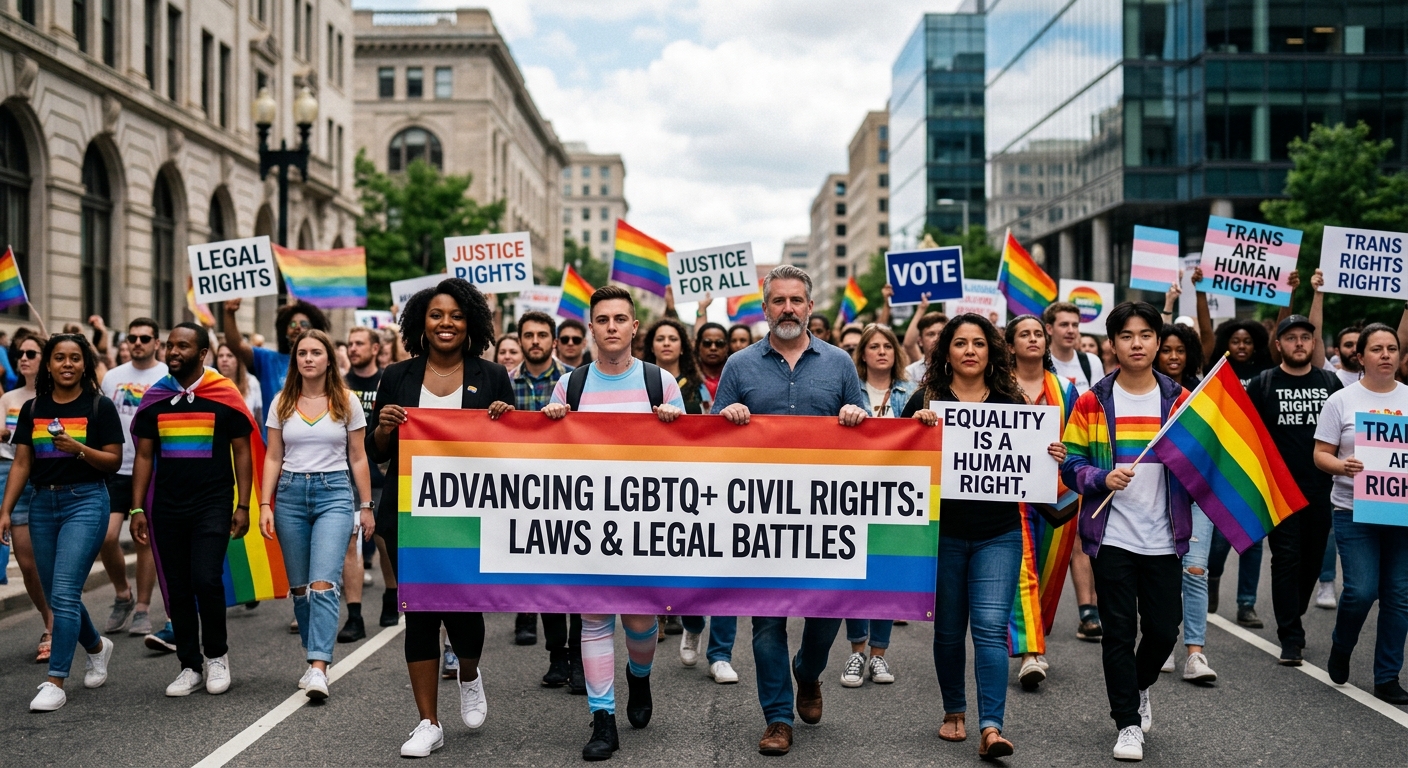
- Direct Action and Protest: Ensuring the public disruption of discriminatory practices through organized rallies and marches, maintaining pressure on elected officials.
By amplifying personal stories, grassroots advocates humanize complex legal and political issues, clarifying to the broader public that civil rights are not abstract legal concepts, but urgent matters of fundamental human dignity, physical safety, and basic survival. Furthermore, local organizers often serve as the first line of defense against state-level anti-LGBTQ+ legislation. They launch targeted awareness campaigns to educate voters and create a palpable political cost for discriminatory behavior, building a groundswell of support that national organizations can later leverage in the courtroom.
Legislative Hurdles and Policy Advocacy
While grassroots activism fundamentally shifts the cultural narrative, dedicated legislative advocacy is required to codify those cultural shifts into enduring legal protections. Currently, the United States relies on a fragmented patchwork of state and local laws regarding LGBTQ+ rights. In some progressive states, LGBTQ+ individuals enjoy comprehensive statutory protections against discrimination in housing, employment, and public accommodations. In many others, however, no explicit statewide protections exist. This leaves individuals highly vulnerable to sudden eviction, job loss, or the denial of medical service simply because of their sexual orientation or gender identity.
This geographical lottery underscores the urgent, undeniable need for comprehensive federal legislative action to ensure equal protection under the law regardless of zip code. The primary vehicle for achieving this national consistency is the Equality Act. Introduced to amend the landmark Civil Rights Act of 1964, the Equality Act proposes to explicitly add sexual orientation and gender identity to the established list of protected classes, which already includes race, color, religion, sex, and national origin. If passed, the legislation would mandate explicit protections across several critical sectors:
- Employment and Housing: Preventing unjust firing, hiring discrimination, and eviction based on identity.
- Public Accommodations: Ensuring equitable, unimpeded access to retail businesses, transportation, and public services.
- Federally Funded Programs: Guaranteeing non-discrimination in state and local services that receive federal tax dollars.
Advocating for the Equality Act and similar policy reforms requires immense coordination and resilience. Civil rights organizations engage in rigorous lobbying, coalition building, and widespread public education campaigns to definitively demonstrate the necessity of these federal protections. However, legislative progress is frequently met with fierce, highly organized opposition. Opponents routinely introduce counter-legislation aimed at rolling back existing civil rights, such as state-level bills aggressively targeting transgender youth participation in sports or restricting access to essential gender-affirming healthcare. Consequently, policy advocacy remains a dual-front battle: pushing forward proactive, inclusive federal legislation while simultaneously playing desperate defense against a steady stream of discriminatory bills at the state level.
The Courtroom Battlefield: Legal Precedents and Protections
When legislative bodies stall indefinitely or actively pass discriminatory laws, the judicial system often emerges as the most critical arena for moving the civil rights ball forward. Strategic, highly coordinated litigation has been a vital cornerstone of the LGBTQ+ rights movement, resulting in some of the most transformative legal victories in modern American constitutional history. Legal organizations meticulously select and argue test cases that possess the potential to establish sweeping national precedents, challenging unconstitutional laws and demanding that the judicial branch forcefully uphold the constitutional promise of equal protection.
Two recent Supreme Court decisions stand as monumental testaments to the sheer power of judicial advocacy. The first is the historic ruling in Obergefell v. Hodges (2015). In this landmark decision, the Supreme Court unequivocally held that the fundamental right to marry is guaranteed to same-sex couples by both the Due Process Clause and the Equal Protection Clause of the Fourteenth Amendment. This decision instantly invalidated state-level constitutional bans on same-sex marriage, declaring that all states must issue marriage licenses to same-sex couples and recognize such marriages legally performed in other jurisdictions. Obergefell was more than a legal victory; it was a profound cultural milestone acknowledging the equal dignity of LGBTQ+ families.
Five years later, the Supreme Court delivered another seismic ruling in Bostock v. Clayton County (2020). The central legal question in Bostock was whether Title VII of the Civil Rights Act of 1964, which heavily prohibits employment discrimination “because of… sex,” inherently encompasses discrimination based on sexual orientation and transgender status. In a definitive decision, the Court ruled that it does. The majority reasoned that it is functionally impossible to discriminate against a person for being homosexual or transgender without necessarily discriminating against that individual based on sex. The Bostock decision effectively granted long-overdue federal workplace protections to millions of LGBTQ+ Americans overnight.
Despite these monumental judicial victories, the courtroom battlefield remains fraught with intricate challenges. The broad application of these precedents is continually tested in aggressive lower court battles, particularly concerning religious exemptions. Advocacy organizations frequently clash over exactly where the constitutional line should be drawn between First Amendment religious freedoms and anti-discrimination mandates. As new judicial appointments continuously alter the ideological makeup of the federal courts, civil rights litigators must proactively adapt their strategies to protect established precedents and fight vigorously against attempts to carve out broad exemptions that could hollow out existing LGBTQ+ protections.
Intersectionality and Compounded Vulnerabilities
To truly and effectively move the civil rights ball forward, the broader movement must consciously embrace an intersectional approach to advocacy. Intersectionality refers to how various social identities—such as race, gender identity, sexuality, disability, and socioeconomic class—overlap and intersect to create entirely unique modes of systemic discrimination and structural privilege. In the context of modern LGBTQ+ advocacy, a generalized, one-size-fits-all approach is deeply insufficient because the myriad challenges faced by the community are far from monolithic.
For instance, LGBTQ+ people of color frequently experience deeply compounded discrimination that stems simultaneously from systemic racism, homophobia, and transphobia. Statistically, they are far more likely to face severe poverty, chronic housing insecurity, and disproportionate targeting by the criminal justice system compared to their white LGBTQ+ counterparts. Similarly, transgender individuals—particularly transgender women of color—face tragic, epidemic levels of violence and confront severe, systemic barriers in accessing competent healthcare and securing stable employment. An advocacy strategy that fundamentally fails to address these specific, intersecting vulnerabilities ultimately leaves the most marginalized and vulnerable members of the community behind.
Furthermore, economic justice is fundamentally recognized as a critical LGBTQ+ civil rights issue. Without equitable, reliable access to safe housing, fair living wages, and comprehensive healthcare, legal rights written on paper do not smoothly translate to lived, everyday equality. Advancing civil rights therefore requires deliberately expanding the scope of advocacy to include fighting for affordable housing, comprehensive and humane immigration reform, and robust disability rights. By centering the distinct voices and critical needs of those who live at the intersection of multiple marginalized identities, the movement ensures that the ball is moved forward for absolutely everyone.
Moving Forward: Sustaining Momentum Against Backlash
The long trajectory of the American civil rights movement involves periods of rapid, thrilling progress inevitably followed by intense, organized reactionary backlash. As LGBTQ+ visibility, societal acceptance, and legal protections expand, organized opposition actively seeks new, sophisticated methods to erode those gains. Sustaining momentum in the face of this relentless backlash requires incredible resilience, strategic adaptability, and the active cultivation of broad-based, diverse coalitions. The movement’s next phase must rigorously focus on securing new, expansive legal rights while aggressively enforcing the vital rights already won.
Corporate responsibility and active allyship will play increasingly vital roles in this pivotal next phase. Modern businesses and large institutions are now heavily expected to go far beyond performative, surface-level support during Pride Month. They must actively implement deeply inclusive internal policies, offer equitable and comprehensive healthcare benefits, and forcefully leverage their massive economic influence to oppose discriminatory state laws. True allies are required to consistently use their platforms to amplify marginalized voices, demand strict accountability from elected officials, and vote in alignment with civil rights values.
Ultimately, moving the civil rights ball forward remains a deeply collective endeavor. It demands the daily courage of individuals choosing to live authentically, the tireless dedication of organizers mobilizing their local communities, the stubborn persistence of lawmakers crafting inclusive policies, and the brilliance of legal minds arguing for justice in the highest courts. While the path ahead may be heavily fraught with legal complexities and steep political obstacles, history demonstrates that organized resistance yields undeniable progress. By remaining highly vigilant, adaptable, and united, the LGBTQ+ community and its dedicated allies can successfully ensure that the momentum for civil rights continues to boldly advance.
Frequently Asked Questions (FAQs)
What is the Equality Act and why is it legally significant?
The Equality Act is a piece of proposed federal legislation designed to formally amend the Civil Rights Act of 1964. Its primary goal is to explicitly prohibit discrimination based on sex, sexual orientation, and gender identity. It is legally significant because it would successfully replace the current, highly inconsistent state-by-state patchwork of laws with uniform, nationwide protections in critical areas like employment, housing, education, and access to public accommodations.
How did the Supreme Court rule in Bostock v. Clayton County?
In the landmark 2020 case Bostock v. Clayton County, the United States Supreme Court ruled that firing an employee strictly for being homosexual or transgender directly violates Title VII of the Civil Rights Act of 1964. The Court definitively determined that workplace discrimination based on sexual orientation or gender identity inherently involves unlawful discrimination based on sex.
Why is grassroots activism still necessary if we have favorable Supreme Court rulings?
While Supreme Court rulings successfully establish critical, binding legal precedents, they do not automatically erase ingrained cultural prejudice or prevent hostile lawmakers from introducing new, nuanced forms of discriminatory legislation. Grassroots activism remains essential to continuously educate the public, hold local officials strictly accountable, loudly push for comprehensive federal legislation like the Equality Act, and actively ensure that high-level legal victories are actually enforced and respected on the ground.
References
Note: The foundational legal cases and statutes cited below, though older than 24 months, are included because they represent uniquely authoritative, controlling, and currently active legal standards for modern civil rights protections in the United States.
- Bostock v. Clayton County, 590 U.S. 644 — Supreme Court of the United States. 2020-06-15. https://www.supremecourt.gov/opinions/19pdf/17-1618_hfci.pdf
- Obergefell v. Hodges, 576 U.S. 644 — Supreme Court of the United States. 2015-06-26. https://www.supremecourt.gov/opinions/14pdf/14-556_3204.pdf
- H.R.5 – Equality Act, 117th Congress — Congress.gov. 2021-03-01. https://www.congress.gov/bill/117th-congress/house-bill/5
- The Equality Act — Human Rights Campaign. 2023-05-10. https://www.hrc.org/resources/the-equality-act
Similar Articles








Read full bio of medha deb


