
Advancing Accessibility Through Modern Building Codes
How building codes, federal civil rights laws, and design practices work together to create an inclusive built environment for people with disabilities.
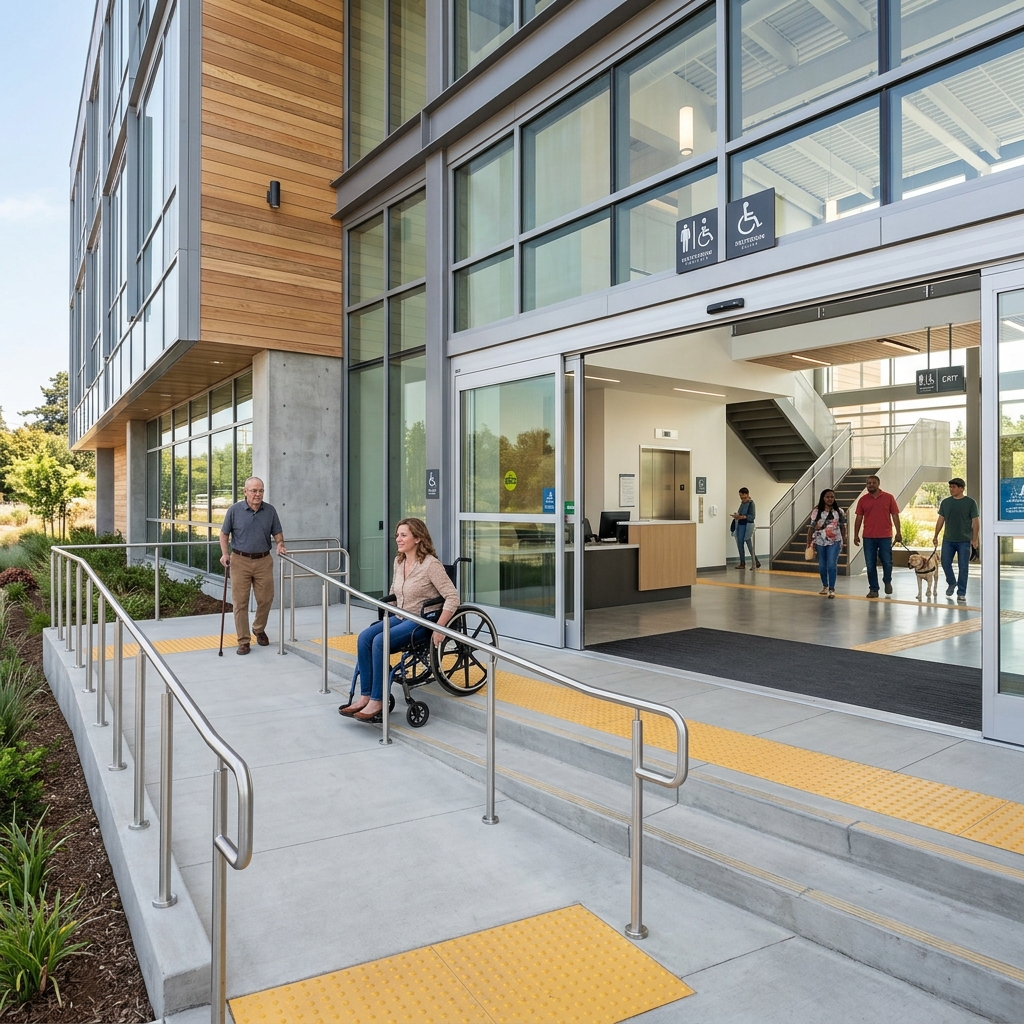
The built environment can either enable or exclude. When doors are too narrow, steps are the only way in, or controls are placed out of reach, people with disabilities face barriers that limit where they can live, work, study, and participate in community life. Modern building codes, operating alongside federal civil rights laws, are a powerful tool for removing these barriers and ensuring that physical spaces are designed to be usable by everyone.
This article explains how building codes and federal accessibility requirements intersect, the role of key laws such as the Americans with Disabilities Act (ADA) and the Fair Housing Act (FHA), and how policymakers, code officials, and design professionals can promote a more inclusive built environment.
The Civil Rights Foundation of Accessible Design
Accessibility in building codes is not just a technical matter; it is fundamentally rooted in civil rights law. Several federal statutes establish a right to accessible environments for people with disabilities and provide enforceable design and construction requirements.
- Americans with Disabilities Act (ADA): Prohibits disability discrimination by state and local governments (Title II) and by private businesses classified as public accommodations (Title III). It requires newly constructed and altered facilities to meet minimum accessibility standards so they are readily usable by individuals with disabilities.
- Fair Housing Act (FHA): Prohibits discrimination in housing and includes specific design and construction requirements for certain multifamily dwellings, ensuring that units and common areas have features that are accessible to people with disabilities.
- Section 504 of the Rehabilitation Act: Requires programs and activities receiving federal financial assistance to be accessible, which often includes ensuring that new construction and alterations meet federal accessibility standards.
Together, these laws establish a baseline: certain residential, commercial, and public facilities must be designed and built with accessibility features, and failure to do so can be a form of discrimination.
How Building Codes and Federal Law Interact
State and local governments adopt building codes that govern structural safety, fire protection, energy performance, and increasingly, accessibility. These codes often reference or incorporate technical standards to specify how accessible features must be designed.
Federal accessibility laws and state or local building codes interact in several important ways:
- Baseline versus enhancement: Federal requirements set minimum levels of accessibility. A state or city may adopt building code provisions that go beyond these minimums. In such cases, the more stringent local requirement applies, and federal law does not reduce that obligation.
- Overlap of coverage: Some facilities, such as multifamily housing or government buildings, are subject to both building codes and federal accessibility laws. Designers must ensure compliance with all applicable standards, not just one set of rules.
- Different scopes: Building codes may apply to a wide range of structures, including detached single-family homes, while federal laws may focus on specific categories of facilities, such as multifamily dwellings or public accommodations.
| Aspect | Federal Accessibility Law | State/Local Building Code |
|---|---|---|
| Primary purpose | Prevent disability discrimination and ensure access. | Promote health, safety, welfare, and sometimes accessibility. |
| Minimum standard | Sets a national baseline for covered facilities. | May meet or exceed federal minimums; can be more stringent. |
| Enforcement | Federal agencies & courts; private and government enforcement. | Local code officials, inspectors, and permitting authorities. |
| Scope of buildings | Targets specific categories (e.g., Title II facilities, FHA-covered dwellings). | Applies broadly to most construction in the jurisdiction. |
Key Technical Standards for Accessibility
To make the legal requirements workable in practice, federal regulations adopt detailed technical standards describing accessible design. For many facilities, the central reference is the ADA Standards for Accessible Design.
ADA Accessibility Standards
The U.S. Department of Justice adopted the 2010 ADA Standards for Accessible Design, which became mandatory for new construction and alterations under Titles II and III as of March 15, 2012. These standards include both:
- Scoping requirements: Define which elements must be accessible (for example, the number of accessible parking spaces or the proportion of seating that must be wheelchair-accessible).
- Technical requirements: Specify how those elements must be designed (such as dimensions, reach ranges, and slope limits for ramps).
Under these standards:
- New facilities built by state and local governments or by private entities as public accommodations or commercial facilities must be accessible if construction commenced after January 26, 1992, and must comply with the 2010 Standards if physical work started on or after March 15, 2012.
- Alterations that affect usability must also comply, and any change that reduces accessibility below the level required for new construction is prohibited.
Fair Housing Act Design and Construction Features
The Fair Housing Act includes design and construction requirements for covered multifamily dwellings. According to federal guidance, covered buildings must include specific accessible features in both units and common areas.
- Accessible public and common use areas: Entrances, lobbies, community rooms, and other shared spaces must be readily accessible and usable by persons with disabilities.
- Accessible doors: Doors into and within covered dwellings must be wide enough for wheelchair passage.
- Features within units: Each covered dwelling must include an accessible route into and through the unit, reachable controls, adequate clear floor space at appliances and fixtures, and reinforcement in bathroom walls to allow installation of grab bars.
These requirements apply to multifamily buildings with four or more dwelling units that are designed and constructed for first occupancy after March 13, 1991, and extend to newly added buildings and common areas in expansions of older developments.
The Role of Model Codes and Local Innovation
Many jurisdictions base their building regulations on model codes developed by national code organizations. These model codes often incorporate accessibility provisions, sometimes by reference to federal standards and sometimes through distinct requirements that are more protective of disabled residents.
Some examples of how local codes can advance accessibility include:
- Requiring accessible features in types of housing not fully covered by federal design and construction rules, such as certain single-family homes.
- Mandating more generous space allowances, clearer wayfinding, or higher ratios of accessible units than federal standards require.
- Aligning technical criteria with the ADA Standards while adding local provisions tailored to regional needs, climate, or common building types.
Federal authorities explicitly recognize that state and local codes may provide a greater degree of accessibility in some respects than federal law and encourage such efforts to improve the built environment. Where a local code requires more accessibility than a federal statute, the local requirement must still be satisfied; federal law does not authorize lowering local standards.
Digital Accessibility: The Emerging Parallel to Building Codes
Although the focus of building codes is physical construction, the concept of accessibility now extends to the digital environment. The Department of Justice has adopted rules requiring state and local governments to make their web content and mobile applications accessible under Title II of the ADA, using the Web Content Accessibility Guidelines (WCAG) 2.1 Level AA as the technical benchmark.
This digital accessibility framework is similar in spirit to building codes:
- It establishes a minimum standard (WCAG 2.1 AA) for public-facing digital content.
- It provides compliance timelines based on the size of the jurisdiction, giving governments time to update legacy systems and content.
- It allows more stringent practices; entities are free to exceed the minimum and adopt higher internal accessibility standards.
For design professionals, policymakers, and accessibility advocates, this parallel underscores a broader trend: accessibility expectations now encompass both bricks-and-mortar facilities and digital interfaces.
Best Practices for Integrating Accessibility into Codes and Design
To make accessibility meaningful in practice, communities and design teams can adopt a series of best practices that go beyond mere technical compliance.
Embed Accessibility Early in the Design Process
- Pre-design planning: Identify applicable federal laws, local building codes, and technical standards before schematic design begins. This prevents costly redesigns and overlooked requirements.
- Stakeholder engagement: Consult with disability organizations and people with lived experience of navigating barriers. Their input can reveal issues that technical standards alone may miss.
Use Codes as a Floor, Not a Ceiling
- Recognize that federal standards are minimums; many users will benefit from broader clearances, more flexible spaces, and enhanced wayfinding than the code requires.
- Consider adopting local guidelines or internal design criteria that exceed mandatory provisions, such as more accessible units or improved acoustic and visual environments.
Maintain Accessible Features Over Time
- Accessible routes, ramps, elevators, and restrooms must be kept usable throughout the life of a building. Under the Fair Housing Act, owners of covered multifamily buildings are expected to maintain accessible features so they continue to meet the law’s requirements.
- Alterations and renovations should be evaluated carefully to avoid inadvertently reducing accessibility below required levels, which is expressly prohibited under the ADA’s construction and alteration rules.
Policy Considerations for Jurisdictions Updating Codes
When a jurisdiction revises or adopts building codes, it has a strategic opportunity to advance accessibility while ensuring coherence with federal law.
Key policy considerations include:
- Alignment with federal standards: Ensure that local code references to accessibility are compatible with ADA Standards and FHA requirements, particularly for public facilities and multifamily housing.
- Coverage of additional building types: Consider extending accessibility requirements to categories of structures not explicitly covered by federal design and construction provisions, such as certain forms of detached housing or small commercial establishments.
- Training and enforcement: Provide training for plan reviewers, inspectors, and permitting staff so they can apply accessibility rules consistently and effectively.
- Public communication: Make accessibility expectations clear to developers and designers through guidance documents, checklists, and pre-application consultations.
Frequently Asked Questions
Do federal accessibility laws replace local building codes?
No. Federal laws such as the ADA and the FHA set national minimum standards for accessibility in certain types of facilities. State and local building codes continue to apply and may include additional or stricter accessibility provisions. Where local codes provide greater accessibility, those requirements remain in force and must be met in addition to federal standards.
Which buildings must comply with the ADA Standards?
Under Department of Justice regulations, facilities constructed by or for state and local governments (Title II) and public accommodations or commercial facilities covered by Title III must be accessible if construction commenced after January 26, 1992. For construction or alterations starting on or after March 15, 2012, these facilities must comply with the 2010 ADA Standards for Accessible Design.
What types of housing are covered by the Fair Housing Act design and construction requirements?
The FHA’s design and construction requirements apply to multifamily buildings with four or more dwelling units that are designed and constructed for first occupancy after March 13, 1991. Within those buildings, both individual units and public or common use areas must include specified accessible features, and accessible routes must connect units to site arrival points.
Can a local building code require more accessibility than federal law?
Yes. Federal civil rights statutes do not prevent a state or locality from adopting more protective accessibility provisions. If a local code demands greater accessibility than the federal minimum, that higher local standard must be provided; federal law does not authorize lowering it.
How does digital accessibility relate to physical building codes?
While building codes primarily regulate physical construction, federal rules under Title II of the ADA now require state and local governments to make their web content and mobile apps accessible using WCAG 2.1 Level AA as the technical standard. These digital rules mirror building code concepts by establishing minimum technical requirements, compliance timelines, and allowing stricter local or internal practices.
References
- DOJ Statement – Promoting Accessibility Through Building Codes — U.S. Department of Justice, Civil Rights Division. 2010-03-01. https://www.justice.gov/crt/doj-statement-promoting-accessibility-through-building-codes
- HUD-DOJ Joint Statement: Accessibility (Design & Construction) Requirements Under the Fair Housing Act — U.S. Department of Housing and Urban Development & U.S. Department of Justice. 2013-04-30. https://www.treasurer.ca.gov/sites/default/files/2025-10/hud_doj.pdf
- ADA Accessibility Standards — U.S. Access Board. 2012-03-15. https://www.access-board.gov/ada/
- DOJ Rule: Nondiscrimination on the Basis of Disability – Web Content and Mobile Apps — Kennesaw State University summary of DOJ Title II rule. 2024-04-26. https://campus.kennesaw.edu/faculty-staff/academic-affairs/curriculum-instruction-assessment/digital-learning-innovations/academic-web-accessibility/advanced-accessibility-solutions/regulations-policies-standards/doj-rule.php
- DOJ’s Latest Rule on Web Accessibility: What You Need to Know — CivicPlus. 2024-05-10. https://www.civicplus.com/blog/wa/dojs-rule-web-accessibility-state-local-governments-need-to-know/
Similar Articles








Read full bio of Sneha Tete


