
Accidental Gun Discharge and Criminal Liability
Understanding when an unintended firearm discharge can become a criminal case.
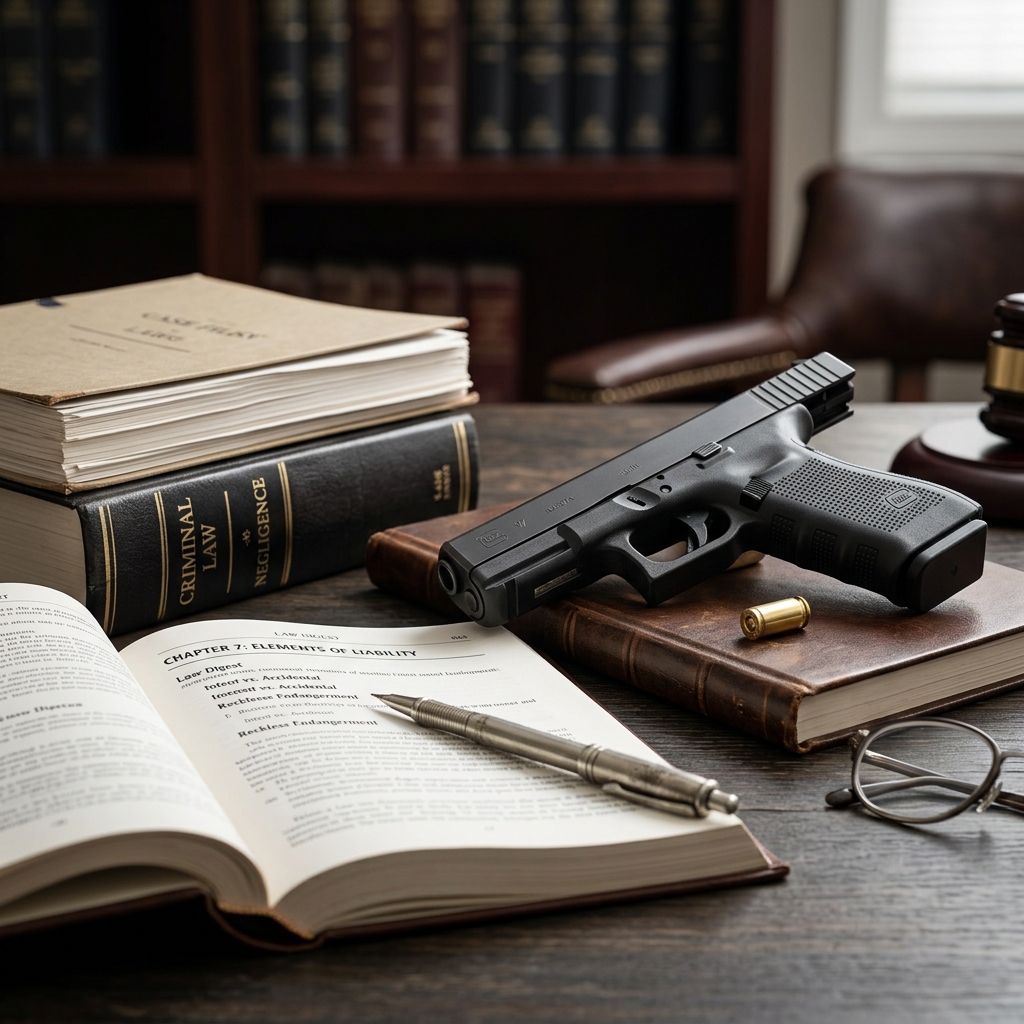
An unintended gunshot does not automatically mean a person has committed a crime, but it can create serious legal exposure if the handling of the firearm was careless, reckless, or otherwise unsafe. Criminal law often focuses less on whether the discharge was “accidental” in the ordinary sense and more on whether the person acted with enough caution under the circumstances.
That distinction matters because many firearm offenses are written to punish reckless, grossly negligent, or unlawful conduct rather than a pure mishap. In practice, prosecutors usually ask a simple question: did the shooter take reasonable care before the gun fired, or did the conduct create avoidable danger to others?
Why “Accidental” Does Not Always Mean “Legally Excused”
People often use the word “accident” to describe any firearm discharge they did not intend. The law is narrower. A gun can discharge unintentionally because of poor handling, unsafe storage, a finger on the trigger, a lapse in attention, a mechanical issue, or a combination of these factors. Some of those situations may be legally excusable, but many are not.
Criminal liability usually turns on the shooter’s state of mind and conduct. If the facts suggest the person used the firearm without due caution, acted recklessly, or ignored the safety of others, a charge may follow even if the person did not intend to fire the weapon.
The Legal Question Prosecutors Ask
When an officer, prosecutor, or judge evaluates a firearm discharge, the central issue is often whether the conduct was more than ordinary carelessness. In many jurisdictions, statutes and case law use terms such as reckless, grossly negligent, heedless, or wanton to describe conduct that can support a criminal case.
That standard is important because ordinary negligence is not always enough for a criminal charge. Instead, the state typically must show that the behavior created a serious, unjustified risk and that a reasonable person would have recognized that risk.
Common Situations That Can Lead to Charges
An unintentional discharge may become a criminal matter when the surrounding facts show a lack of proper caution. The most common examples involve unsafe handling or unsafe conditions that made the discharge foreseeable.
- Handling a loaded firearm while distracted or impaired
- Pointing a gun in a direction where a discharge could injure someone
- Keeping a firearm unsecured where a child or unauthorized person can access it
- Firing in a residential area, vehicle, or public place without adequate safety precautions
- Failing to confirm whether the weapon is loaded before manipulating it
These examples do not automatically prove a crime, but they can strongly influence whether police view the incident as a genuine accident or a punishable act of negligence.
Different Legal Labels Used in Firearm Cases
State laws do not all use the same terminology. Some jurisdictions call the offense negligent discharge, while others refer to unlawful discharge, reckless discharge, or a similar term. The label matters less than the conduct the law prohibits.[10]
In some places, an unsafe discharge is a misdemeanor; in others, it can rise to a felony if the facts show a serious risk to people or property, if the gun was fired toward an occupied structure, or if someone was injured.[10]
| Issue | What Courts and Prosecutors Usually Look At |
|---|---|
| Intent | Whether the person meant to pull the trigger or intended only to handle the firearm |
| Carefulness | Whether the firearm was handled with reasonable caution and awareness |
| Risk | Whether the act created a foreseeable danger to people or property |
| Harm | Whether anyone was injured, threatened, or whether property was damaged |
| Location | Whether the discharge happened in a home, vehicle, public place, or populated area |
How Injury or Property Damage Changes the Case
If the discharge causes physical injury, death, or damage to a home, vehicle, or other property, the stakes rise quickly. Even where the initial firearm offense is relatively minor, the resulting harm can support additional charges or civil claims.[10]
In many cases, a prosecutor will look not only at the discharge itself but also at the chain of events it triggered. A bullet that leaves the property, strikes an occupied structure, or injures another person can transform a basic safety failure into a much more serious criminal case.[10]
Potential Criminal Consequences
The exact penalties depend on the state, the facts, and the charging decision. Some statutes classify careless firearm discharge as a misdemeanor with possible jail time, probation, and fines. Other laws allow felony treatment when the discharge is reckless or endangers others in a more serious way.[10]
A conviction may also create long-term consequences beyond the immediate sentence. Those consequences can include a permanent criminal record, restrictions on firearm possession, court-ordered probation conditions, and difficulty with employment, housing, or professional licensing.
How Defendants Often Try to Explain the Incident
People accused of unsafe firearm handling often argue that the gun truly discharged by accident, that a mechanical defect caused the firing, or that no reasonable person would have predicted the outcome. Those explanations can matter, especially if the evidence suggests the person followed normal safety practices.
However, a claim of accident is not enough by itself. Investigators may examine where the muzzle was pointed, whether a safety device was used, whether the firearm was properly stored, and whether the person had consumed alcohol or drugs. The broader context often determines whether the explanation is credible.
Evidence That May Influence the Outcome
Firearm cases often turn on details that seem small at first but become important once viewed legally. Witness accounts, photographs, shell casings, damage patterns, video footage, and police reports can all help show what actually happened.
- Witness statements about how the weapon was handled
- Physical evidence showing the direction of the shot
- Any signs of intoxication or unsafe behavior
- Firearm inspection results if a malfunction is claimed
- 911 calls or body-camera footage from responding officers
Because these cases are highly fact-specific, the same incident can look very different depending on what the evidence shows about caution, danger, and control.
Possible Civil Liability in Addition to Criminal Charges
Even when the state does not bring the most serious criminal charge, the injured person or property owner may still file a civil lawsuit. Civil claims can seek money for medical treatment, lost income, pain and suffering, repair costs, or replacement of damaged property.
Criminal and civil cases are separate. A person may be acquitted in criminal court but still face civil liability because the burden of proof is lower in a civil lawsuit.
What To Do Immediately After an Unintended Discharge
The first priority is safety. If anyone is hurt, call emergency services right away and give medical aid within your ability. After that, avoid moving the firearm unless doing so is necessary to prevent further harm.
It is also important to preserve evidence and avoid making statements that could be misunderstood. A calm, accurate account is usually better than speculation. If police are involved, the safest course is often to provide basic identifying information and then speak with a criminal defense lawyer before giving a detailed statement.
How a Defense Lawyer May Approach the Case
A defense strategy usually begins with the exact statutory language. Counsel may examine whether the statute requires recklessness, gross negligence, or a willful act, and then compare that standard to the client’s conduct.[10]
From there, the defense may raise one or more of the following arguments:
- The discharge was truly accidental and not the result of criminal negligence
- A mechanical malfunction caused the gun to fire unexpectedly
- The accused followed ordinary safety practices
- The location and circumstances did not create the level of risk required by the statute
- The prosecution lacks proof that the conduct met the criminal standard
In some cases, attorneys may also negotiate for reduced charges, diversion, or probation-based resolution if the facts support a less severe outcome.[10]
Frequently Asked Questions
Is every accidental gunshot a crime?
No. A pure accident may not be criminal if there was no reckless or negligent handling. The key issue is whether the person used the firearm without proper caution.
Can someone be charged even if no one was injured?
Yes. Many firearm statutes punish dangerous handling even when no one is hurt, especially if the discharge endangered others or occurred in a populated area.[10]
Does it matter if the gun was fired at home?
Yes. The location matters because discharging a firearm inside or near a residence can create risks to family members, neighbors, and nearby property. Some laws impose greater consequences when the discharge occurs in a municipality or toward an occupied structure.[10]
What if the gun malfunctioned?
A malfunction can be a strong defense if it can be supported by evidence. However, the existence of a defect does not automatically end the case; investigators may still look at how the firearm was stored, loaded, and handled before the discharge.
Can a careless discharge affect future gun rights?
It can. A conviction may create lasting consequences, including firearm restrictions depending on the offense and jurisdiction.
When Legal Help Becomes Important
Because firearm cases can shift quickly from a minor incident to a serious criminal prosecution, early legal advice is often important. A lawyer can assess the statute, preserve favorable evidence, evaluate whether police overstated the facts, and help respond to any charges or investigative questions.
If a firearm discharge has led to an arrest, a police interview, a search, or a formal complaint, the safest assumption is that the situation is already being viewed through a criminal-law lens. That makes it essential to treat the matter as more than an ordinary mistake and to understand how the state will try to characterize the conduct.[10]
References
- Can I Get Arrested For Accidentally Discharging a Firearm? — Michigan Criminal Attorney. 2024-01-01. https://michigancriminalattorney.com/accidentally-discharging-a-firearm/
- § 246.3 PC – Negligent Discharge of a Firearm — Shouse Law Group. 2025-01-01. https://www.shouselaw.com/ca/defense/penal-code/246-3/
- Is Negligent Discharge a Crime? — Surasky Law Firm. 2024-01-01. https://www.suraskylaw.com/single-post/is-negligent-discharge-a-crime
- How Does Negligent Discharge Differ From Other Offenses? — TMC Attorneys. 2024-01-01. https://tmcattorneys.com/blog/how-does-negligent-discharge-differ-from-other-offenses/
- Negligent Discharge in Texas — Walker Taylor Law. 2024-01-01. https://www.walkertaylorlaw.com/negligent-discharge-in-texas/
- Accidental Gun Discharge: Causes and Dangers — Christensen Hymas. 2024-01-01. https://christensenhymas.com/blog/accidental-gun-discharge-causes-and-dangers/
- Negligent Discharge of Firearms in Colorado – Complete Guide — Anderson Hemmat. 2024-01-01. https://andersonhemmat.com/personal-injury-resources/colorado-personal-injury-blog/negligent-discharge-of-a-weapon-in-colorado-what-you-should-know
Similar Articles








Read full bio of medha deb




