
Academic Freedom and the Debate Over Diversity Programs
Analyzing the legislative impact on free speech and educational equity.
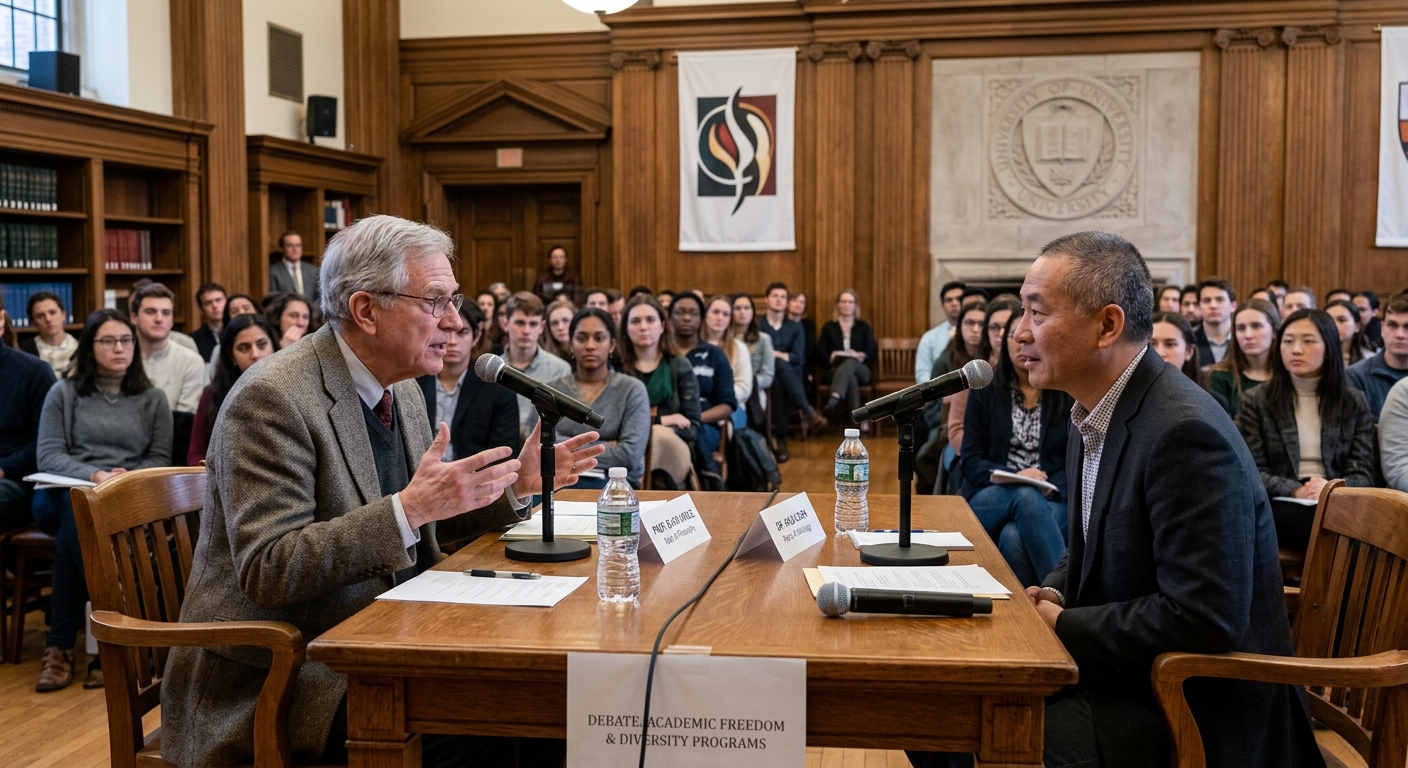
The landscape of higher education and public administration in the United States is currently navigating a profound and highly politicized legal transformation. Across various state legislatures, a concerted effort has emerged to regulate, restrict, or entirely dismantle institutional programs focused on demographic representation and historical inequality. These legislative maneuvers represent far more than routine bureaucratic restructuring; they strike at the very core of constitutional free expression and the fundamental tenets of academic freedom. By examining the legal frameworks, historical precedents, and the cascading impacts on educational equity, it becomes evident that the current regulatory climate is fundamentally altering the boundaries of acceptable discourse within public institutions.
At the center of this debate is the tension between state governments’ authority over publicly funded entities and the constitutionally protected rights of educators, students, and employees to engage in open dialogue. As lawmakers draft increasingly broad statutes aimed at curtailing specific viewpoints regarding systemic inequality, legal scholars and civil liberties advocates are sounding alarms. The implications extend well beyond university campuses, threatening to establish new precedents for how the state can dictate ideological conformity and suppress minority viewpoints under the guise of educational neutrality.
The Evolution of Educational Censorship and Legislative Mandates
To understand the current wave of legislative restrictions, one must examine the recent historical trajectory of educational censorship. The initial phase of this movement largely targeted K-12 education, utilizing statutory bans to eliminate specific pedagogical frameworks—most notably, complex sociological theories concerning historical discrimination. These early efforts were characterized by intense political rhetoric and the implementation of educational gag orders, which effectively prohibited teachers from discussing topics deemed excessively controversial or potentially uncomfortable for students.
As these efforts gained political traction, the legislative focus inevitably expanded upward into higher education and outward into the administrative structures of public institutions. The goalposts shifted from restricting classroom instruction to dismantling entire administrative departments dedicated to fostering inclusive environments. Lawmakers began targeting funding for offices, personnel, and programs that utilized terminology related to systemic equity. This expansion is critical to understanding the underlying strategy: by targeting the administrative infrastructure, these legislative efforts seek to fundamentally re-engineer the demographic and ideological makeup of the institution itself.
Furthermore, this evolution demonstrates a sophisticated escalation in statutory drafting. Early bills were often clumsy, naming specific books or highly specific sociological theories, which made them relatively easy to challenge in federal court on First Amendment grounds. Modern iterations, however, often employ sweeping, generalized language prohibiting the expenditure of public funds on any initiative that might be construed as promoting differential treatment based on demographic categories. This strategic ambiguity is not an accident; it is a calculated feature designed to maximize the suppressive impact of the legislation.
First Amendment Implications: Vagueness, Chilling Effects, and Viewpoint Discrimination
The foremost constitutional concern surrounding these sweeping restrictions is their collision with the First Amendment. In the context of public higher education, the Supreme Court has long recognized academic freedom as a “special concern of the First Amendment, which does not tolerate laws that cast a pall of orthodoxy over the classroom” (Keyishian v. Board of Regents, 1967). When state legislatures pass laws forbidding the discussion of specific concepts related to race, gender, or historical oppression, they are engaging in what constitutional scholars term “viewpoint discrimination.”
Viewpoint discrimination occurs when the government targets not just a broad subject matter, but specific perspectives or ideologies within that subject. By permitting discussions of historical events that portray national history in a purely celebratory light, while penalizing instruction that critiques historical inequalities, the state is actively manipulating the marketplace of ideas. This creates an environment where only state-approved narratives are legally permissible, fundamentally undermining the purpose of a university as a forum for rigorous, uninhibited intellectual exploration.
Moreover, the mechanism by which these laws suppress speech is often indirect, relying heavily on the “chilling effect.” Because the statutory language is frequently broad and poorly defined—prohibiting, for instance, concepts that might cause “discomfort” or “guilt”—educators are left guessing what speech might trigger severe professional or institutional penalties. Faced with the threat of termination or the loss of university funding, rational actors will inherently self-censor, avoiding entirely benign or crucial academic discussions simply to ensure they do not cross an invisible, undefined line. This vagueness violates the Fourteenth Amendment’s due process guarantees, which require that laws provide ordinary people with fair notice of what conduct is prohibited.
The legal vulnerability of academic tenure is also exacerbated by these dynamics. While tenure was traditionally designed to protect scholars engaged in controversial research or teaching, new legislative frameworks often include provisions that explicitly bypass traditional faculty governance and tenure protections if an educator is found to be in violation of these ideological restrictions. Consequently, the shield of academic freedom is systematically dismantled, leaving scholars exposed to the political whims of the current legislative majority.
Comparative Analysis of Academic Speech Protection
To better conceptualize the conflict between constitutional protections and recent legislative actions, the following table outlines the traditional standards of academic freedom versus the mechanisms employed by restrictive state mandates:
| Concept | Traditional First Amendment Protections | Recent Legislative Mechanisms |
|---|---|---|
| Curriculum Design | Faculty-driven, based on subject matter expertise and peer consensus. | State-mandated prohibitions on specific sociopolitical concepts and terminologies. |
| Viewpoint Neutrality | Institutions encourage a pluralistic marketplace of diverse and competing ideas. | Statutory elimination of specific critical perspectives regarding historical inequality. |
| Enforcement | Internal academic review and established tenure grievance procedures. | Threats of institutional defunding, individual termination, and civil liabilities. |
The Impact on Institutional Autonomy and Educational Equity
Beyond the immediate constitutional legal battles, the practical implications for students and institutional operations are profound. Programs designed to support historically marginalized populations are rarely about promoting preferential treatment, as critics often allege. Rather, they are structural mechanisms intended to ensure equal access, improve retention rates among first-generation and minority students, and foster an environment where diverse perspectives can thrive. By mandating the closure of multicultural centers, limiting targeted mentorship programs, and defunding equal opportunity initiatives, lawmakers are actively dismantling the support networks that facilitate student success.
The psychological and academic toll on underrepresented groups within these institutions cannot be overstated. When the state formally declares that institutional efforts to acknowledge and rectify historical disadvantages are illegal, it sends a powerful, alienating message to those communities. It suggests that their specific historical experiences and the contemporary challenges they face are invalid subjects for public resources or academic inquiry. This inevitably leads to a decline in institutional trust, lower enrollment rates among minority populations in heavily restricted states, and a homogenization of the student body and faculty.
Furthermore, institutional autonomy is a bedrock principle of American higher education, allowing universities to remain competitive on a global scale. When politicians micromanage university administration, dictating what departments can exist and what training can be provided to staff, it severely degrades the quality of the institution. Accrediting agencies, which require universities to demonstrate commitments to broad academic inquiry and student support, frequently find themselves at odds with state laws, placing universities in the impossible position of choosing between state funding and their academic accreditation.
The Broader Threat to Democratic Discourse and Civic Engagement
The ramifications of these legislative efforts extend into the broader civic landscape. Universities are often the primary arenas where young adults encounter viewpoints that challenge their preconceived notions. This exposure to pluralism is not an accidental byproduct of higher education; it is an essential component of preparing citizens for participation in a diverse democratic society. When lawmakers insulate students from complex, controversial, or systemic analyses of their society, they are severely hindering the development of critical thinking skills.
A functioning democracy relies on an electorate capable of grappling with the uncomfortable realities of its history and the complex structural issues of its present. The erasure of specific historical narratives and the suppression of discussions regarding systemic inequality serve to manufacture a false consensus. It replaces genuine historical and sociological inquiry with a state-sanctioned mythology. Ultimately, the systematic dismantling of inclusive educational frameworks is not merely a bureaucratic adjustment; it is an ideological offensive aimed at controlling the parameters of public thought.
Civil rights organizations and legal advocacy groups continue to mount robust challenges against these statutes, arguing that they constitute egregious violations of the First and Fourteenth Amendments. However, the litigation process is inherently slow, and the immediate chilling effect on campuses and in public administration is already deeply entrenched. The resolution of these legal battles will likely define the scope of free speech, the autonomy of public institutions, and the definition of equality in American public life for generations to come.
Frequently Asked Questions
- What is the primary constitutional argument against laws restricting academic concepts?
Legal scholars argue these laws violate the First Amendment by engaging in “viewpoint discrimination”—targeting specific ideas for censorship—and the Fourteenth Amendment through “vagueness,” as their broad language forces individuals to self-censor to avoid uncertain penalties. - Do these legislative restrictions apply to private universities?
Generally, state-level restrictions on funding and administrative structures apply directly to public universities, as they are state entities. However, some broad legislation attempts to influence private institutions through the restriction of state-administered grants or by imposing requirements on professional licensing programs that private universities offer. - How does the “chilling effect” actually work in an educational setting?
The chilling effect occurs when the law is so broad or the penalties so severe that educators avoid teaching even legally permissible, factual content out of fear that it might be misinterpreted as a violation, leading to a broader suppression of speech than the law explicitly states. - Can state governments regulate workplace training for their own employees?
Yes, the government has more leeway to regulate the speech of its employees acting in their official capacities than it does the speech of private citizens. However, federal courts are currently scrutinizing whether bans on specific diversity training concepts violate equal protection clauses or Title VII of the Civil Rights Act.
References
- America’s Censored Classrooms 2023 — PEN America. 2023-11-01. https://pen.org/report/americas-censored-classrooms-2023/
- Statement on Legislation Restricting Teaching about Race — American Association of University Professors (AAUP). 2021-08-01. https://www.aaup.org/report/statement-legislation-restricting-teaching-about-race
- First Amendment Overview — Legal Information Institute (LII), Cornell Law School. 2023-05-01. https://www.law.cornell.edu/wex/first_amendment
- Keyishian v. Board of Regents, 385 U.S. 589 — U.S. Supreme Court (via Justia). 1967-01-23. https://supreme.justia.com/cases/federal/us/385/589/
Similar Articles








Read full bio of Sneha Tete


